Address
304 North Cardinal
St. Dorchester Center, MA 02124
Work Hours
Monday to Friday: 7AM - 7PM
Weekend: 10AM - 5PM
LED strip lumens per meter explained: convert to lm/ft and lux, read CRI with the R9 gap it hides, compare CCT in mired, and size six details from a lux target.

LED strip brightness is sold in lumens per meter, and that single number is where most specifications go wrong. It is a rate — flux emitted per metre of tape — not a total, not a lux figure, and not comparable between strips until you divide it by the watts that produced it. A strip rated 960 lm/m at 9.6 W/m delivers 4,800 lm from a 5 m roll, 1086 lux on a worktop 0.45 m below it, and nothing at all on a ceiling three metres away. Same strip, three different numbers, and only the first appears on the reel.
This page works the arithmetic in full: lumens per meter into lux for a real run length, lux targets back into lumens per meter, then the two colour numbers that decide whether the light looks right — CRI, with the R9 gap it hides, and CCT, which is only comparable in mired. Every figure here is printed by the same script that draws the diagrams, the way we treat a photometric report, so the tables and the pictures cannot disagree. If your detail needs a fixture instead of tape, our ATRO linear light system is specified with the same arithmetic.
Three numbers describe a strip completely: flux per metre, the watts that produced it, and the colour. Everything else — LEDs per metre, bus voltage, IP rating — is packaging. The table below is the reference set used throughout this page; lumens per foot and efficacy are computed from the two columns to their left, which is exactly the check you should run on any datasheet a supplier sends you.
| Strip | Bus | W/m | lm/m | lm/ft | lm/W | CRI | CCT |
|---|---|---|---|---|---|---|---|
| 12 V side-view neon | 12 V | 12.0 | 720 | 219 | 60 | 90 | 3000 K |
| 12 V 2835, 60 LED/m | 12 V | 4.8 | 480 | 146 | 100 | 80 | 3000 K |
| 12 V 2835, 120 LED/m | 12 V | 9.6 | 960 | 293 | 100 | 80 | 3000 K |
| 12 V COB, 320 LED/m | 12 V | 9.6 | 1056 | 322 | 110 | 90 | 2700 K |
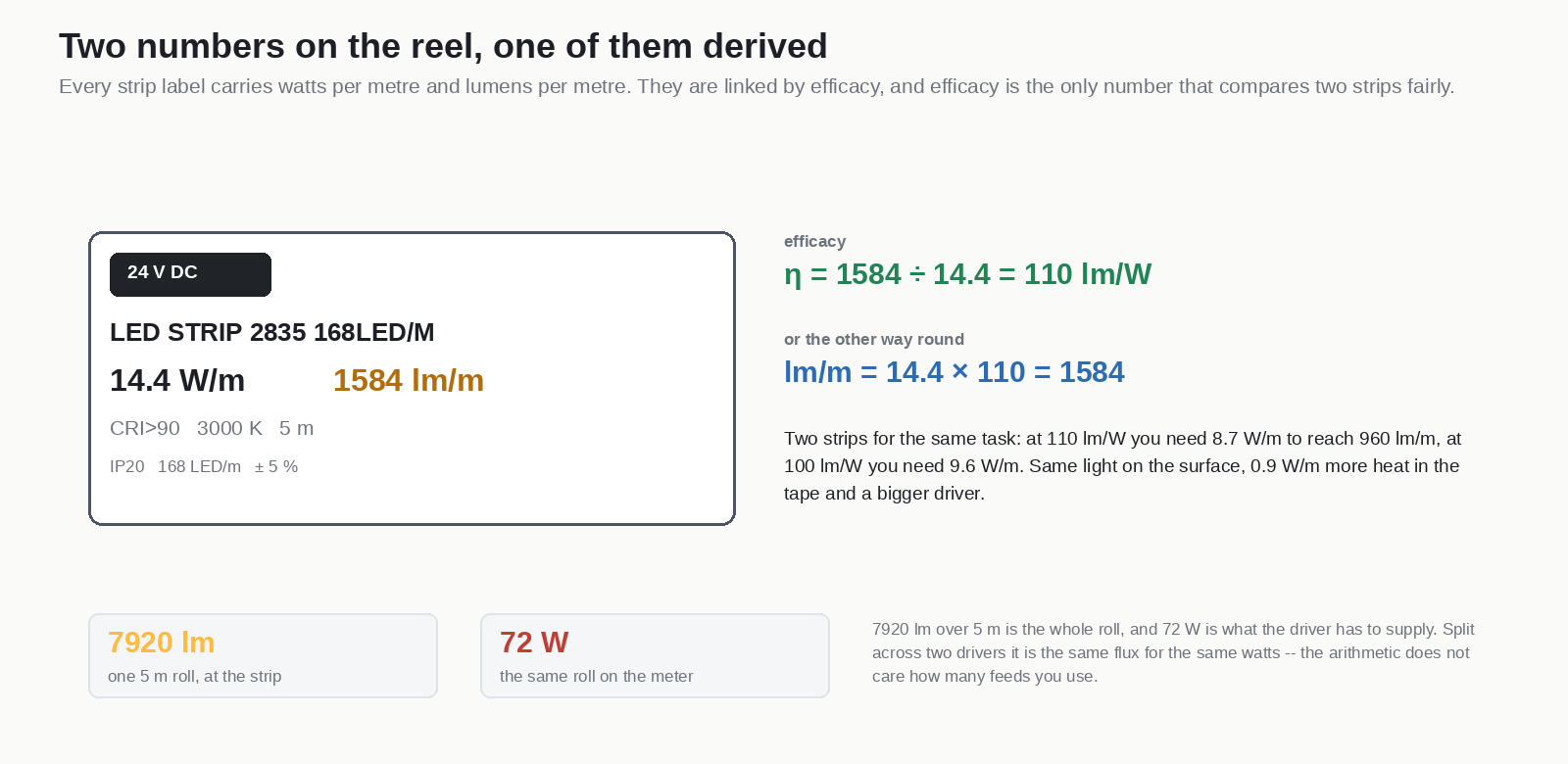
| 24 V 2835, 168 LED/m | 24 V | 14.4 | 1584 | 483 | 110 | 90 | 3000 K |
| 24 V COB, 480 LED/m | 24 V | 14.0 | 1540 | 469 | 110 | 90 | 3000 K |
| 24 V COB, 840 LED/m | 24 V | 20.0 | 2300 | 701 | 115 | 95 | 3000 K |
| 24 V high output | 24 V | 60.0 | 7200 | 2195 | 120 | 90 | 4000 K |
Read the third row against the eighth. Both are 24 V tape; one is 960 lm/m at 9.6 W/m, the other 7200 lm/m at 60 W/m. That is a 7.5× difference in brightness for 6.2× the watts, and it is the whole reason “how many lumens per meter” cannot be answered with one number. The right question is how many lumens per metre at what distance, over what run length.

Flux per metre is a property of the tape. It does not change when you mount it, dim it, or cut it shorter. What changes is the area that flux lands on, and the ratio between the two is illuminance. That distinction is worth about 40 % of the arguments on a site, because two people can quote the same strip and disagree by a factor of three about whether it is bright enough — both correctly.

One foot is 0.3048 of a metre, so a strip at 960 lm/m is 293 lm/ft. The conversion is linear and nothing else changes: 24 V 24 V tape at 2300 lm/m is 701 lm/ft. A datasheet quoting “1100 lumens” without a length is unreadable; a datasheet quoting 960 lm/m lets you size a 3.3 ft shelf run in your head.
Divide lumens per metre by watts per metre and you get lumens per watt. It is the only fair way to compare strips, because the watts you do not spend on light are spent on heat inside the tape, in the driver, and eventually in the room’s cooling load. To hold 960 lm/m a 100 lm/W strip burns 9.60 W/m and a 110 lm/W strip burns 8.73 W/m. Both look identical on a sample board; one runs 0.9 W/m hotter per metre, which on a 5 m roll is 4.4 W of extra heat inside a closed profile.
A strip is a line source, not a point source and not a lamp. For a Lambertian line of length L at height h above a plane, the illuminance on that plane, directly under the mid-point of the run, is
I′  = Φ′ / π                                    cd per metre of strip
E(0) = I′ · h · L / ((h²) · √(h² + L²/4))     lux under the middle of the run
E(x) = I′ · h · L / ((x² + h²) · √(x² + h² + L²/4))  lux at lateral offset x
With the reference strip — 960 lm/m, so I′ = 305.6 cd/m — over a 1.2 m cabinet run 0.45 m above the worktop, E(0) comes out at 1086 lx. A 600-step numerical integration of the same geometry returns 1086.5 lx, which is the check that the formula is the geometry and not an approximation of it.
Two levers move that number, and they do not move it equally. Doubling the flux to 2×960 lm/m doubles the result to 2173 lx. Doubling the mounting height to 0.90 m cuts it to 377 lx, a factor of 0.35. Fluorescent-replacement instinct says inverse square, which would have predicted 0.25. It is wrong for tape, and knowing why saves you from over-lighting every shelf in the project.
Inverse square assumes all the light leaves one point. A strip’s light leaves every point along its
length, so as you move the surface away, the far parts of the run fall off but the geometry also lets
them contribute from a shallower angle. The two effects partly cancel. For a run whose length is large
compared with the height, the closed form collapses to E = 2Φ′/(πh): lux
falls as 1/h, not 1/h². Doubling the height halves the light.
For a short run the collapse is incomplete, and the real ratio sits between the two rules. Our 1.2 m run between 0.45 m and 0.90 m keeps 0.35 of its lux, against 0.50 for an infinite line and 0.25 for a point. Which one applies depends on L/h: a 4 m cove run 0.30 m off the ceiling behaves like a line, a 0.9 m stair tread at 0.30 m sits nearer the point-source end.

Directly under the middle of a 1.2 m run the lux is 1086; directly under its very end it is 636, because there is no tape beyond that point contributing. That 0.59× end falloff is visible on a worktop and obvious on a wall wash, and it is a different mechanism from the voltage drop that makes the last metre of a long roll dimmer. Fix the end falloff with layout — extend the run, or stop the cabinet short of the wall — and fix the voltage drop with a feed; the arithmetic for the second is in LED strip voltage drop.
Designers rarely start from a strip. They start from a lux target, because that is what the standard, the client or the photographer asks for. Invert the formula and lumens per meter becomes an output rather than an input. The table below runs the inversion for six details at the distances they are normally built at, all against the reference 960 lm/m strip.
| Detail | Target | Strip to surface | Run length | lm/m needed | 960 lm/m reaches it? |
|---|---|---|---|---|---|
| Toe-kick / floor glow | 75 | 0.12 m (0.4 ft) | 2.40 m | 14 | yes |
| Stair tread, nosing | 120 | 0.30 m (1.0 ft) | 0.90 m | 68 | yes |
| Cove wash, ceiling | 150 | 0.30 m (1.0 ft) | 4.00 m | 71 | yes |
| Vanity / mirror | 300 | 0.60 m (2.0 ft) | 1.20 m | 400 | yes |
| Shelf / display, retail | 500 | 0.40 m (1.3 ft) | 1.00 m | 402 | yes |
| Under-cabinet task | 500 | 0.45 m (1.5 ft) | 1.20 m | 442 | yes |
The pattern is the opposite of what most people expect. The bright details are not the demanding ones. A retail shelf needs 402 lm/m only because the surface is 0.40 m away and the run is short; a 4 m ceiling cove needs 71 lm/m because a long run at 0.30 m puts a great deal of light on the plane. What drives lumens per metre is distance and run length, not how precious the surface is. If you need the lux targets themselves room by room, the room-by-room lux guide has them.

Under a 0.60 m worktop, one run at the wall is the cheapest layout and the worst result. It puts 1086 lx under the strip and 305 lx at the front edge — a uniformity of 0.28, which reads as a lit stripe with a dark front. Lumens per metre cannot fix that: adding flux lifts both numbers by the same factor and U does not move.
Moving the second run does fix it. With the pair 0.40 m apart U is 0.67; with the front run at the front edge, 0.60 m from the wall, it is 0.97. The curve has a clear maximum there and falls away again beyond it, because a strip hanging past the edge of the bench is lighting the floor. That is the same rule cabinet makers already apply by eye — this is just the arithmetic behind it.
Note what changes and what does not. The peak illuminance falls as the gap opens (1086 lx with one run, 1753 at 0.40 m). Evenness is bought with peak brightness, and if you need both you need more lumens per metre as well as the second run — two decisions, not one.


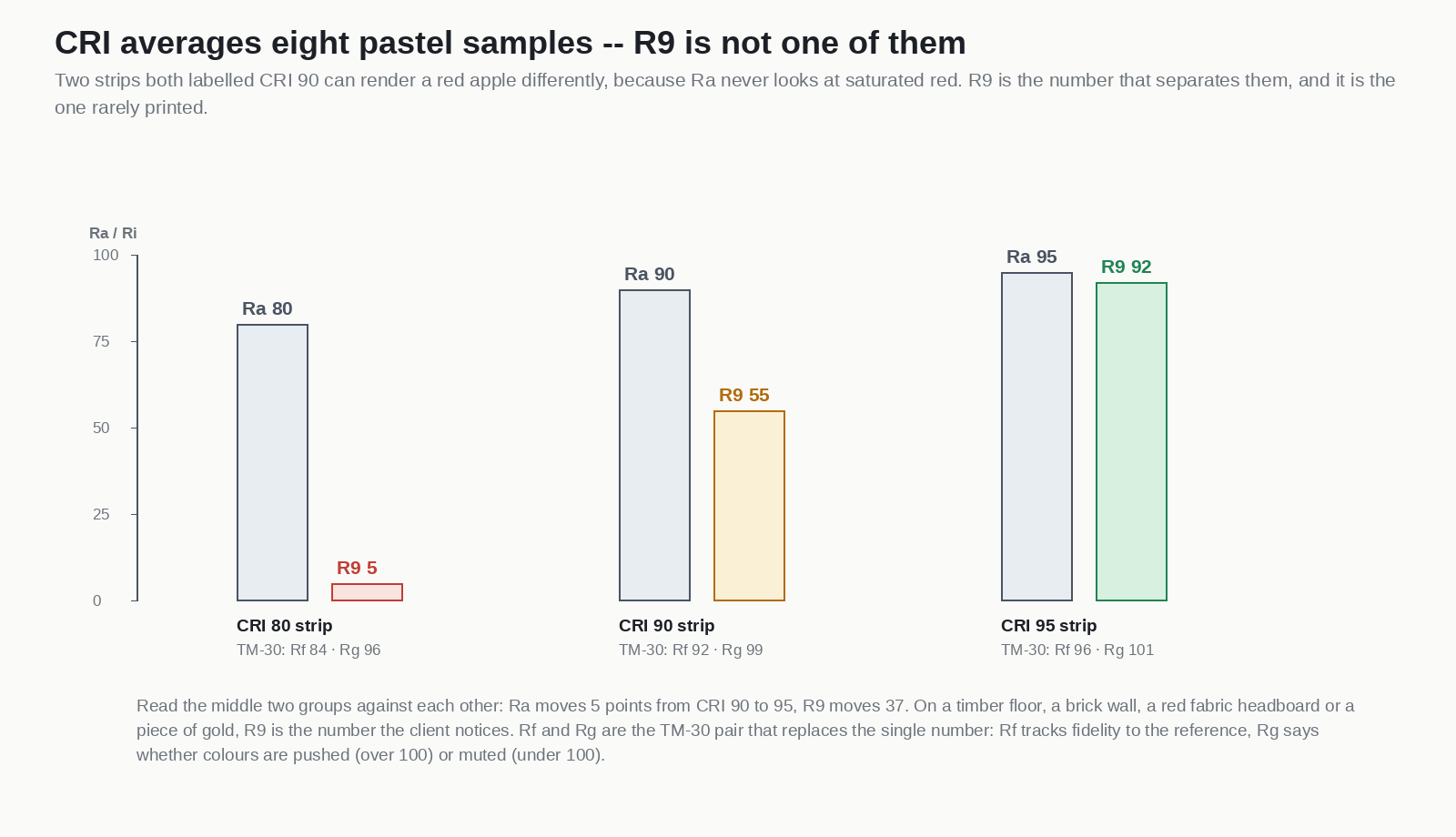
CRI — technically CIE Ra — is the mean of eight special colour rendering indices, R1 to R8. Those eight samples are pastel: a light skin tone, a leaf green, a dusty blue, three mid-saturation tones. None of them is a saturated colour. R9, the saturated red, is reported separately, and it is not part of the number printed on the box.
That is not a technicality. Two strips both sold as CRI 90 can differ by 37 points on R9, and R9 is the index that decides how timber, brick, red fabric, meat, and gold render. A strip with R9 at 5 will not show you a red bias even though its Ra looks respectable; a strip with R9 above 90 will.
| Grade | Typical R9 | Typical Rf (TM-30) | Typical Rg (TM-30) |
|---|---|---|---|
| 80 | 5 | 84 | 96 |
| 90 | 55 | 92 | 99 |
| 95 | 92 | 96 | 101 |

Specify R9 above 50 whenever the surface is one of: timber or veneer, brick or stone with warm minerals, red or orange fabric, food on a counter, plaster skin tones, or metal with a warm finish. Specify CRI 80 without shame on circulation paths and service corridors — nothing looks at those surfaces, and the extra cost buys nothing you can see. The distinction matters commercially: a designer can defend “CRI 90, R9 > 90” to a client, and cannot defend “CRI 90” once the client’s upholsterer asks why the sofa looks grey. We work through the R9 question in more depth in R9 and saturation, and the CRI-versus-TM-30 argument in CRI vs TM-30.

TM-30 refuses to average ninety-nine samples into one figure. It reports Rf, fidelity to a reference illuminant (100 is perfect), and Rg, gamut relative to that reference (100 means saturation is neither pushed nor muted). A strip at Rf 92 / Rg 99 renders closely and neutrally; one at Rf 88 / Rg 105 renders less accurately but with more punch, which is sometimes what a retail display wants. Neither is “better” — they are answers to different questions, and a single Ra number cannot express the difference.

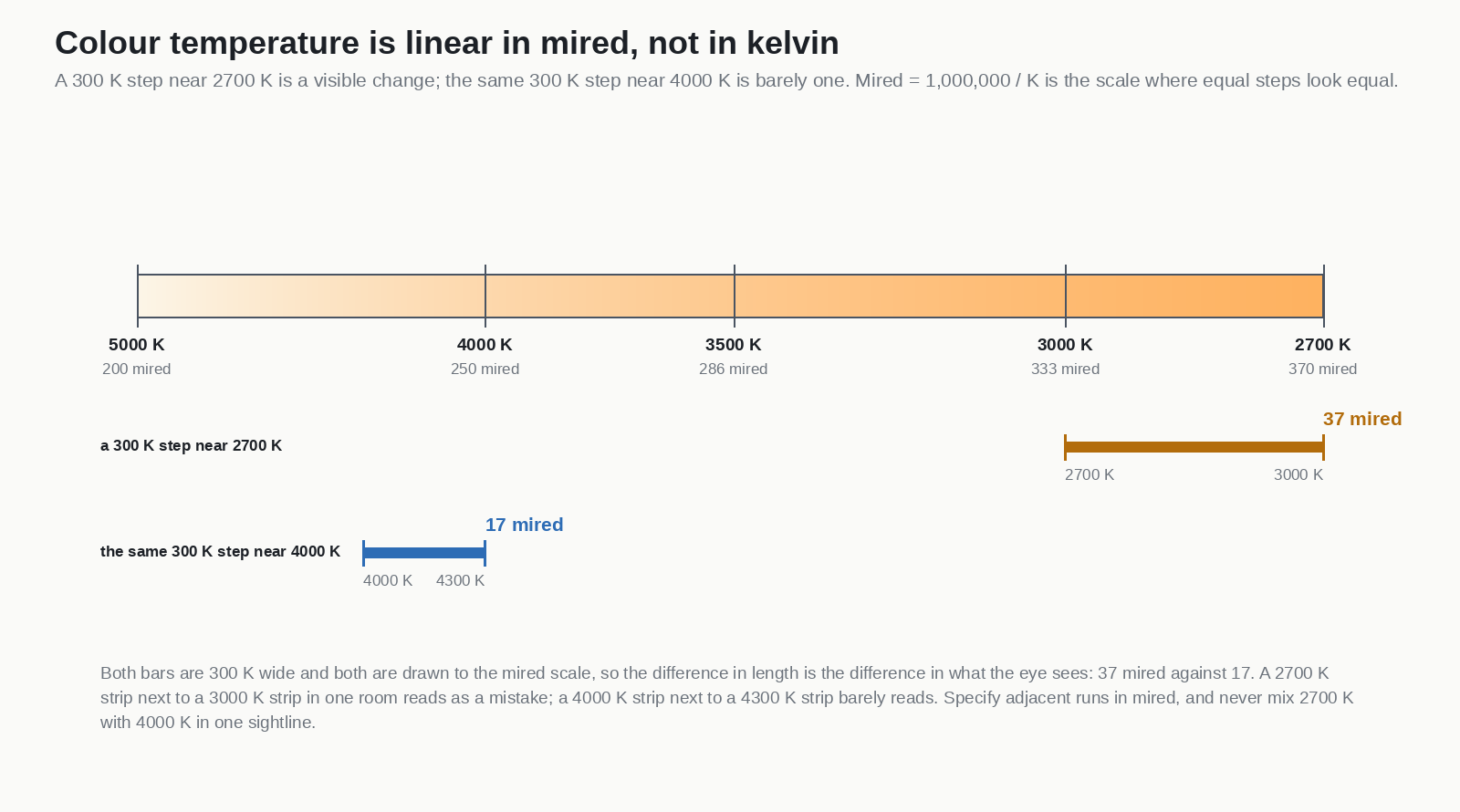
Colour temperature is a reciprocal scale, and reciprocals are where intuition fails. Mired, or
micro reciprocal degrees, is 1,000,000 / K, and on the mired scale equal steps look like
equal steps. 2700 K is 370 mired, 3000 K is
333 mired, 4000 K is 250 mired.
So a 300 K step at the warm end is 37 mired, and the same 300 K step at 4000 K is 17 mired. The 500 K step from 3500 K to 4000 K is 36 mired — still less than the 300 K step near 2700 K. That is why a 2700 K strip beside a 3000 K strip looks like a mistake, while a 4000 K strip beside a 4300 K one barely reads. Kelvin is fine for picking one strip; mired is what you use when two strips share a wall.
For strip work the practical range is narrow. 2700 K sits with timber, plaster and bedrooms. 3000 K is the default that suits most retail and residential work. 4000 K belongs where task speed beats warmth — a workshop bench, a back-of-house prep line — and it will make a warm oak floor look grey. The wider comparison, including how CCT interacts with CRI, is in the 2700K to 4000K guide.

Five things sit outside the arithmetic, and all five are things a specification should name.
Binning. LEDs are binned by flux and by chromaticity, and a reel is one bin or it is not. A “1000 lm/m” strip assembled from two adjacent flux bins will show a step where the reels join, on a wall wash, on a shelving run, on a ceiling slot. Ask whether the reel is single-bin.
The ±5 % tolerance. Watts per metre is measured at rated voltage, and constant voltage drivers are rarely exactly 24.00 V. A driver running 5 % high pushes the tape 5 % over its wattage, which is roughly 10 % over its heat, and heat is what the L70 number is really about.
Diffusers and profiles. A 960 lm/m strip inside an opal diffuser loses 8 to 20 % before it leaves the profile, and the loss is not uniform across the run if the profile is deep. If the specification matters, specify the delivered flux for the assembly, not the bare tape.
LEDs per metre is not brightness. A COB strip at 480 LED/m and an SMD strip at 168 LED/m can both be 14 W/m. What changes is the spot: COB reads as a continuous line, SMD reads as discrete dots close up, which matters behind a diffuser, along a stair nosing, or in a photograph.
Dimming low-end. Lumens per metre is a full-output figure. A strip that measures 960 lm/m at full may not hold a straight dimming curve to 1 %, and perceptually that is where a bedroom cove falls apart. Ask for the dimming range with the flux figure, and see 0-10V vs DALI vs Triac if the protocol is still open.

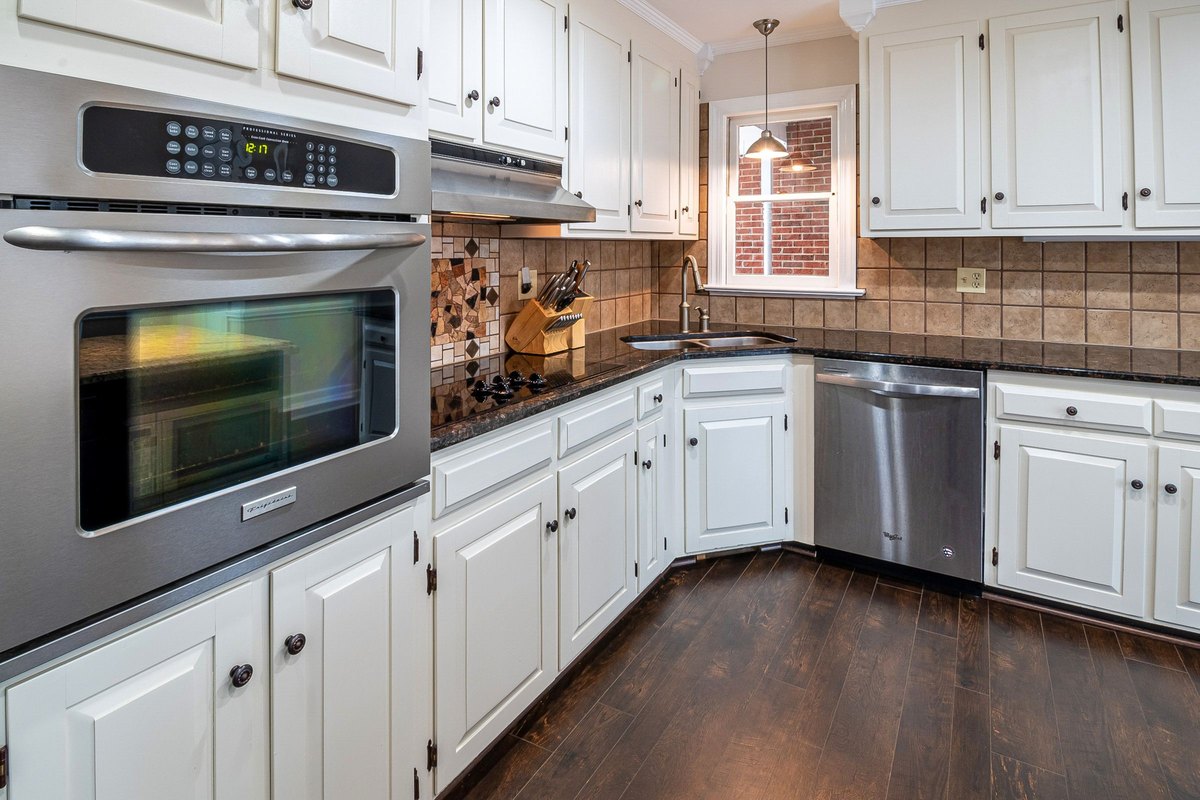
A kitchen bench. 1.2 m of worktop, 0.60 m deep, two runs under the wall cabinets 0.45 m above it. 500 lx needs 442 lm/m, which the reference strip clears. Put the front run at the front edge and U is 0.97 at a peak of 1431 lx; stop it 0.40 m from the wall and U drops to 0.67 at 1753 lx. Nothing about the strip changed — that is the cheapest decision on the page and it is taken with a tape measure, not a purchase order.
A 4 m ceiling cove. Strip 0.30 m below the ceiling plane, aimed up. Only 71 lm/m is needed for a 150 lx wash, so a 960 lm/m strip is roughly 13.4× more than required — use the surplus by lowering the flux and saving the watts, or accept a brighter ceiling. Either way the run is 4 m, which means the voltage drop question arrives immediately: feed both ends, or move to 24 V.

A retail shelf. 1.0 m run, 0.40 m deep, 500 lx on the goods. Needs 402 lm/m at the surface, which the reference strip clears at 1193 lx. Here CRI and R9 stop being optional: shelf lighting is where a customer compares a garment to daylight, and an R9 of 5 will end the sale. Ask for CRI 95 with R9 above 90 and a single-bin reel, and note that a diffuser will cost you 8–20 % of the flux before it reaches the merchandise.


Strip is the right tool for cove, under-cabinet, toe-kick, stair nosing and shelf runs. It is the wrong tool for anything that needs aiming, anything that runs more than a few metres from one feed, and anything in a profile deep enough that a diffuser eats the flux. In those cases the linear fixtures we build are specified the same way, with a delivered lumens-per-metre figure and a measurable CRI.

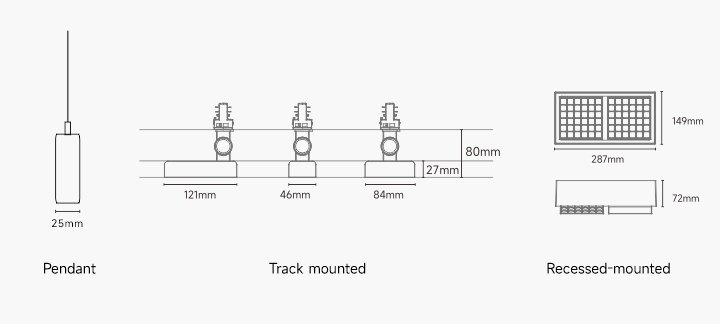
The ATRO 26 mm linear system covers the case where tape would sit in a profile too shallow for the lux you need, and the SLEM 2.4 in linear system covers longer suspended and recessed runs. Where the linear element has to move or be re-aimed on site, the magnetic track system takes the same heads. All three are quoted with a photometric file rather than a nominal lumens figure, which is the point of the whole page: ask for the number that was measured, at the distance you are building.


It depends on the distance to the surface and the run length, not on a preference. Work backwards from a lux target: 75 lx for a toe-kick, 150 for a cove, 300 for a vanity, 500 for a worktop or a retail shelf. At the distances those details are normally built at, that means roughly 14, 71, 400 and 442 lm/m respectively. A 960 lm/m strip clears all of them, which is why it is the common default.
It is a moderate figure. On a 5 m roll 1,000 lm/m is 5,000 lm total, which is about four 1,200 lm downlights spread along the same length. What makes it look bright or dull is the distance to the surface: our 960 lm/m strip puts 1086 lx on a worktop 0.45 m away and 113 lx on a plane 3 m away under a 4 m run. Brightness per metre and brightness on a surface are two different quantities.
Only if efficacy is unchanged. Heat follows watts per metre, and watts per metre is lumens per metre divided by lumens per watt. Holding 960 lm/m takes 9.6 W/m at 100 lm/W and 8.7 W/m at 110 lm/W. A 2,300 lm/m strip at 115 lm/W runs at 20 W/m and needs a profile that can shed it, which is why high-output tape is specified with an extrusion rather than bare.
CRI 90 with R9 above 50 wherever colour matters — timber, brick, fabric, food, faces. CRI 80 is adequate for circulation and service areas. The number to add to the specification is R9, because Ra averages only R1–R8 and therefore never tests saturated red; two CRI 90 strips can differ by 40 points on R9 and both be correctly labelled.
Neither is better; they belong in different places. 3000 K suits residential and most retail work and keeps timber warm. 4000 K suits workshops and task areas where speed beats warmth, and it will make a warm floor look grey. Mixing them in one sightline is the real error: 2700 K beside 3000 K is a 37 mired jump and reads as a mistake, while a 300 K step at 4000 K is only 17 mired and barely reads.
Two separate mechanisms. Voltage drop along the copper makes the last metre receive fewer volts, so it emits less light — that follows the arithmetic in LED strip voltage drop and gets worse with the square of the length. Separately, the end of any run has no tape beyond it, so the illuminance directly under the very end falls to about 0.59 of the value under the middle. One is fixed with a feed, the other with layout.
Lumens per meter is a rate, and a rate alone never answers a lighting question. Divide it by watts per meter to get efficacy, divide it by the geometry of the run to get lux, and invert it whenever a designer hands you a lux target instead of a strip. Then add the two colour numbers that Ra and kelvin hide: R9, which decides whether timber and fabric look right, and mired, which decides whether two adjacent runs read as one light source. If the detail needs a fixture rather than tape, send the layout and we will size it with the same arithmetic, photometric file attached.
Line-source illuminance and the 2Φ′/(πh) limit: standard photometry, as
tabulated in the Illuminating
Engineering Society handbook. Colour rendering indices R1–R15 and the exclusion of R9 from
Ra: CIE 13.3, summarised in the same handbook. TM-30 Rf/Rg: IES TM-30-20. LED efficacy and the
light-output ratio: US Department of Energy, Solid-State Lighting. Colour-temperature
discrimination thresholds: DOE SSL programme reports on mired steps.