Address
304 North Cardinal
St. Dorchester Center, MA 02124
Work Hours
Monday to Friday: 7AM - 7PM
Weekend: 10AM - 5PM
Downlight vs recessed light: one names a job, the other a mounting. Learn the terminology, then size the aperture, beam angle and cut-off with Encore Lume.
Downlight vs recessed light is not a choice between two products. One word names a job — light delivered downward from a small aperture — and the other names a mounting — the body of the fitting sits inside the ceiling. A recessed downlight is both at once, which is why the two terms get swapped in every catalogue and on every job site. The difference that survives the vocabulary is measurable: a 75 mm aperture with a 24° optic puts 968 lx on the floor from one metre of lit surface, and the same head with a 50° optic puts 226 lx there. This page separates the words first, then does the arithmetic the words never cover.
Four words circulate, and each one describes a different thing. A downlight is a direction of delivery. A recessed light is a mounting condition. A pot light or can is the North American housing that a lamp drops into. An eyeball or gimbal is a movement. Only the third one promises a hole in your ceiling, and only the last one can be changed after installation.
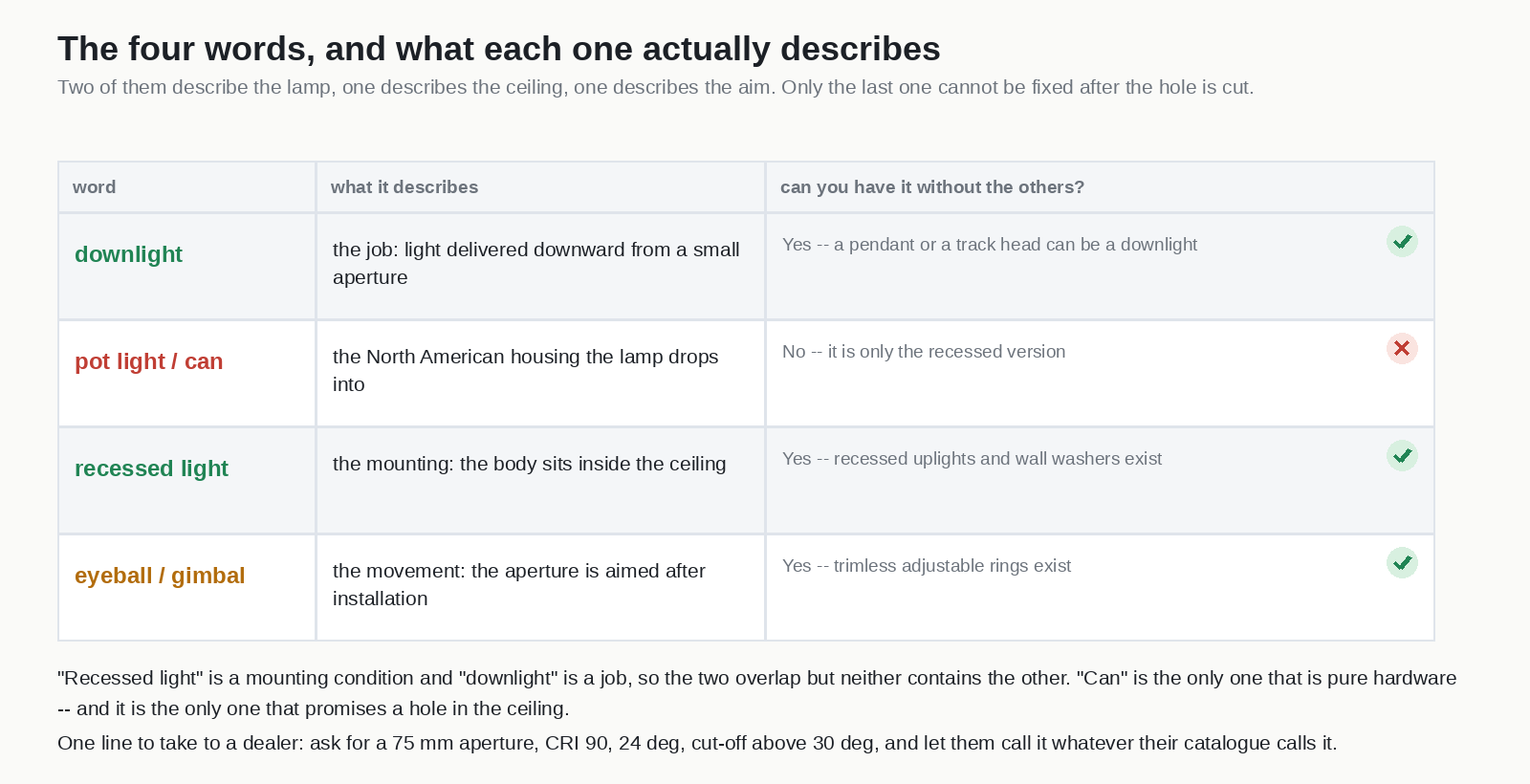
The overlap explains most of the confusion. A recessed downlight is a downlight that happens to be recessed. A surface-mounted downlight is a downlight that is not. A track head aimed down is a downlight with a different mounting. So “downlight vs recessed light difference” is not a comparison at all — it is a subset relation that only holds when the fitting is also recessed.
US retail catalogues sell “recessed lights” and contractors install “cans” because the housing was historically the expensive part and the lamp was a household bulb. The UK, EU and the specifier side of the trade sell “downlights”, because the whole fitting is one sealed unit and the only dimension a drawing needs is the aperture. Both vocabularies describe the same ceiling, from opposite ends of the supply chain.
Recessed uplights, recessed wall washers and recessed linear slots are all recessed and none of them is a downlight. Conversely, a surface-mounted cylinder, a track head, a pendant and a floor uplighter can all deliver downlight. That is the whole reason the two words cannot be used as synonyms in a specification: one of them tells you where the light goes, the other tells you where the metal is.
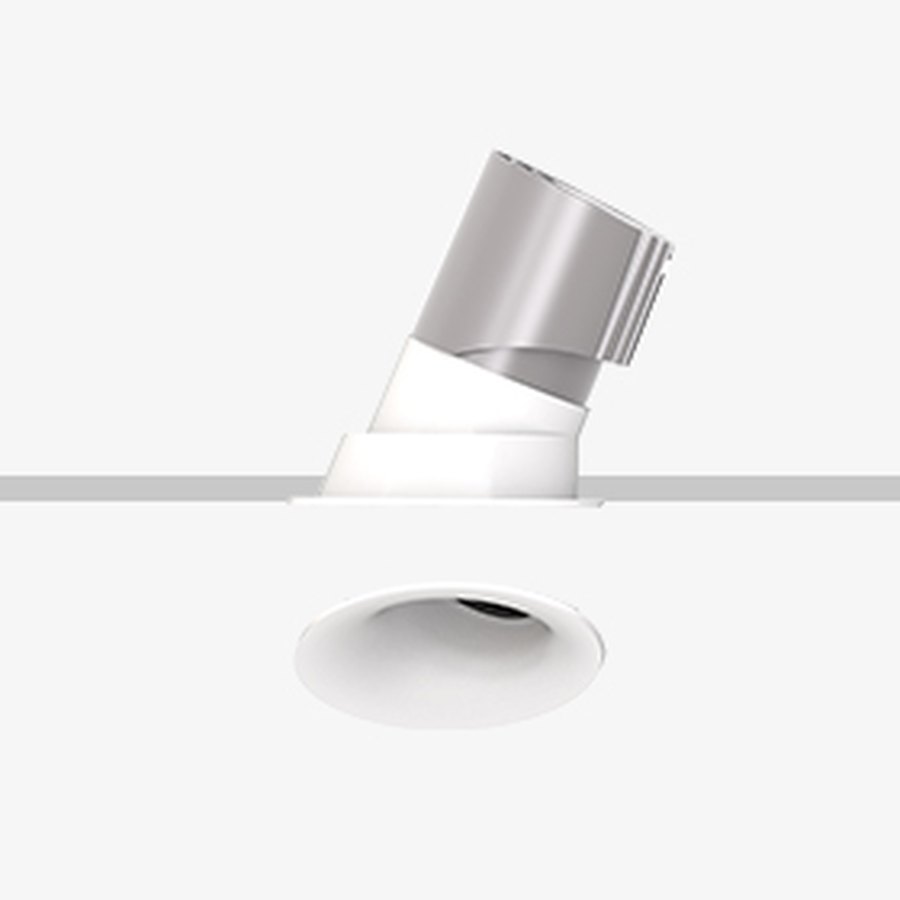
Strip the vocabulary off and there are four physical arrangements. All four in the figure below carry the same COB and the same driver class; what differs is the hole, the shield and the way the light is aimed.
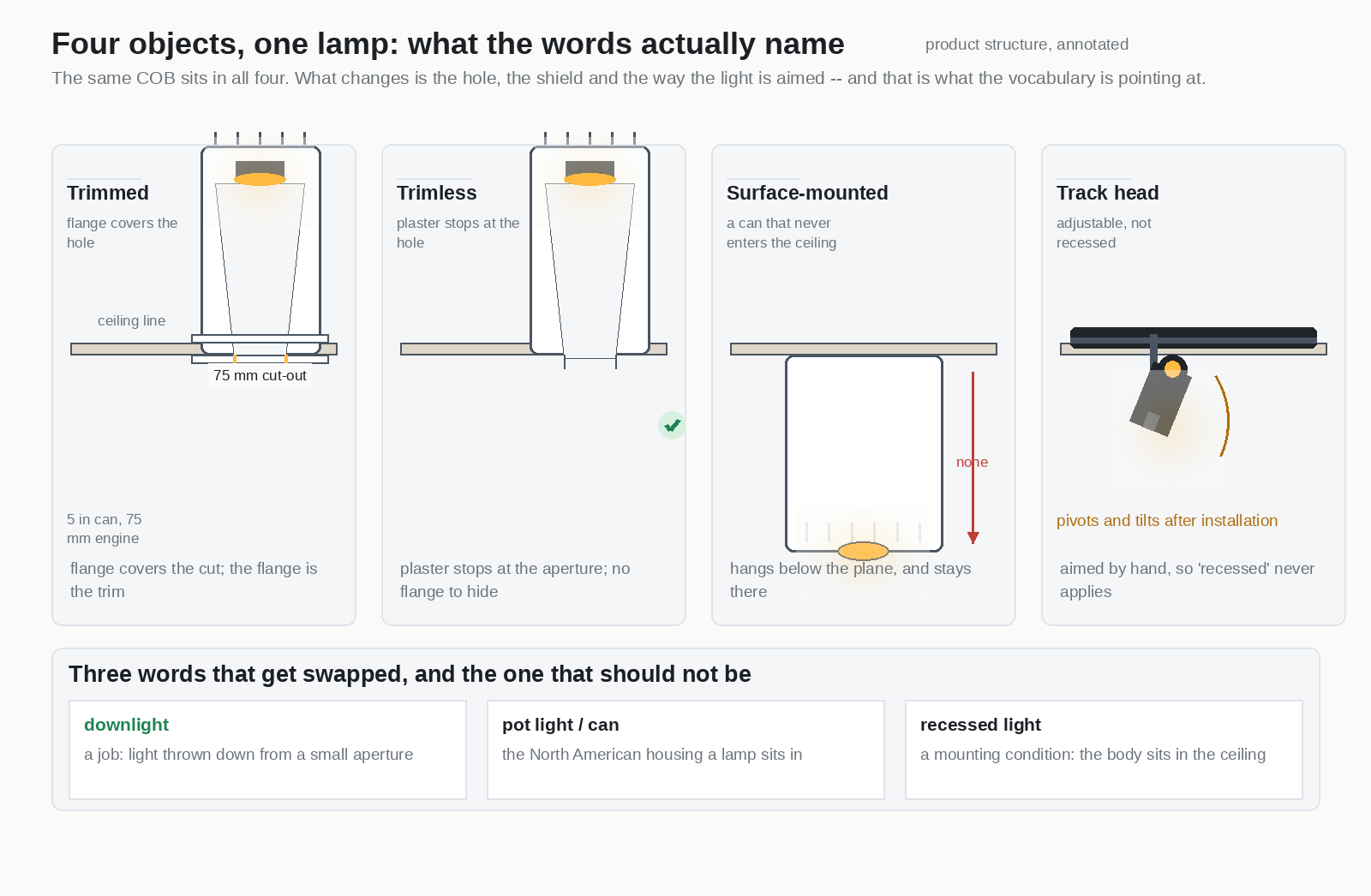
The trimmed version covers the cut edge with a flange. The trimless version stops the plaster at the aperture, so the ceiling plane runs unbroken into the reflector — and the cut has to be right first time, because there is nothing over it. The surface-mounted can never enters the ceiling at all, which is why it cannot be called recessed and why it is the only option when the plenum is 40 mm deep. The track head is the same lamp on a stem: aimed by hand, so “straight down” is a setting rather than a property.
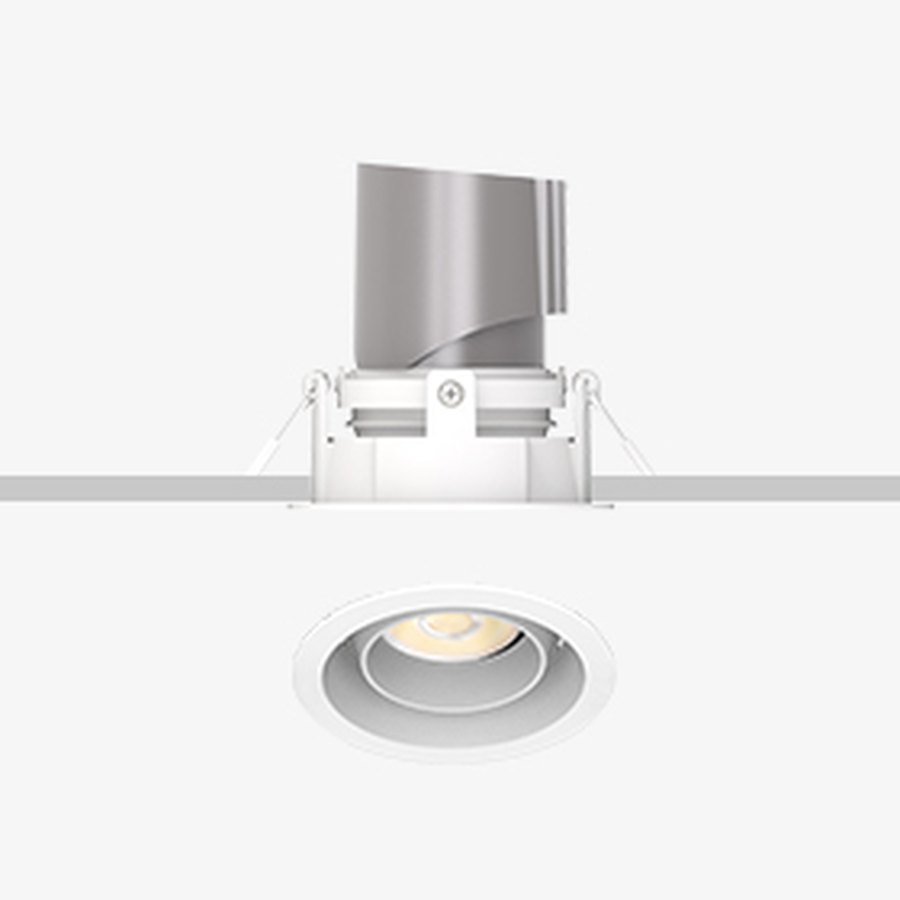
ENCORE builds the first two from one 75 mm engine, which is a useful way to see that the words describe rings, not lights:

Neither term carries a single photometric number. Take one 1,000 lm head at 9 ft (2.74 m) and change only the optic. The pool diameter follows D = 2 H tan(θ/2), and the peak illuminance follows from the same solid angle, so both move at once.
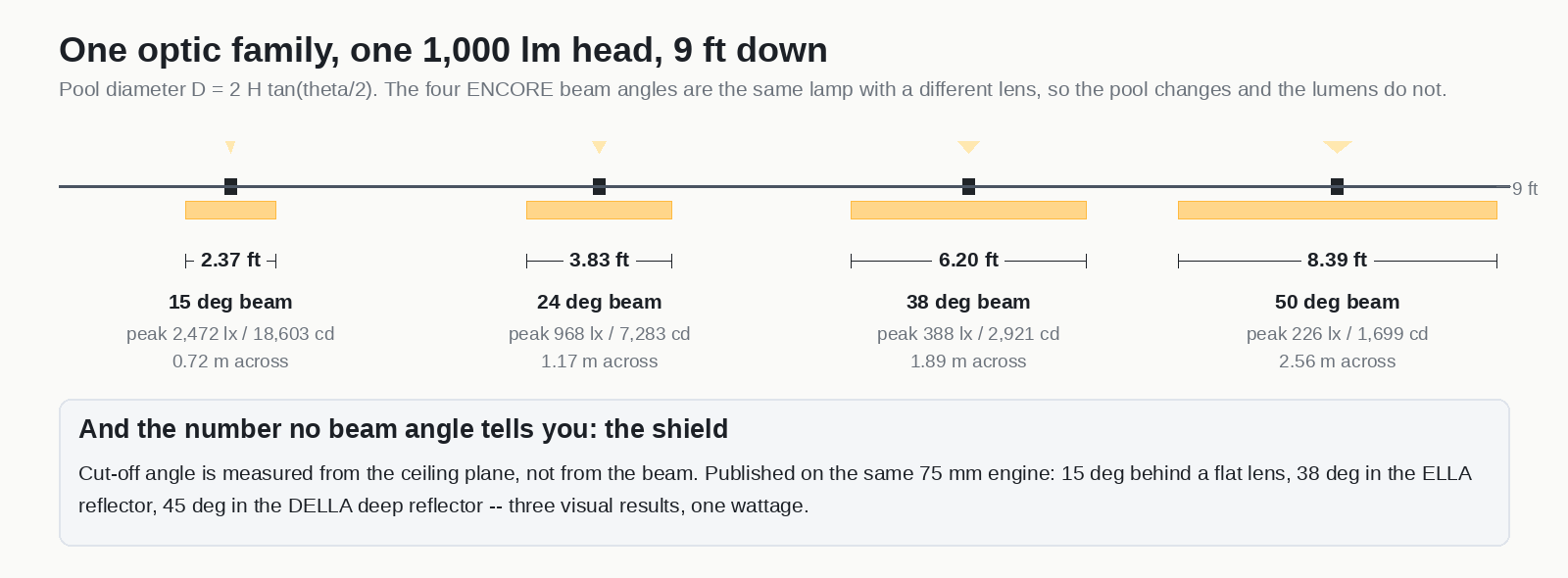
That is the whole argument for specifying beam angles rather than fixture counts. A 15° head at 9 ft already delivers 2,472 lx directly underneath, which is roughly three times what a kitchen worktop needs; the same head with a 38° optic spreads the same flux over a 6.20 ft pool at 388 lx. Buying a fourth narrow head to cover a wider counter costs more and looks worse than buying the right lens.
| Beam | Pool at 9 ft | Peak illuminance | Peak intensity | Centre spacing, 30 % overlap | Where it belongs |
|---|---|---|---|---|---|
| 15° | 2.37 ft / 0.72 m | 2,472 lx | 18,603 cd | 1.66 ft | One object: art, a plinth, a table centre |
| 24° | 3.83 ft / 1.17 m | 968 lx | 7,283 cd | 2.68 ft | Counters, vanities, a wall of frames |
| 38° | 6.20 ft / 1.89 m | 388 lx | 2,921 cd | 4.34 ft | General room light, circulation |
| 50° | 8.39 ft / 2.56 m | 226 lx | 1,699 cd | 5.88 ft | Soft ambient over a large floor |
Note the spacing column: it is derived, not chosen. Fix the beam angle and the ceiling height, and the centres that hold a 30 % edge overlap are already decided. The same method, worked through for wall-washers and low ceilings, is in our guide to spacing by beam angle and ceiling height; the full formula family is in the beam angle guide.
If you get to choose the ceiling, the vocabulary is academic. If the ceiling already exists, one sentence decides the whole job: can this surface be cut? A 12 x 16 ft room at roughly 5,200 lm needs eight 650 lm cans or six 900 lm track heads, and the two options open very different amounts of plasterboard.
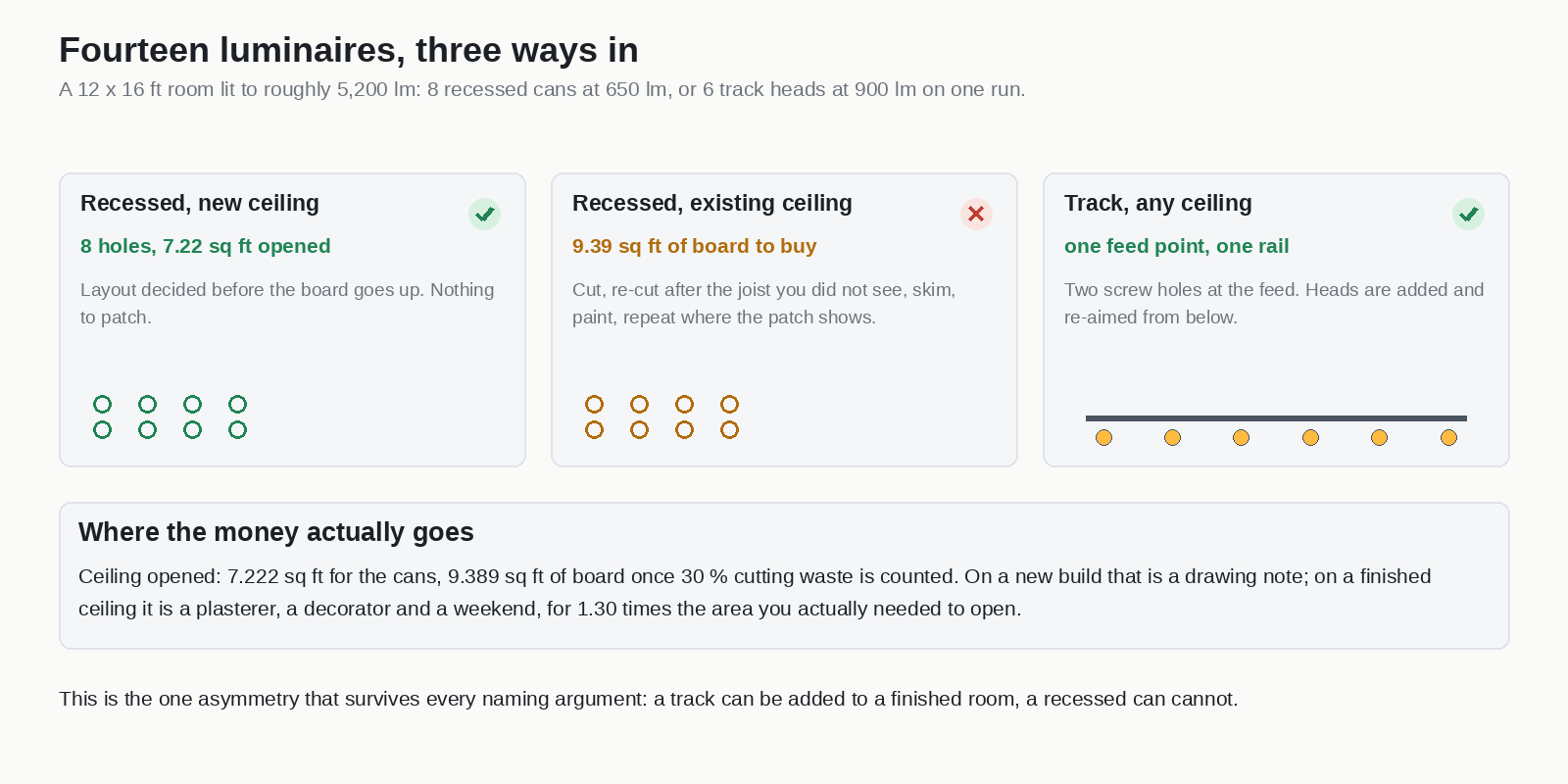
Recessed lighting is a decision made before the board goes up. Once the ceiling is painted, the same specification costs a plasterer, a decorator and a weekend. That asymmetry — not brightness, not fashion — is the real difference between the two families, and it is invisible in every definition of either word.
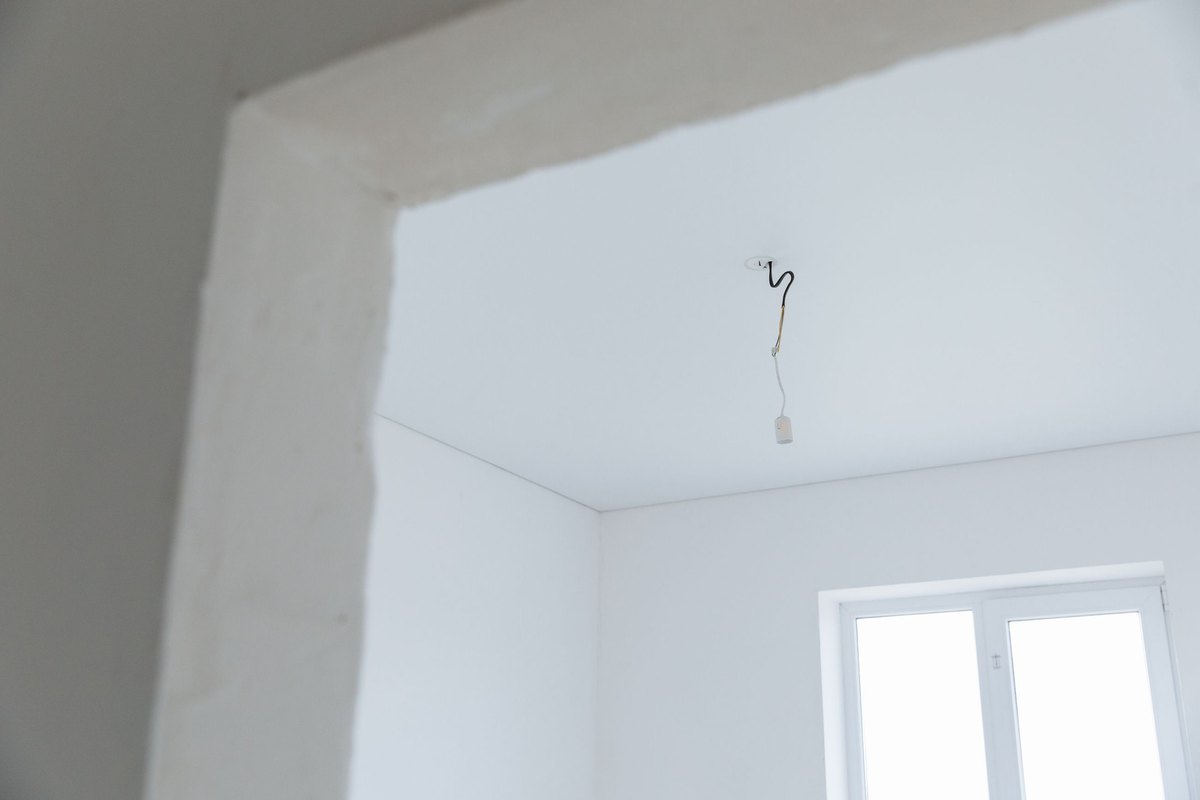
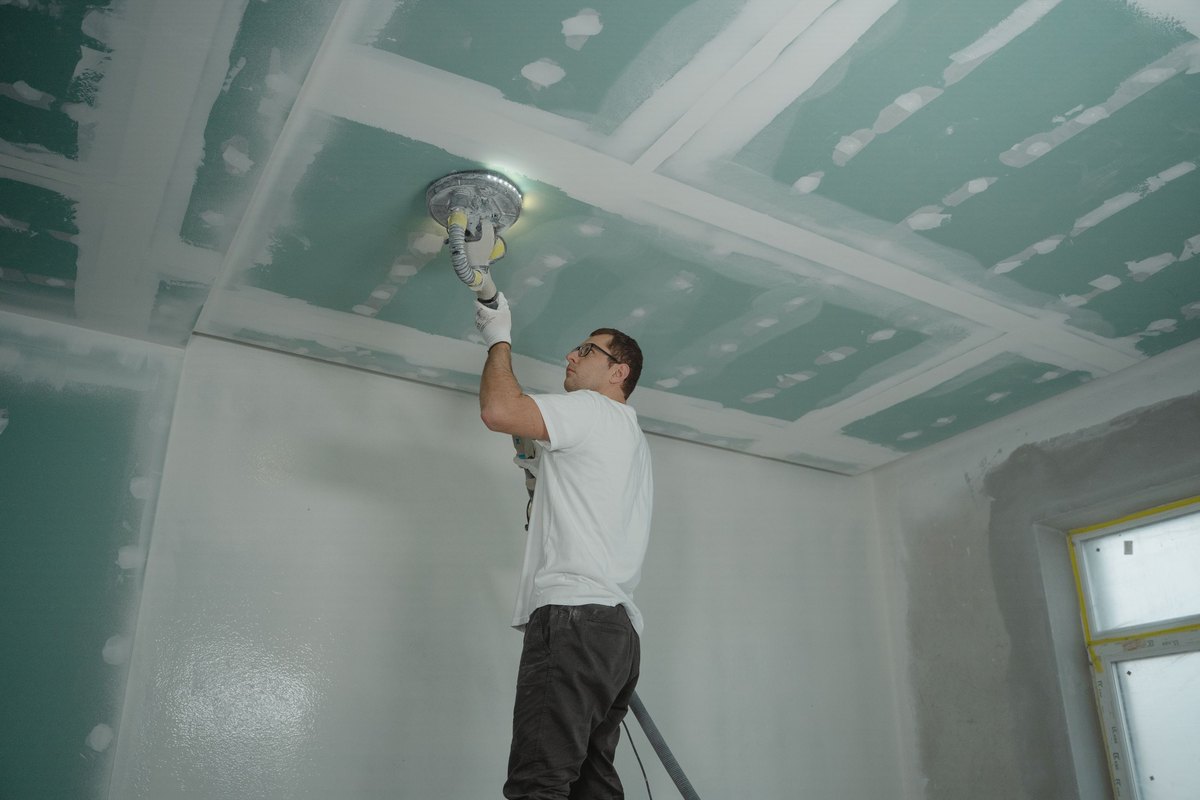
Draw the grid from the beam angle and the mounting height before the joists go in, so the pools land where the furniture will be rather than where the joists allowed. Check the plenum depth against the can depth at the same time — a 5 in body needs 5 in of clear space, plus a finger’s width for the spring clips.
Surface-mounted cans and track heads are the only two families that can be added to a finished room without a trade. A trimless recessed fitting can still be done, but budget the plasterwork, and decide the aperture position to the millimetre, because there is no flange to absorb a 3 mm error.
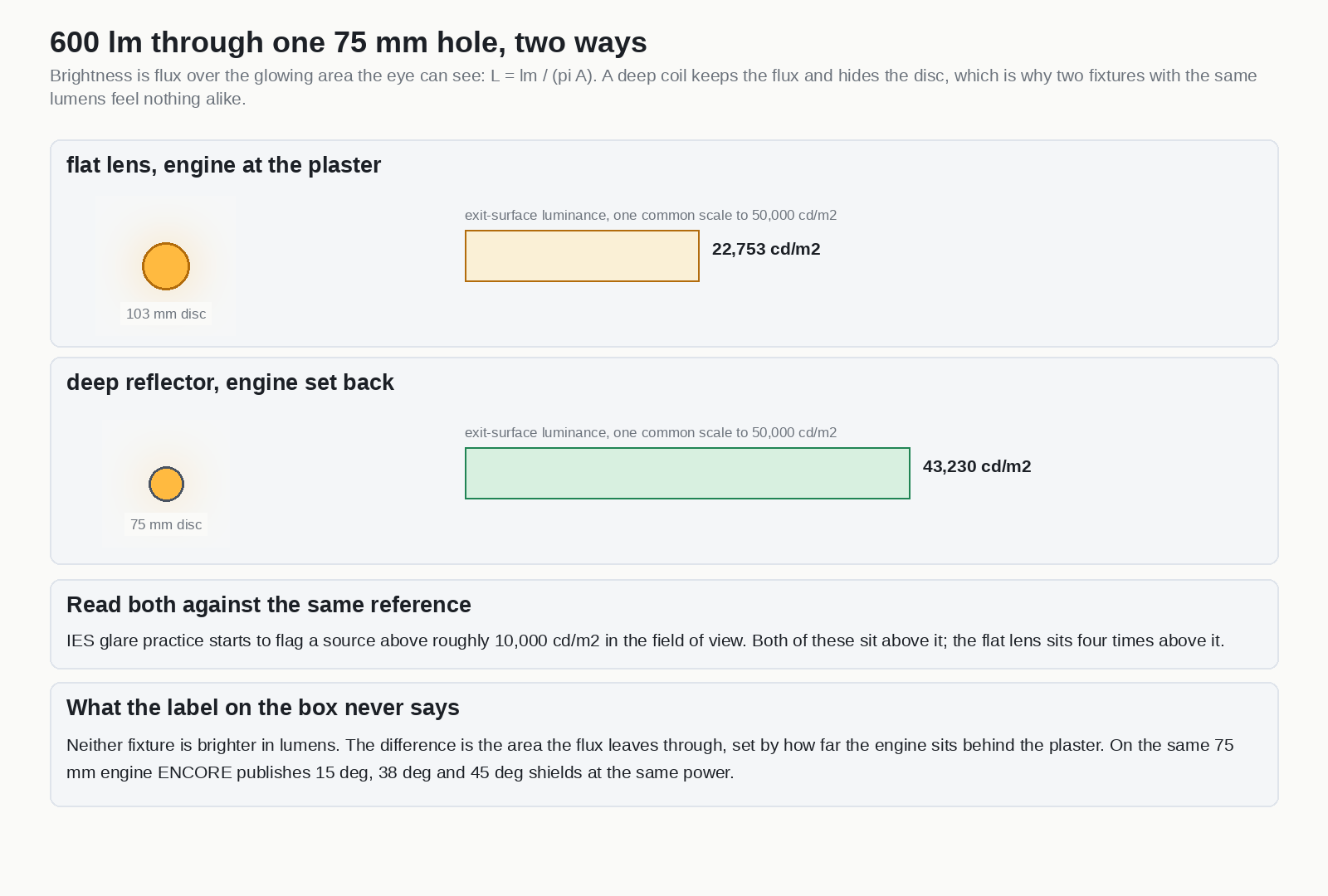
Here is the part of the “downlight vs recessed light difference” that actually changes how a room feels. Luminance is flux divided by the glowing area the eye can see: L = lm / (πA). Push the same 600 lm through a 75 mm aperture and you get 43,230 cd/m². Spread the visible disc wider and the flux is the same while the brightness drops to 22,753 cd/m².
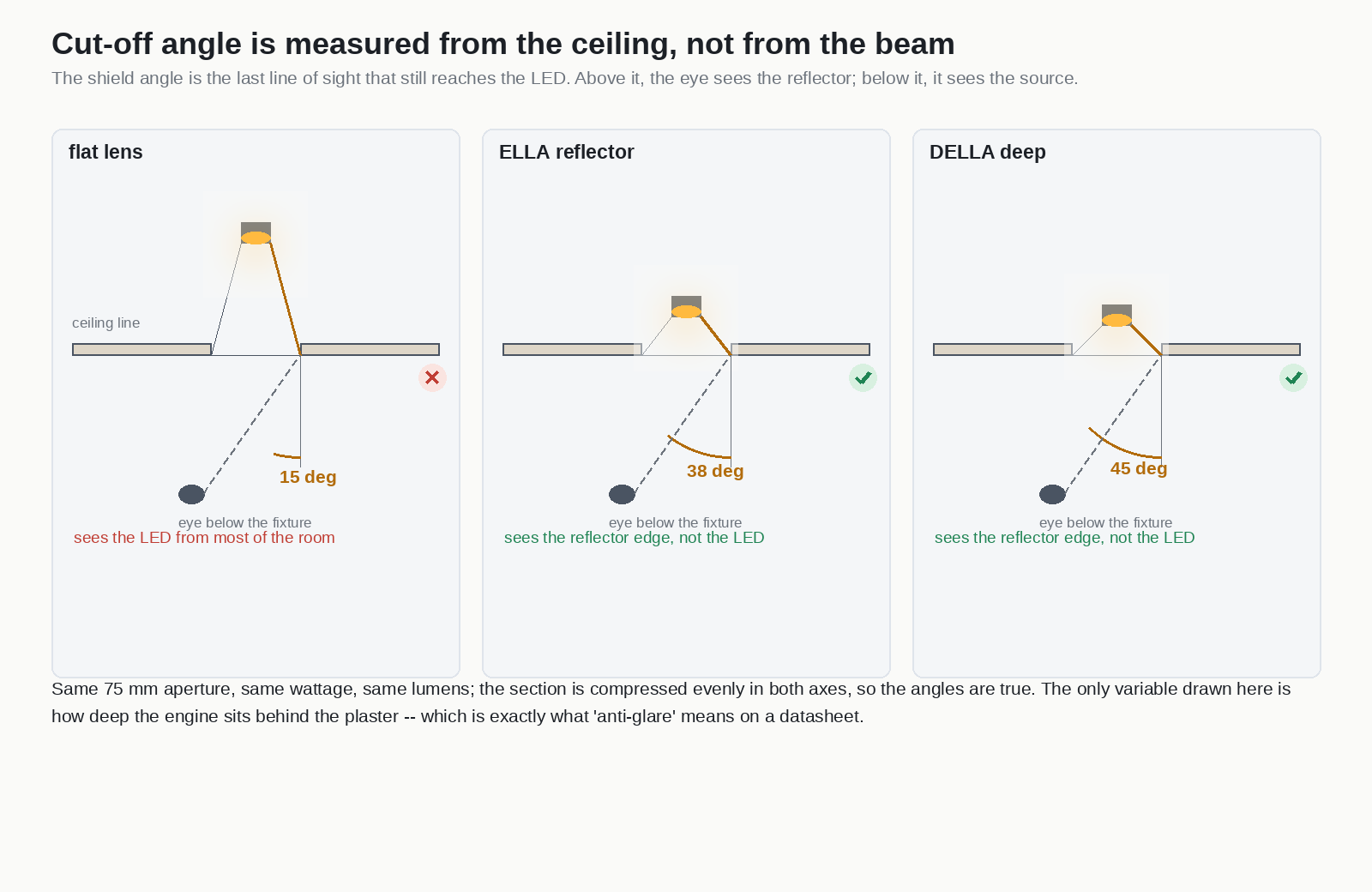
The mechanism is the shield. What the trade calls the cut-off angle is the last line of sight that still reaches the LED, measured from the ceiling plane. On the same 75 mm engine ENCORE publishes three different shields at the same power: 15° behind a flat lens, 38° in the ELLA reflector, 45° in the DELLA deep reflector.
This is also why “UGR < 19” on a datasheet should be read as a property of a specific configuration, not of a product family. The same body with a different ring, a honeycomb and a different optic will not produce the same number. Our walk-through of what a diffuser plate actually changes works the luminance arithmetic to show why dimming the room does not fix glare.

| Question | Downlight | Recessed light |
|---|---|---|
| What the word names | A job: light delivered downward from a small aperture | A mounting: the body sits inside the ceiling |
| Can it exist without the other? | Yes — surface cylinders, track heads, pendants | Yes — recessed uplights, wall washers, linear slots |
| Is the ceiling cut? | Not necessarily | Always, and the cut position is fixed for good |
| Can it be added to a finished room? | Yes | Only with plasterwork |
| What the word says about the light | Nothing about beam or glare | Nothing about beam or glare |
| Numbers to ask for | Beam angle, CCT, CRI, lumens, cut-off angle | Cut-out size, plenum depth, trim or trimless, IP rating |
| Typical failure | One narrow optic used for general light, so the room reads as spotty | Holes cut to a joist rhythm instead of a lighting grid |
Row five is the answer to the whole question, and rows six and seven are why the article keeps going. The words are a starting point for ordering; the numbers are what gets installed.
A single-page request removes the ambiguity entirely, whichever word your supplier prefers. Five items do it:
A quotation that comes back with all five is the right quotation, whatever the heading on the page says. ENCORE publishes the whole 75 mm family — fixed, adjustable, trimless, pin-hole, wall washer — with beam angles, cut-offs and .ldt files per variant on the recessed downlight family pages, so a specification can be checked against real optics rather than a catalogue adjective.
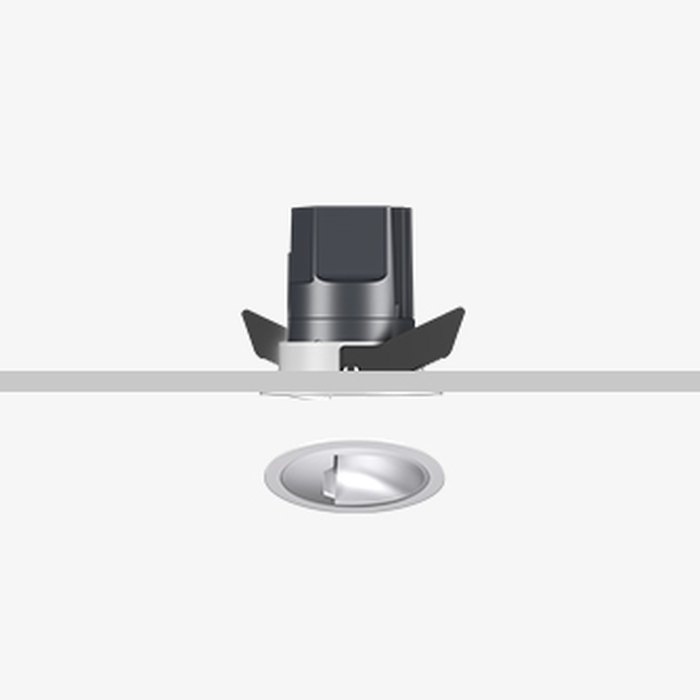
The vocabulary question disappears once a room has a ceiling condition and a task. Four patterns cover most residential and hospitality work.
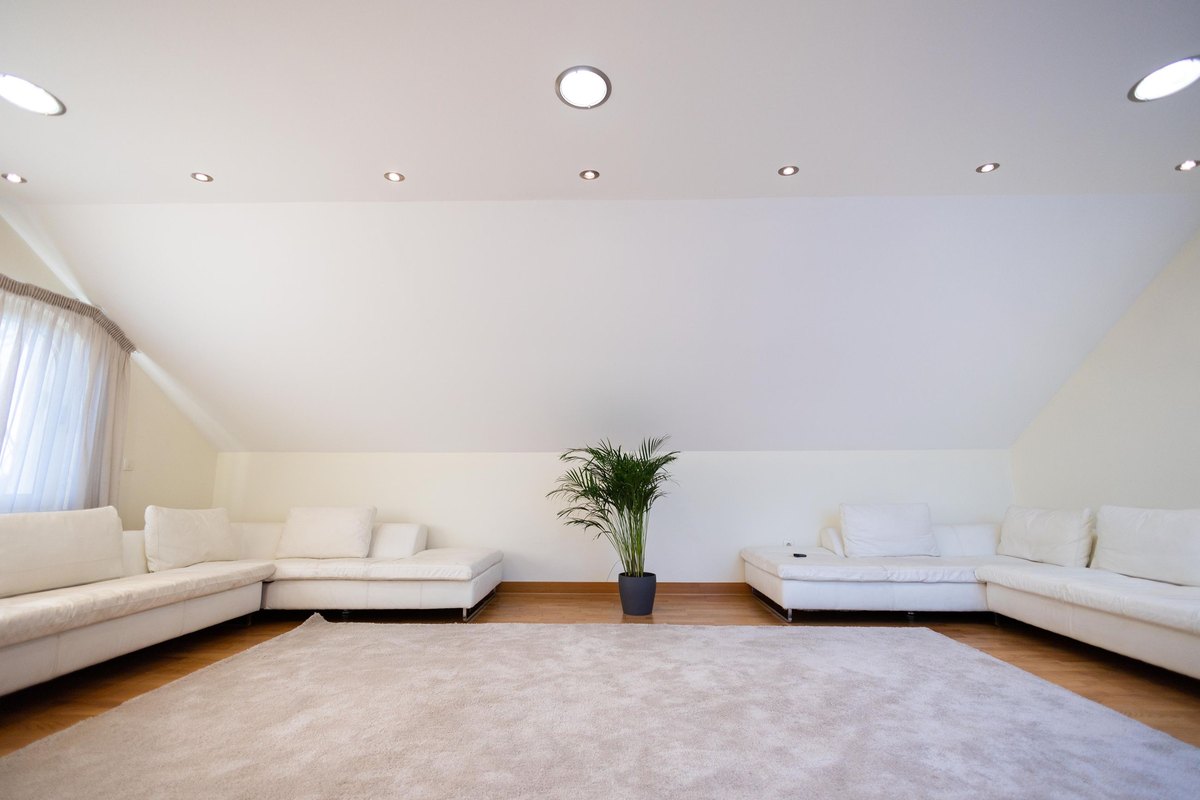
Living rooms usually need ambient light with no visible source, and the ceiling is normally open at the time. That is the recessed case: a row of 38° heads at 4.34 ft centres, dimmed, with a separate 24° layer for art. If the ceiling is already finished, the same effect comes from a track run parallel to the main wall.
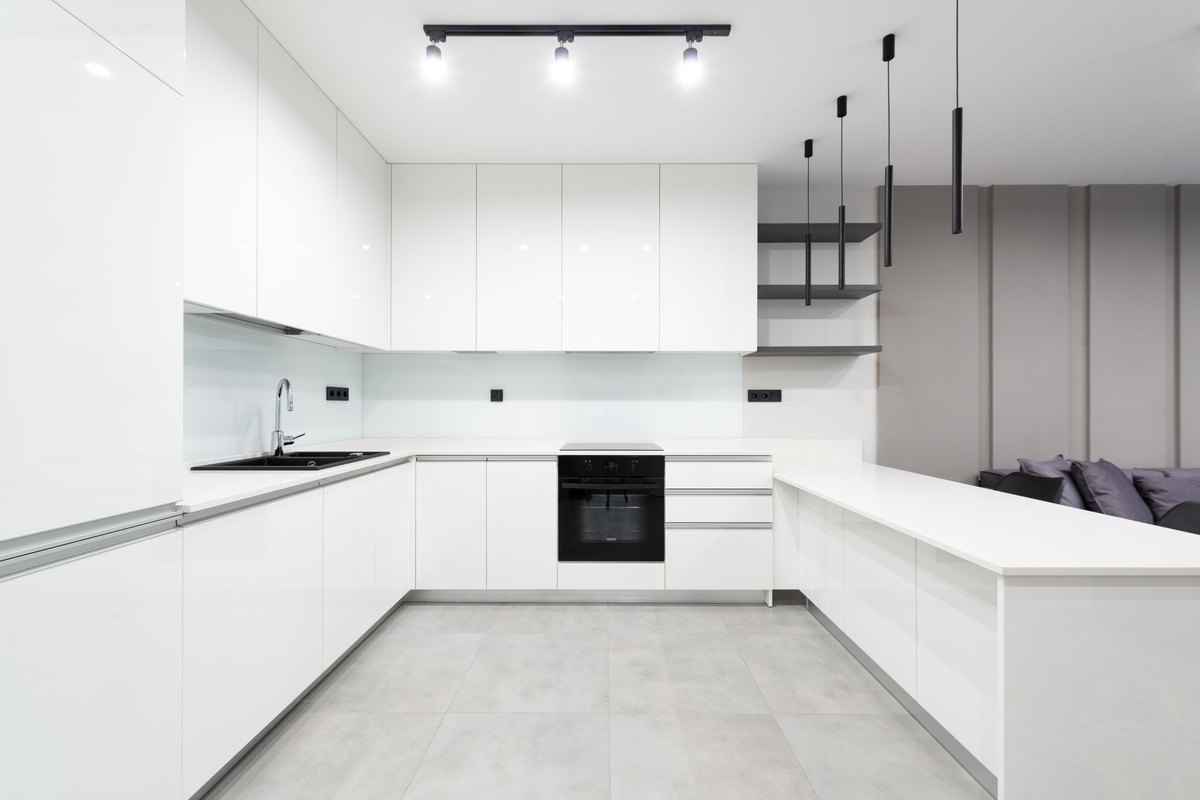
Kitchens are the one room where two beam angles on one circuit are almost mandatory: 24° over the counter and the hob, 38–50° for circulation. Getting the counter layer right matters more than the fixture count — 968 lx at the pool centre is ample, so the spacing is what buys evenness, not the wattage.

Corridors and hallways are where a 50° optic earns its keep. At 9 ft the pool is 8.39 ft across, so heads at 5.88 ft centres produce a continuous ribbon of light rather than a row of spots. And where the ceiling is a slatted or panelled construction that cannot be cut at all, a track or surface fitting is not a compromise — it is the only option.
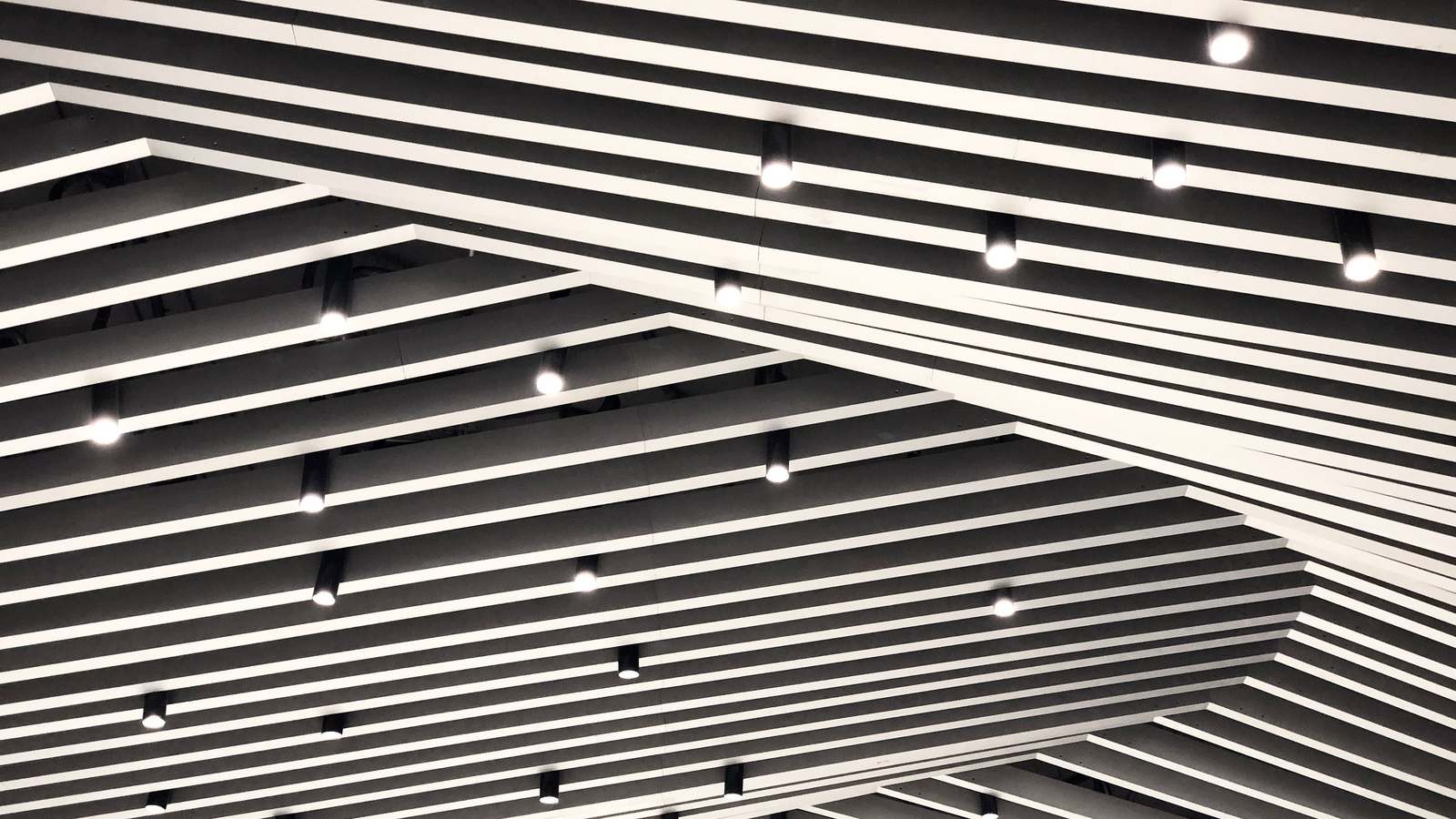
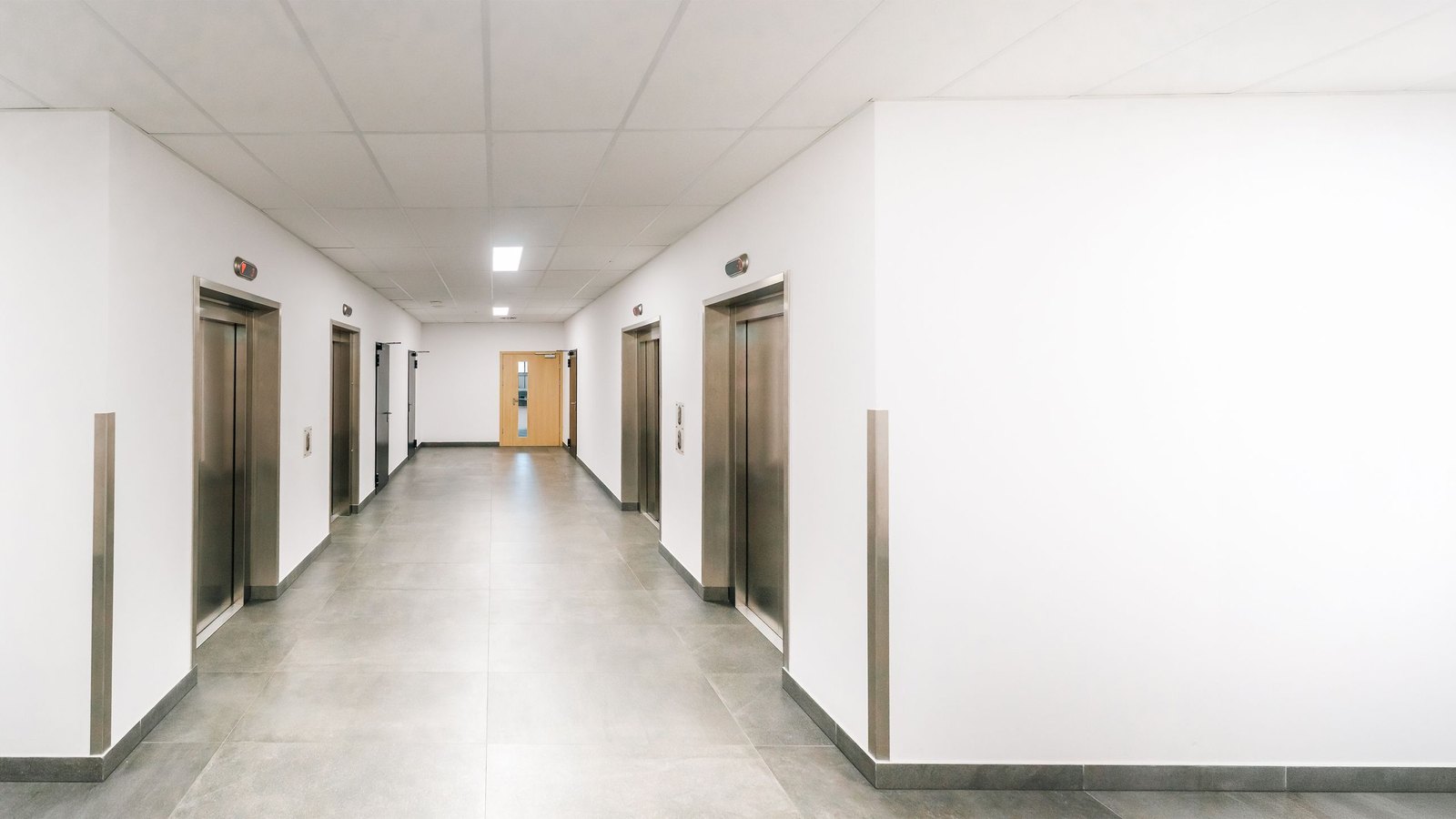
Galleries, retail and bathrooms each add one variable. Galleries want a 15–24° optic and an adjustable ring, so an eyeball or gimbal is the real specification; the recessed part is incidental. Retail wants aiming that survives re-merchandising, which is why the ceiling usually carries a rail. Bathrooms want a 24° optic over the mirror, an IP rating in the wet zone, and a shield high enough that a person standing at the basin is not looking into the source.



Put both families on the same 12 x 16 ft plan and the arithmetic does the arguing. Two rows of four 38° cans hold 5,200 lm and open eight holes. One track run with six 24° heads holds 5,400 lm on two screw holes and a feed.
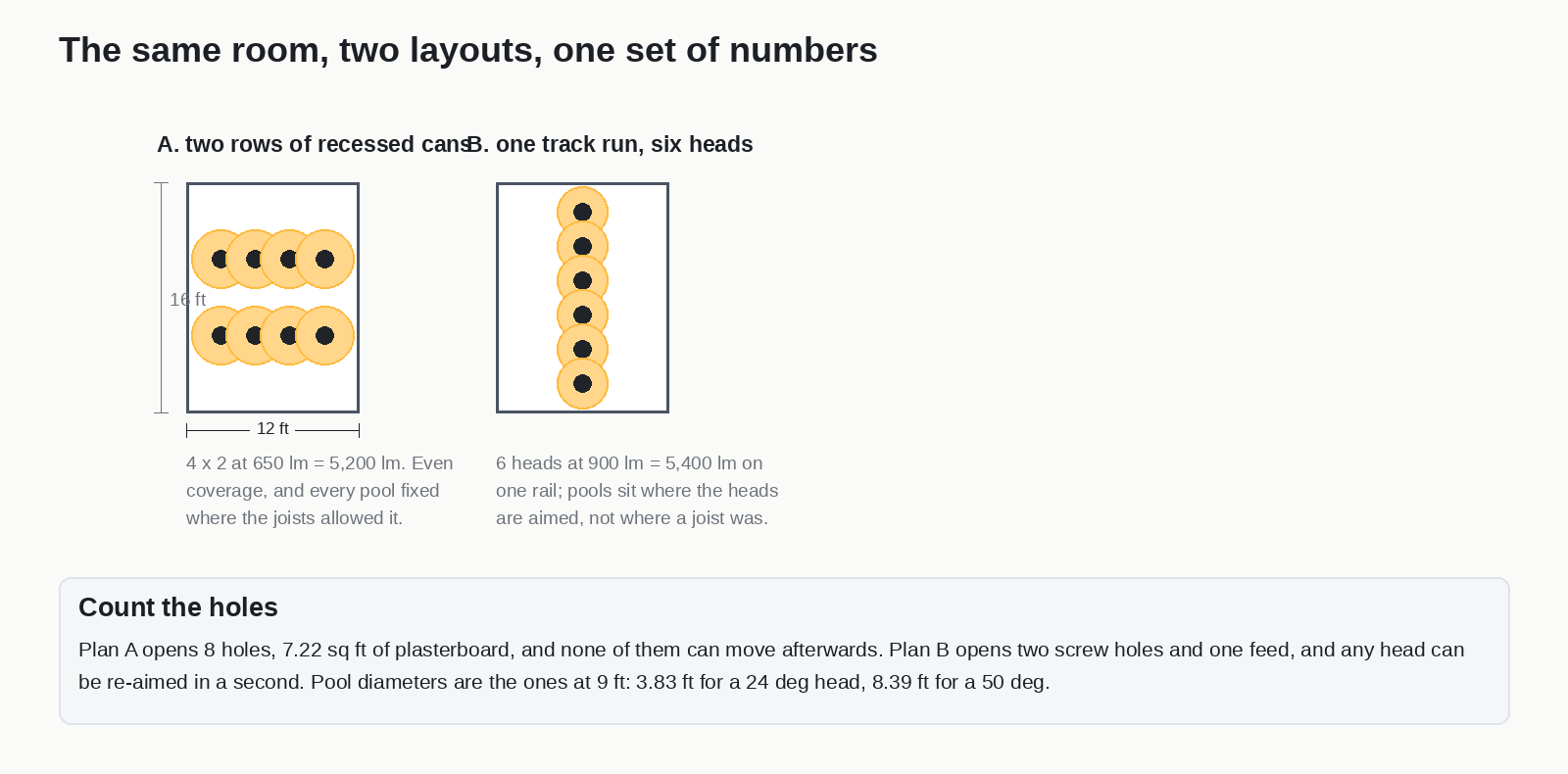
Which one is better depends entirely on what the ceiling is made of and who is going to touch it next. If you want the room to relearn itself every few years — furniture moves, a child’s desk arrives, the art changes — the track wins on maintenance alone. If the ceiling is the design and the layout will not change, recessed wins on the architectural result, and the earlier you cut, the cheaper it is.
Not quite. A downlight describes light delivered downward from a small aperture; a recessed light describes a fitting whose body sits inside the ceiling. A recessed downlight is both, but a surface cylinder or a track head is a downlight that is not recessed, and a recessed uplight is recessed without being a downlight.
Pot light or can is the North American name for the housing a lamp drops into, so it belongs to the recessed family only. In a specification it usually implies a US-style housing with a replaceable bulb rather than a sealed integrated engine.
No — the mounting does not add lumens. At 1,000 lm and 9 ft, a 15° optic delivers 2,472 lx at the pool centre and a 50° optic delivers 226 lx, and both are downlights. Brightness at the surface is set by beam angle, output and mounting height, never by the word on the carton.
Yes, with plasterwork. In a 12 x 16 ft room eight cans open 7.22 sq ft of plasterboard, and a realistic 30 % cutting allowance means buying 9.39 sq ft of board plus skim and paint. If the ceiling is listed, slatted, concrete or rented, a surface fitting or a track is the practical answer.
A trimmed downlight has a flange that covers the cut edge of the plasterboard. A trimless downlight stops the plaster at the aperture, so the ceiling surface runs unbroken into the reflector — a cleaner line, and a cut position that has to be exact, since there is no flange to absorb the error.
Yes, because UGR is a result of a configuration, not a property of a product family. The same 75 mm engine is published with 15°, 38° and 45° cut-off angles at the same power, and each produces a different view of the source — which is what UGR ends up measuring.
Downlight and recessed light describe different things: a direction and a mounting. They overlap whenever the fitting is both, and the overlap is where most sentences about them stop being precise. Specify the aperture, the mounting, the optic, the shield and the control layer, and the naming argument stops costing anything.
ENCORE builds the 75 mm family — fixed, adjustable, trimless, pin-hole and wall washer — from one modular engine, with cut-off angles, beam angles and photometric files per variant. If you are choosing between a recessed layout and a rail for a room that already exists, send us the ceiling drawing and the plenum depth and we will come back with the optics and the hole count.