Address
304 North Cardinal
St. Dorchester Center, MA 02124
Work Hours
Monday to Friday: 7AM - 7PM
Weekend: 10AM - 5PM
Address
304 North Cardinal
St. Dorchester Center, MA 02124
Work Hours
Monday to Friday: 7AM - 7PM
Weekend: 10AM - 5PM
Unified glare rating is a specification, not a label. See how UGR 19 pins down aperture luminance, shielding angle and track head count — with the arithmetic.
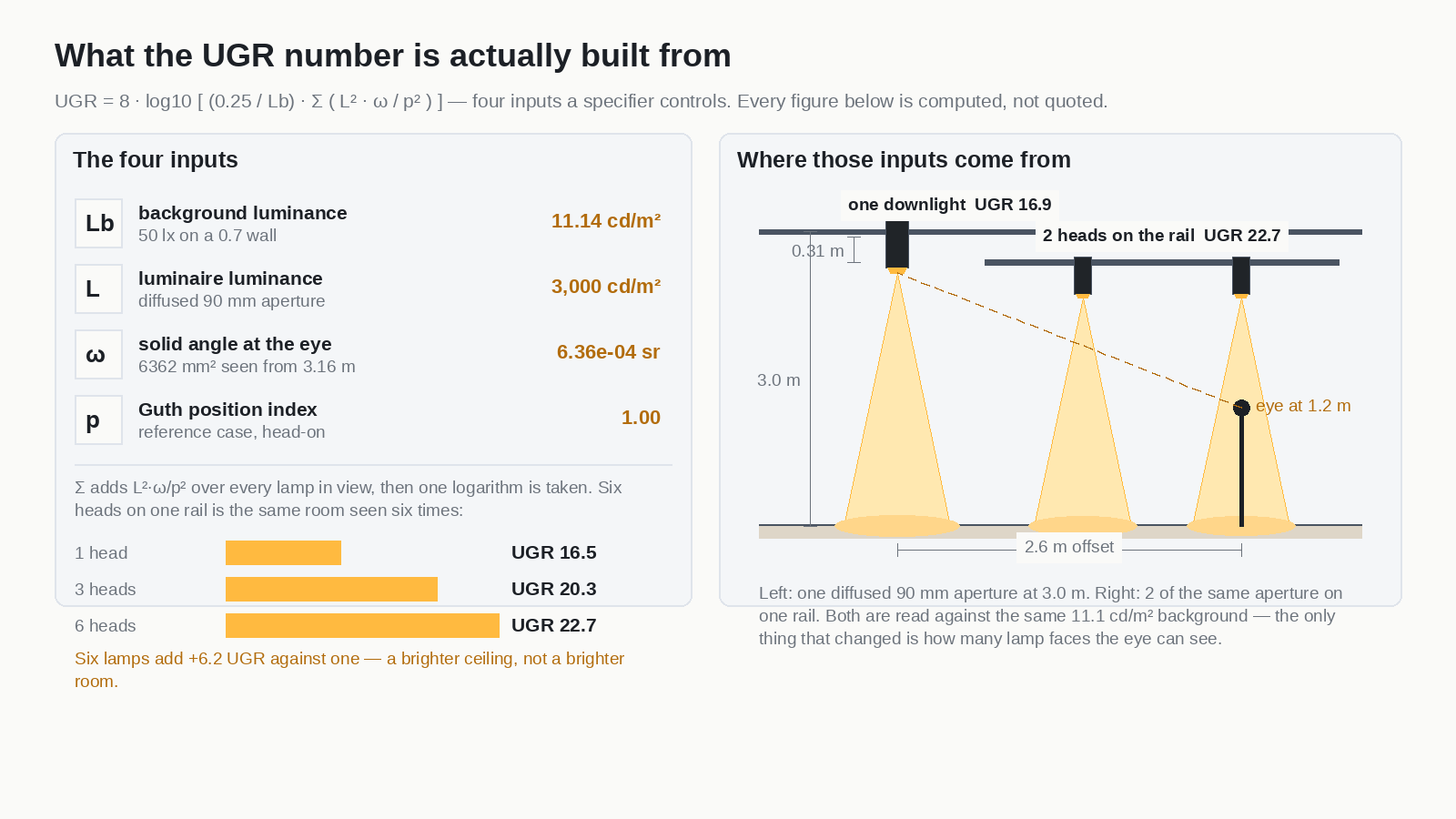
Unified glare rating is the only number on a lighting specification that describes the occupant rather than the fixture. Lux tells you how much light arrives. Colour temperature tells you what it looks like. UGR tells you whether the room is going to be unpleasant to sit in — and unlike the other two, it cannot be met by buying a brighter product. It is met by buying a dimmer-faced one.
That is why UGR is the specification most often written into a project and least often checked. An architect specifies “UGR ≤ 19 for the offices”, the tender returns three downlights that all claim 19, and nobody asks which aperture diameter, which shielding angle, or how many track heads were in view when the number was produced. Those three quantities are what the rating actually constrains — and once you see the expression behind it, you can reverse-engineer the right fixture instead of trusting a badge.
This article walks the arithmetic the other way round from the usual introduction: not what is UGR (that ground is covered in our primer on UGR for downlights and track lights), but what does a UGR target force a downlight or a track head to be. The worked examples below use the log expression defined by the International Commission on Illumination (CIE 117) and adopted in EN 12464-1; the recommended limits and measurement conventions follow the Illuminating Engineering Society. Every figure in this article is computed, and the arithmetic is printed so you can check it.
UGR is a single number derived from four inputs. Three of them belong to the fixture or the room; the fourth belongs to where a person happens to be standing. Written out in the form used by CIE 117:
UGR = 8 · log₁₀ [ (0.25 / Lb) · Σ ( L² · ω / p² ) ]
The sum runs over every luminaire in the observer’s field of view. Because it is a sum and not a maximum, UGR is a property of a scene, not of a product. Two identical downlights can sit at UGR 17 and UGR 23 in the same box depending only on how many of them a seated person can see. That single sentence is the reason UGR claims on datasheets need reading carefully.


Four symbols, four handles. Each one is something you can put in a specification or change on site.
Background luminance is the brightness of what the eye sees around the lamp, in candelas per square metre. It is the denominator inside the bracket, so a brighter background lowers UGR. For a matte surface, Lb = ρ · E / π, where ρ is reflectance and E is illuminance. A 0.7-reflectance wall at 50 lx gives Lb ≈ 11.14 cd/m². Doubling wall illuminance to 100 lx lowers UGR by 2.4.
This is the term that explains why a glossy dark wall around a bright downlight is worse than the same downlight on a bright ceiling — not because dark surfaces reflect more, but because they leave the eye with nothing to adapt to except the lamp.
This is the average luminance of the visible emitting surface, L = I / A, where I is intensity in candelas toward the observer and A is the projected area of the face. It enters as L², which is the first thing most people miss. Because the term is squared, halving luminance does not halve the glare contribution — it cuts it to a quarter, worth 4.8 UGR. That single exponent is why aperture luminance, not lumen output, is the number to put in a specification.
Solid angle measures how much of the observer’s field the lamp occupies, ω = A / r², where r is the distance from eye to lamp. A large aperture at close range subtends more solid angle than a small aperture far away, even at identical luminance. It is the term that makes ceiling height a glare decision: on a 2.6 m ceiling the same head sits 0.21 m closer to the eye, and UGR rises +0.5. Our guide to reading a photometric report shows where the intensity data behind this term comes from.
The position index accounts for the fact that a lamp straight ahead is more annoying than one at the edge of vision. It sits in the denominator as p², and it is the only one of the four inputs that changes when a person simply looks in a different direction — which is also why UGR is defined for a stated observer position and cannot be quoted as a property of a room.
Because L is squared, the lever with the most authority over a UGR result is the luminance of the visible face. The useful way to read that is as a ladder, because the whole industry sits inside a fairly narrow band.
A quality recessed diffuser is generally quoted between 2,000 and 4,000 cd/m². A small-aperture adjustable head runs several times hotter, because the same lumens are concentrated onto a much smaller face. A visible bare lamp behind a clear lens is an order of magnitude above that — which is precisely why the diffuser exists.


The practical consequence is that a shielding specification is really a luminance specification. When a project asks for UGR ≤ 19, it is asking for a visible face luminance low enough that the L² term cannot exceed the limit at the stated observer geometry — not for a particular lamp, reflector or brand.
Shielding — a deeper recess, a baffle, a honeycomb or microprism lens, a lower cut-off angle — reduces UGR by reducing how much of the emitting face the eye is allowed to see at the angles that matter. In the expression, that shrinks the effective ω while also reducing the measured luminance at those angles, and both effects push in the same direction.
This is where a specification is often written imprecisely. “Deep baffle” is not a number. What a specifier can actually verify is:
In the worked example that runs through this article, the open 90 mm diffused aperture reaches UGR 16.9 while the same luminaire with a deep baffle that cuts the visible face to 50% and the viewed luminance to 1,500 cd/m² lands at UGR 9.6 — a 7.2 unit improvement from shielding alone, with the lumen package, the aperture and the ceiling untouched. Our deep anti-glare downlight, the Ella 10W–35W, is built around that trade: the light is thrown down, the source is kept out of the 45° view.

EN 12464-1 sets UGR limits by the visual task a space supports. The values below are the ones that turn up most often in specifications; they are limits on the installation, evaluated at the standard observer position, not ratings any single fixture can carry alone.
| Space / task | UGR limit | What it implies for the optics |
|---|---|---|
| Offices — writing, reading, CAD | 19 | Diffused or deep-baffled recessed optics; heads not in the seated sight line |
| Education — classrooms, lecture halls | 19 | Same as office, plus no exposed lamp over the front of the room |
| Industry — precision and fine assembly | 19 | Shielded task optics; bare high-bay heads usually fail this |
| Retail — display areas | 22 | Higher limit, but the merchandise, not the ceiling, has to be the bright object |
| Residential — living rooms, lounges | 22 | Absence of glare matters more than a low absolute level |
| Circulation — corridors, stairs, lobbies | 25 | Transient occupancy, so exposure time substitutes for shielding |
Three things about that table are routinely misread. First, 19 is not a magic number of universal goodness — it is the limit for a specific group of tasks, and a corridor can comfortably sit at 25. Second, all of the limits assume a bright interior; applying an office limit in a dim room with dark finishes is optimistic, because the background luminance term gets worse. Third, the limit applies to the whole installation, so a compliant fixture used in a non-compliant arrangement fails the project.
Take the expression and hold everything except one input fixed at a time, and a UGR target turns into three concrete specification lines.
At an office observer position — eye 1.2 m, 2.6 m offset from the fixture — and a background of 11.14 cd/m², a 90 mm aperture must stay at or below roughly 3,000 cd/m² to hold UGR under 19 at the single-head case. Ask for that number, or ask for the viewing-angle luminance curve, and you have made the requirement checkable.
Aperture diameter and lumen package work against each other. The same 700 lm delivered through a smaller face produces a higher luminance and a worse UGR; widening the aperture spreads the same flux over more area and brings the number down. This is why “same wattage, smaller cut-out” is a glare trap rather than an upgrade, and why a deep-baffled fixture with a modest lumen package often outperforms a high-output one in a low-UGR room.
UGR is evaluated at a distance, and distance is set by ceiling height. Moving the observer from 3.16 m to 4.02 m off the fixture drops UGR from 16.9 to 15.2, a 1.7 unit swing, with nothing about the luminaire changed. A UGR claim made for a 3.5 m office ceiling does not transfer to a 2.6 m residential one: at 2.6 m the same head rises +0.5 UGR. Always ask what ceiling height the number was computed at.


Track lighting changes the problem because heads are aimable. That freedom makes it easy to build a good scene and just as easy to build a bad one from the same parts.
The sum over luminaires is linear before the logarithm. Going from one visible head to three adds 3.8 UGR; going to six adds 6.2. That is the difference between a comfortable and an uncomfortable ceiling, produced entirely by how many heads are in the seated person’s field of view. Nothing about the individual head changed.
Because the position index p penalises sources near the centre of vision, the cheapest fix on a track is orientation. Aim the head onto the wall it is washing or the display it is highlighting, keep the lens out of the horizontal band a seated person looks along, and the same fixtures perform substantially better. Tracks that run parallel to a worktop or a table are worse than tracks that run across it, for exactly this reason.
A track mounted low on a sloped ceiling, or a pendant rail brought down over a table, shortens the eye-to-lamp distance and enlarges the solid angle. On a 3.0 m ceiling at 2.8 m offset, six heads reach UGR 22.7; drop the same rail to 2.6 m and they reach 23.2. If a track has to hang lower, the shielding has to improve to compensate. Deep-baffled heads such as the Aimer 25W–35W and the compact Cadio 20W–30W exist for exactly that compromise; more options are listed in our track light collection.


Both cases below use the same observer geometry — eye 1.2 m above the floor, background 11.14 cd/m² from a 0.7-reflectance surface at 50 lx — and the same expression:
UGR = 8 · log₁₀ [ (0.25 / 11.14) · Σ ( L² · ω / p² ) ]
Case A — recessed downlight. One 90 mm diffused aperture at 3.0 m, seen from 3.16 m at a 0.7-reflectance wall. Face luminance 3,000 cd/m², solid angle 6.36e-04 sr, giving UGR 16.9. That misses the office limit of 19, by a margin small enough that a specifier relying on the badge alone would never see it. Substituting the deep-baffled version — viewed luminance 1,500 cd/m², effective area 50% — gives UGR 9.6, comfortably inside.
Case B — a track rail. Six 90 mm heads at 3.0 m on a rail 3.33 m from the observer. One head alone would be UGR 16.5; adding heads moves it to 20.3 for three and 22.7 for six. The rail fails an office limit at six heads with open optics — and passes at 15.5 with the same count of deep-baffled heads. Retiring the observer to 4.8 m does the same job more cheaply if the room allows it: 20.2.
| Check | Case A — one downlight | Case B — six heads on a rail |
|---|---|---|
| Observer geometry | eye 1.2 m, 2.6 m offset | eye 1.2 m, 2.8 m offset |
| Visible lamp faces | 1 | 1 / 3 / 6 |
| Face luminance, open | 3,000 cd/m² | 3,000 cd/m² |
| Result, open optics | UGR 16.9 | UGR 16.5 / 20.3 / 22.7 |
| Result, deep-baffled | UGR 9.6 | UGR 15.5 |
| Office limit | 19 — open fails, baffled passes | 19 — open fails, baffled passes |
| Cheapest remaining lever | ceiling height: 2.6 m costs +0.5 | distance: 4.8 m saves -2.5 |
A printed UGR figure is meaningful only if the conditions travel with it. When you see one, five questions settle whether it applies to your project.
If four of those five are missing, treat the figure as a marketing statement rather than a specification — and specify luminance, cut-off angle and head count instead, because those you can verify on site.


Copy this into a tender document or a purchase note. Each line is something a supplier can answer with a number, which is the only kind of glare requirement that survives procurement.
Two lines on this list do most of the work. Luminance at viewing angles determines whether the L² term can be contained, and the stated observer geometry determines whether the claim applies to your room at all.
Unified glare rating is a scale from about 10 to 30 that describes how much discomfort glare a lighting installation produces for a person in a stated position. Lower is more comfortable. It is calculated from the luminance of every luminaire in view, how much of the field of view each one occupies, how far off-centre it sits, and the brightness of the surrounding surfaces.
UGR 19 is the EN 12464-1 limit for offices, classrooms and precision work. For a downlight it translates into a ceiling on visible face luminance — roughly 3,000 cd/m² at a typical seated observer position in the worked example above — together with a shielding geometry, an aperture diameter and a ceiling height that keep the calculated installation below the limit. No single fixture is intrinsically UGR 19; the installation is.
No. Very low UGR values usually mean a deep baffle, a small aperture with a wide distribution, or heavy shielding, all of which can reduce efficiency and produce a flatter, less characterful light. Most spaces should be specified to their limit and no further: 19 for task areas, 22 for display and residential, 25 for circulation.
Track heads can carry a UGR figure for a stated arrangement, but the number that matters is the one for the rail as installed, because the sum runs over every head in view. Three heads on a rail can add about 3.8 UGR over one, and six can add about 6.2 — so the count and the aim matter as much as the optic.
In order of cost: aim heads away from the seated sight line, replace open heads with deep-baffled or honeycomb versions, raise the general background luminance so the eye has something to adapt to, and — if the track allows — raise the mounting height or move seating further from the rail. Replacing the whole rail is almost never necessary.
Because UGR depends on observer distance, the number of luminaires in view and the background luminance, all of which change with the room. A head at 3.5 m on a pale ceiling with one luminaire visible can sit several units below the same head at 2.6 m near a dark wall with a row of them in view.
Unified glare rating is a specification dressed as a rating. The number on a datasheet is the output of four inputs, three of which belong to the room and the arrangement rather than the product — which means the useful way to write a glare requirement is not “UGR 19” but “visible luminance at or below X cd/m², cut-off angle at least 30°, no more than N heads in view from the seated position at this ceiling height”.
That version of the requirement can be checked, quoted and delivered. The single number cannot.
If you are working through a project and want the arithmetic run for your own geometry — ceiling height, seat position, rail layout, finishes — send us the plan and we will calculate the expected UGR for the arrangement rather than for the catalogue. Start from our deep anti-glare downlights and track light range, or get in touch with the room dimensions and we will take it from there.
Related reading: what unified glare rating means for downlights and track lights, how UGR under 19 changes a space, and how to read the photometric report your specification is built on.