Address
304 North Cardinal
St. Dorchester Center, MA 02124
Work Hours
Monday to Friday: 7AM - 7PM
Weekend: 10AM - 5PM
Address
304 North Cardinal
St. Dorchester Center, MA 02124
Work Hours
Monday to Friday: 7AM - 7PM
Weekend: 10AM - 5PM
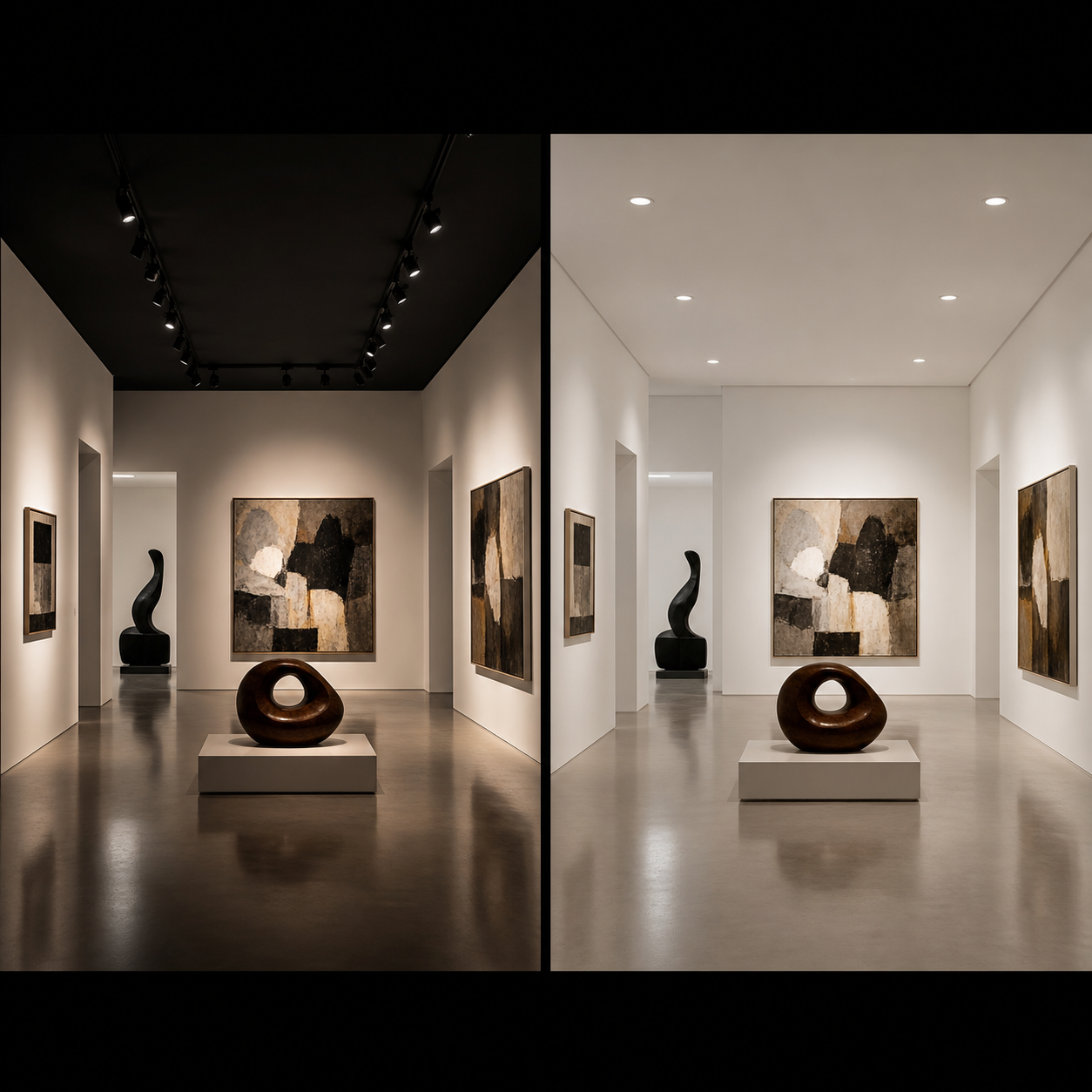
If you have ever stood in a room and wondered why some ceilings feel calm and invisible while others feel busy and technical, the answer is usually hiding in the light fixtures above you. Track lighting and recessed downlights (also called can lights or recessed can lights) are the two dominant ceiling lighting choices for modern residential and commercial spaces — and the difference between them is not just aesthetic. It shapes how you use your space, and follows the recommended lighting levels published by the Illuminating Engineering Society (IES). how much you spend on installation, and how easily your lighting can adapt to change.
This guide cuts through the marketing language and gives you a precise, side-by-side comparison of track lighting vs recessed downlights: installation requirements, flexibility, aesthetics, light quality, cost, and which scenarios each wins.
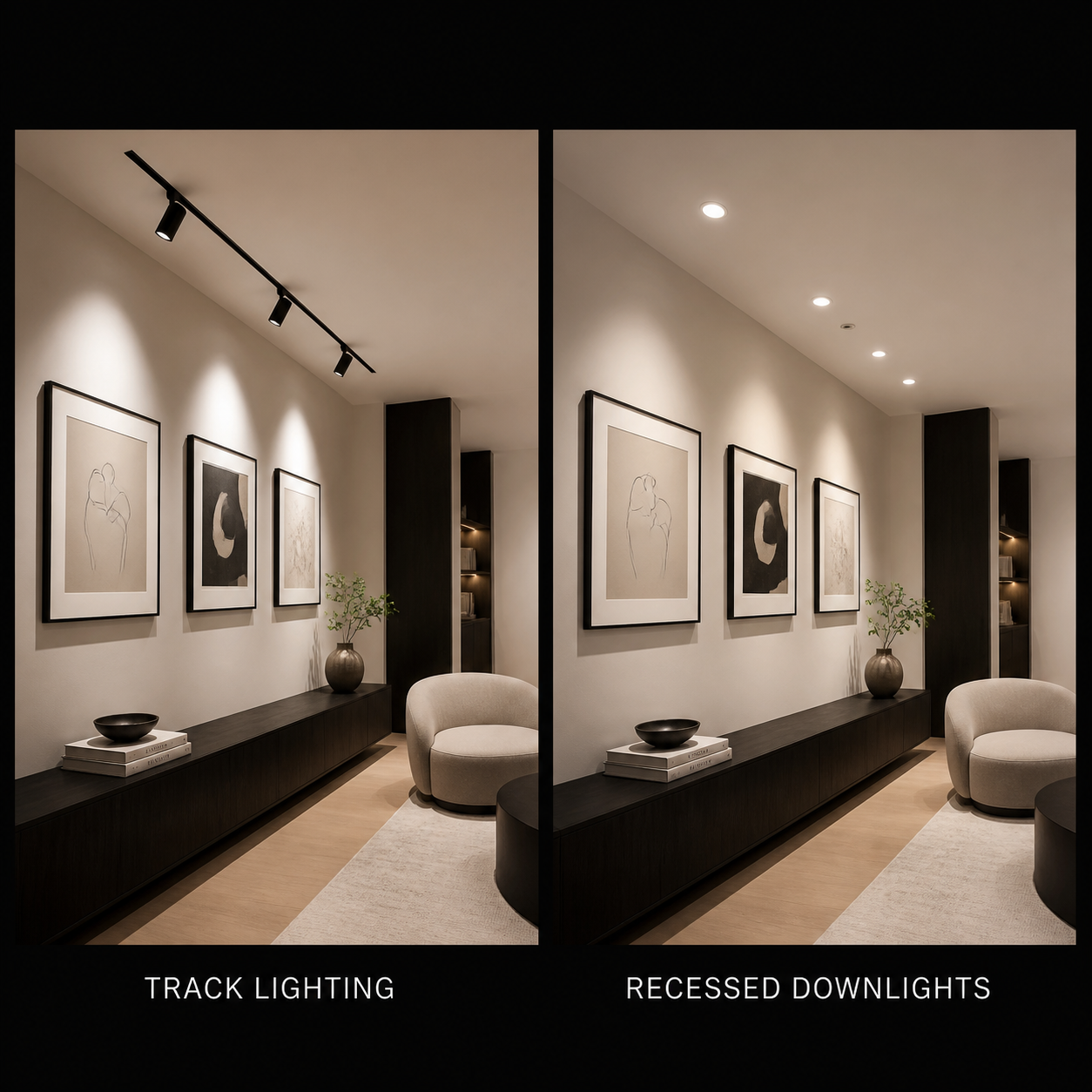
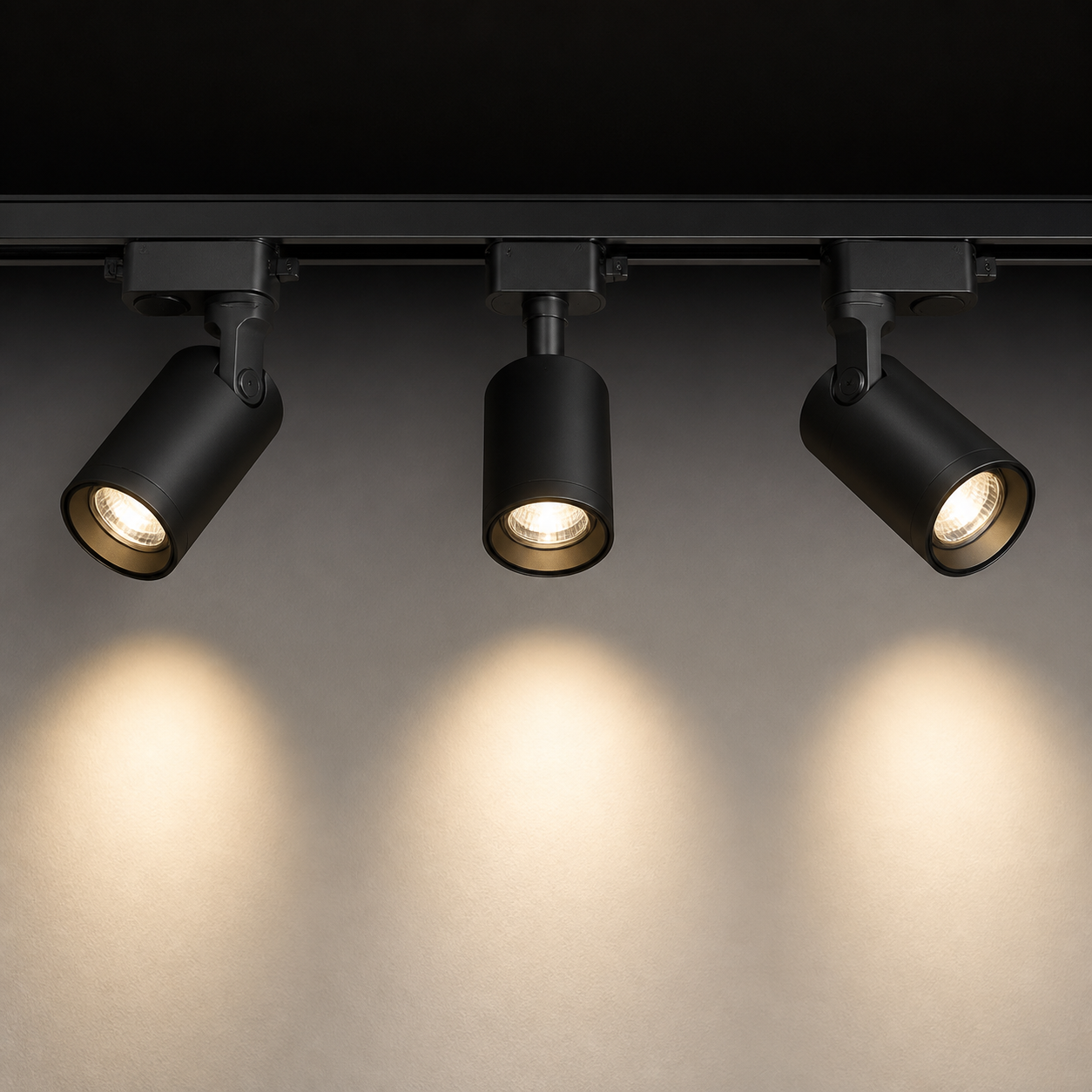
Track lighting consists of a linear rail mounted directly to the ceiling surface (or suspended from it), with individual light fixtures (heads) that clip or slide onto the track and can be repositioned anywhere along its length. Each head can also be aimed independently to direct light exactly where needed.
Key characteristics:
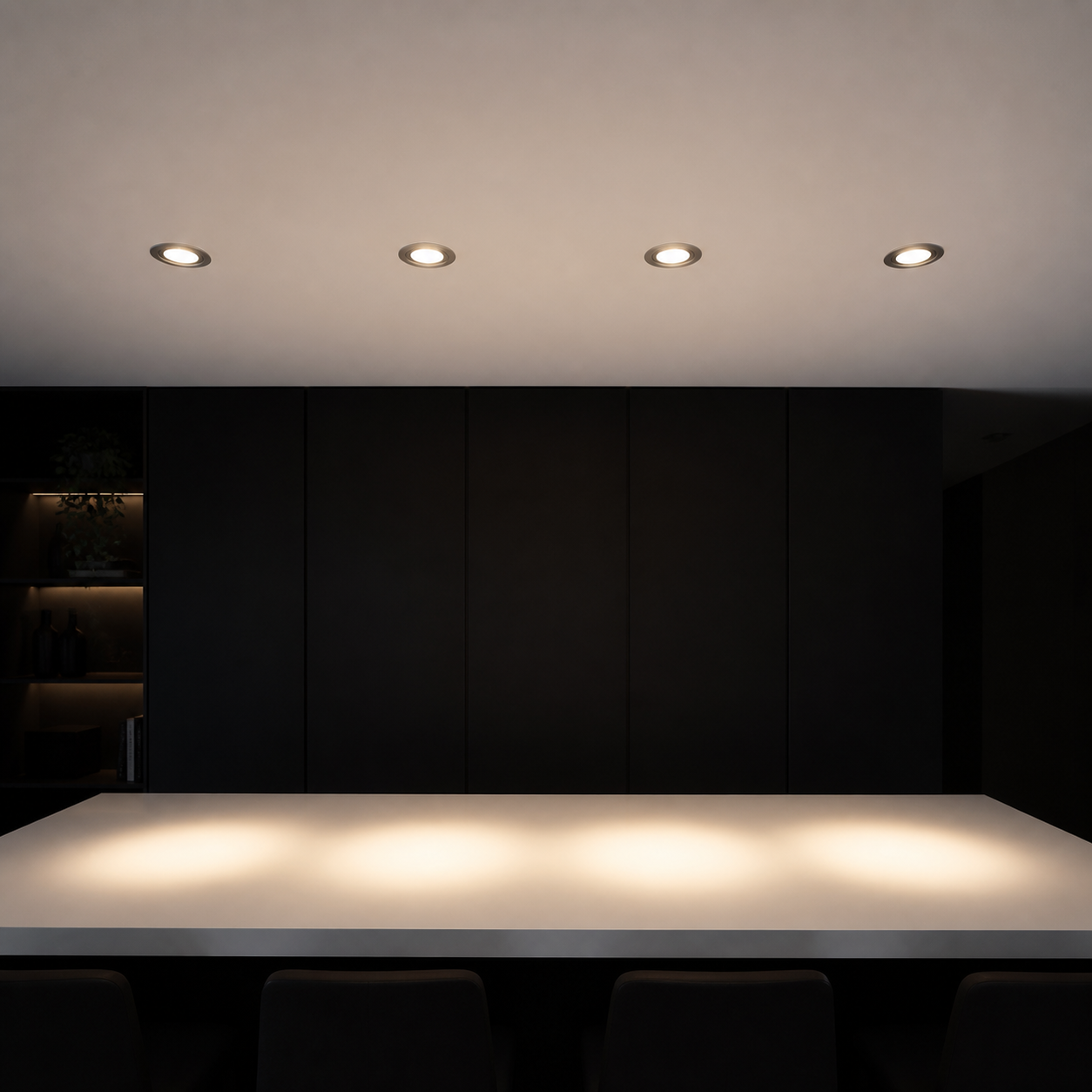
Recessed downlights (recessed lighting, can lights, pot lights) are fixtures installed flush into the ceiling with only the trim and a small portion of the housing visible. The light source sits above the ceiling plane inside a housing can, delivering downward light through a flush lens or reflector.
Key characteristics:
| Factor | Track Lighting | Recessed Downlights |
|---|---|---|
| Installation | Surface-mounts to ceiling; no cutouts needed; can use existing junction boxes | Requires ceiling cutout and housing; often needs new wiring run during construction |
| Flexibility | Heads repositionable along track and individually aimable at any time | Fixed position after installation; adjustable trims offer limited directional control |
| Ceiling Appearance | Visible track rail and fixtures; adds technical/architectural aesthetic | Nearly invisible; ceiling stays clean and uninterrupted |
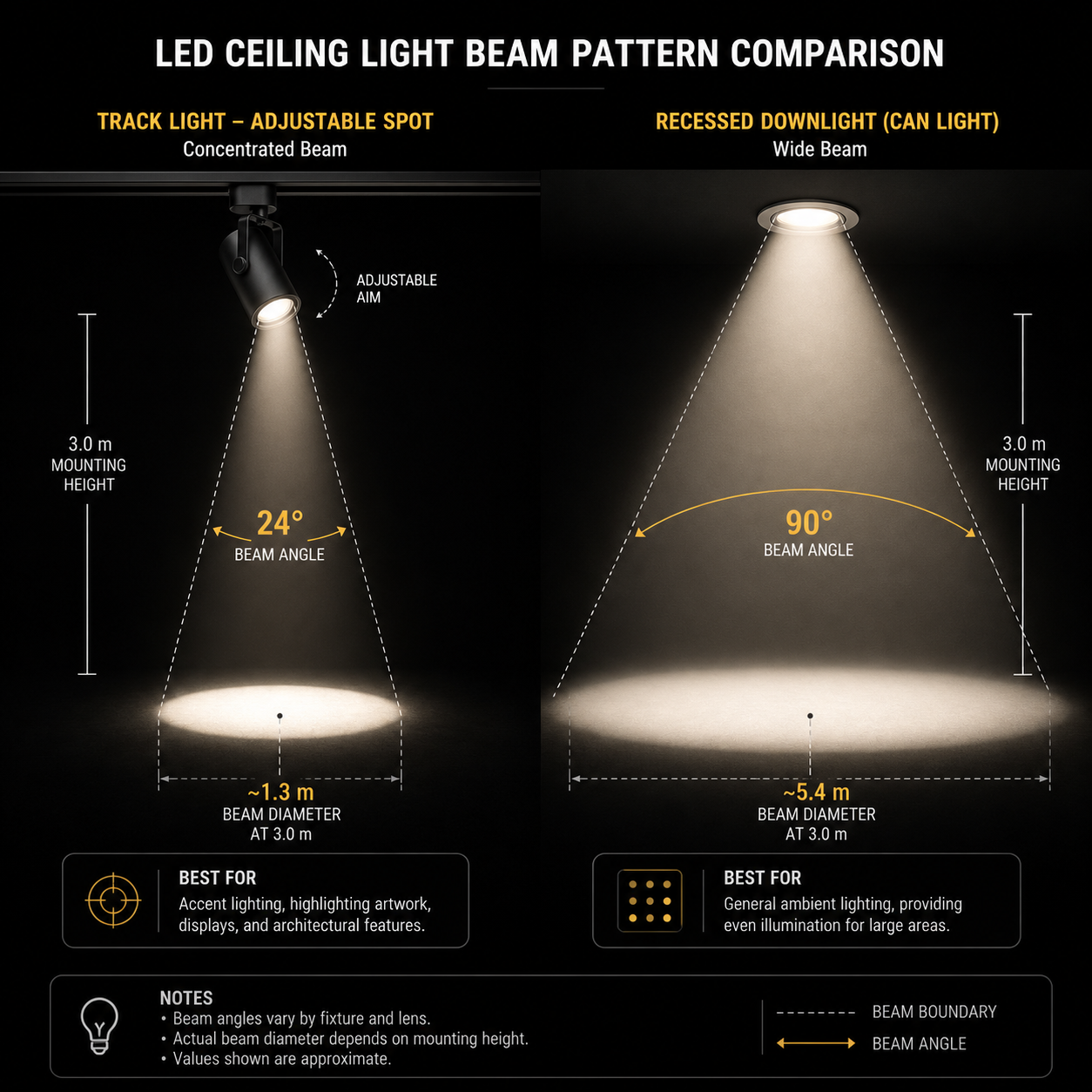
| Light Control | Narrow to medium beams (10°–60°); precise aiming; excellent for accent lighting | Wide to medium beams (60°–120°); even ambient fill; limited accent precision |
| Cost (Material) | $50–$200 per fixture; track rail adds $30–$100 per foot | $30–$150 per fixture; housing adds $20–$80 per unit |
| Cost (Labour) | Lower: surface-mount friendly; no ceiling work | Higher: requires cutouts, housing, and potentially new wiring runs |
| Best For | Accent, task, gallery, retail, art lighting; spaces that change frequently | Ambient general lighting; clean minimalist ceilings; new construction |
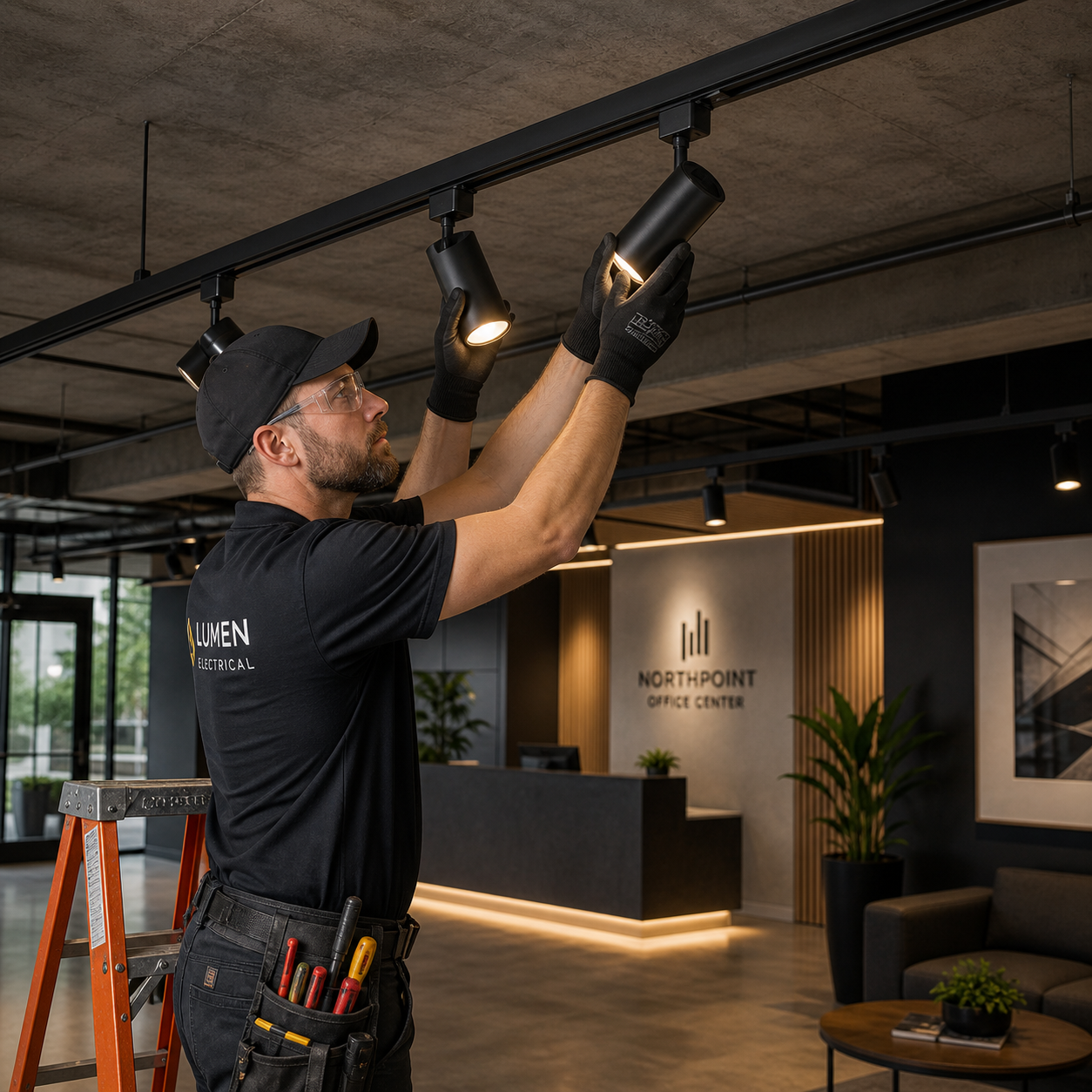
Track lighting wins clearly on installation simplicity. A basic surface-mounted track system can be installed by a competent DIYer in under an hour per run, using existing junction box wiring. No ceiling cutting, no drywall repair, no housing clearance calculations.
Recessed downlights require:
For retrofit projects in existing buildings, track lighting is almost always the faster and lower-disruption choice. For new construction or major renovations where the ceiling is open, recessed lighting is worth the upfront effort because the finished result is cleaner.
For a full guide to selecting the right commercial track system, see our Track Lighting Beam Angles Explained guide.
If there is one dimension where recessed lighting fundamentally cannot compete, it is flexibility. A track system is a lighting platform, not a fixed installation.
With track lighting, you can:
Recessed downlights are installed with a fixed location and typically a fixed downward direction. Adjustable gimbal-style recessed trims exist and can redirect light within a 30°–40° arc — but this is a fraction of track lighting’s 350° rotation and unlimited repositioning flexibility.
This is the most subjective dimension, and the right answer depends entirely on your design intent.
Choose recessed downlights if: you want your ceiling to disappear and let the space speak. Recessed lighting is the default choice for Scandinavian minimalism, clean modern interiors, and anywhere the architecture itself is the feature. The ceiling stays flat and uninterrupted.
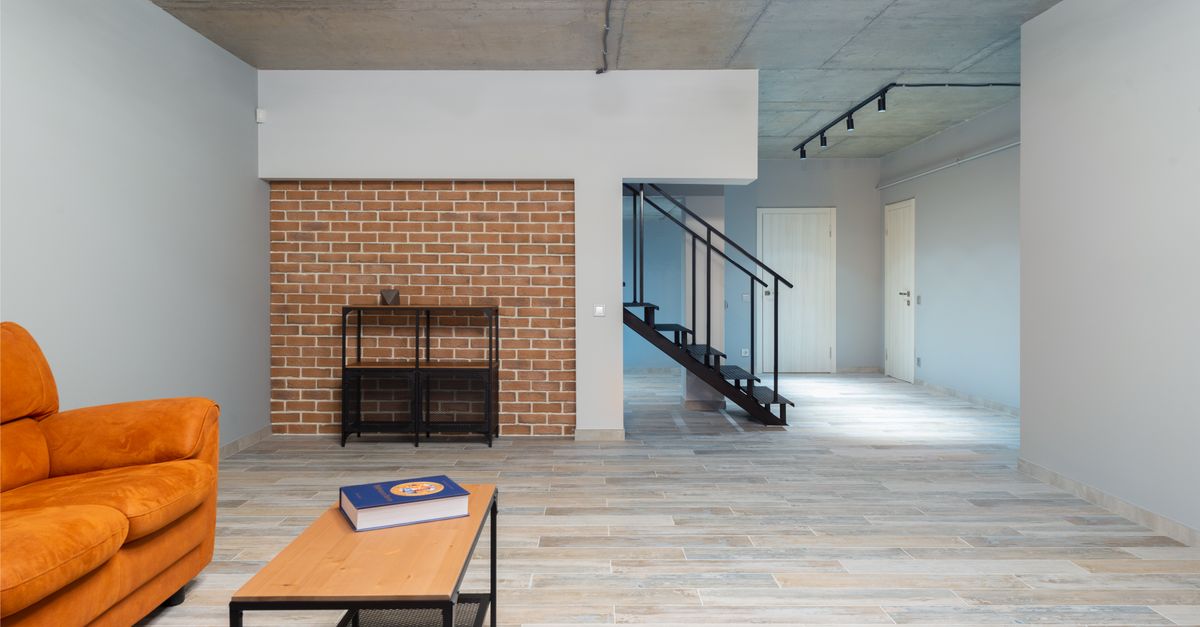
Choose track lighting if: you want the lighting to be part of the design vocabulary. Track systems work exceptionally well in industrial lofts, contemporary galleries, retail environments, and hospitality spaces where the technical nature of the lighting is part of the aesthetic. A matte black track rail on a dark ceiling is not an eyesore — it is an intentional design statement.
Both approaches can look either excellent or terrible depending on specification quality, spacing discipline, and overall design coherence. A cheap plastic track looks worse than no track at all. A poorly positioned recessed light grid looks like an airport terminal.
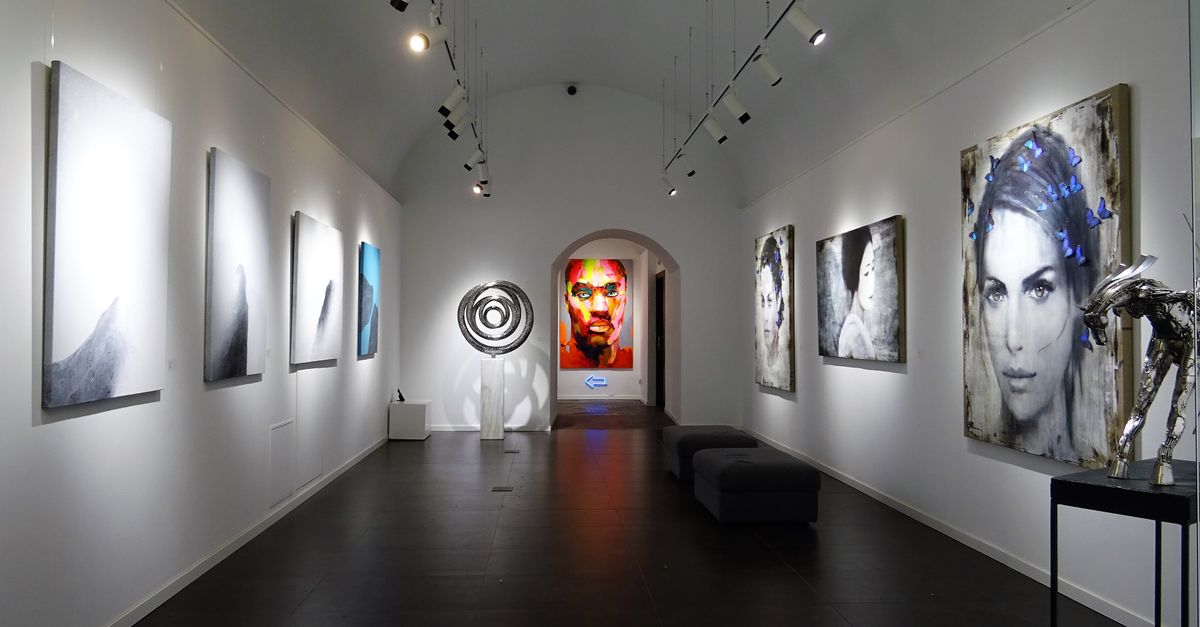
Both track lighting and recessed downlights use LED sources in modern installations, so raw light quality (CRI, CCT, lumens) is largely independent of the form factor. What differs is beam control.
Track lighting heads typically offer:
Recessed downlights typically come in fixed beam angles determined by the reflector or lens:
For high-CRI applications such as museum gallery lighting or luxury retail, track systems give you more control over exactly which surfaces receive how much light. For food presentation or art display, the precision of a 15° or 24° track spot at CRI 95 is unmatched by any recessed equivalent at the same price point.
See our CRI 80 vs 90 vs 95 Guide for how color rendering quality affects commercial lighting decisions.
Track lighting excels in:
Recessed downlights excel in:
ENCORE’s commercial track lighting range (VEGA, IMAX, and FLEX magnetic track systems) is specifically engineered for museums, galleries, and high-end retail — environments where flexibility and light quality are non-negotiable.
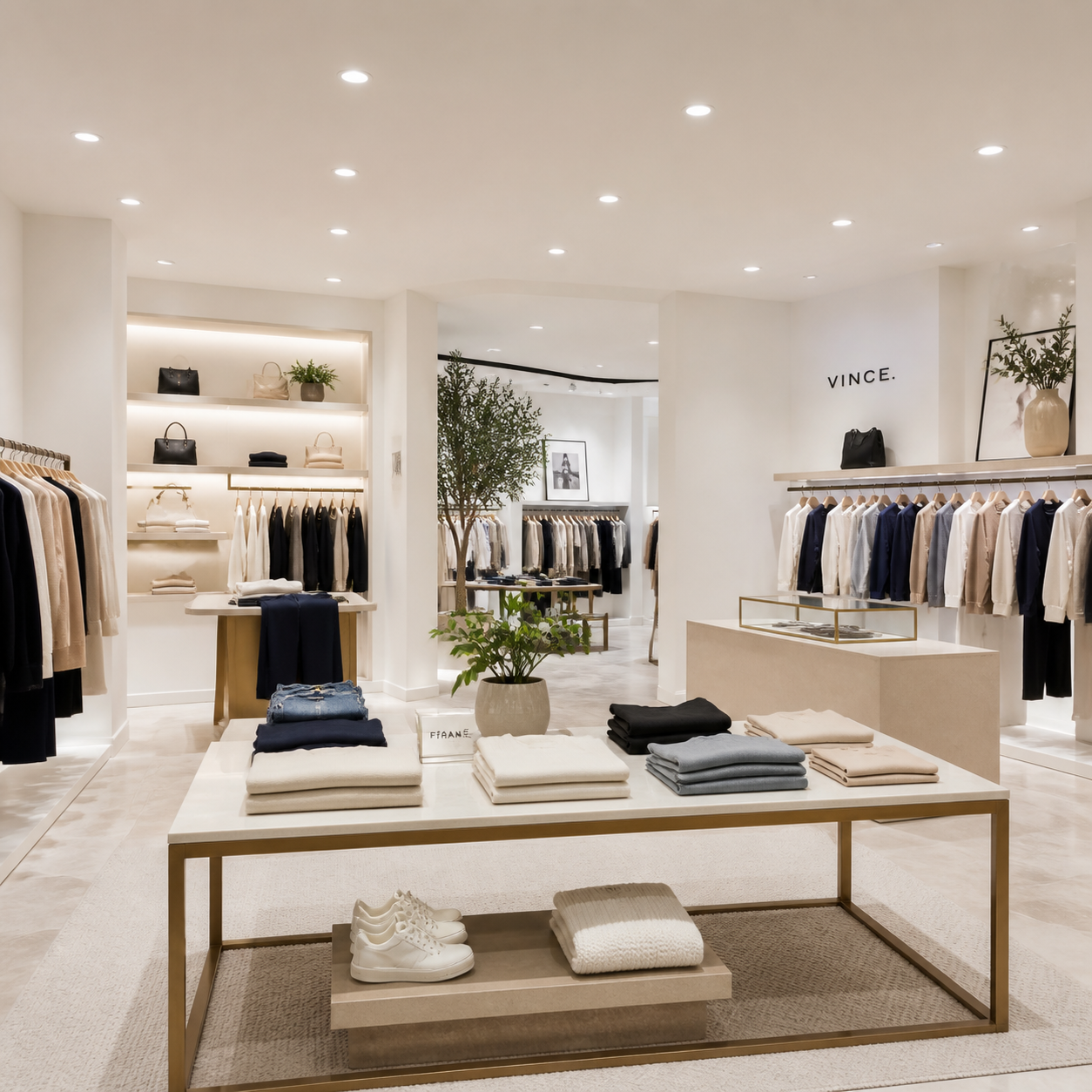
Track lighting and recessed downlights are roughly comparable in material cost per fixture at the consumer level, but diverge significantly in total installed cost:
Track lighting (per linear foot of track + heads):
Recessed downlights (per fixture, including housing):
For commercial-scale projects, the cost gap widens further because recessed installations require more electrical rough-in. Track lighting’s surface-mount advantage is most pronounced in retrofit and renovation scenarios.
Absolutely. The best-lit spaces often combine both systems deliberately:
This layered approach uses recessed lighting as the foundation and track lighting as the precision tool. The key discipline is visual restraint: if you specify too many track fixtures across the same ceiling plane as recessed lights, the result becomes visually chaotic. Use track for zones of focus; use recessed for the ambient field.
For color temperature strategy in layered lighting setups, see our Track Lighting Color Temperature Guide.
Yes. Track lighting surface-mounts directly to the ceiling, so it does not require the ceiling cavity that recessed lights need. You can install track lighting in any room with an existing junction box — you do not need to remove or patch the recessed light holes (though covering them is cleaner). If the existing recessed fixtures are on separate circuits, the track can be wired to its own switch independently.
For ceilings 10 feet (3m) or higher, track lighting with narrow-beam heads (15°–24°) delivers powerful accent lighting that reaches the surface effectively. For ceilings under 9 feet, recessed downlights with wide-beam trims (60°+) avoid the cave effect and maintain visual comfort. Low-voltage track systems with miniaturized heads are also excellent for low-ceiling applications where a clean look is desired but recessed cutouts are impractical.
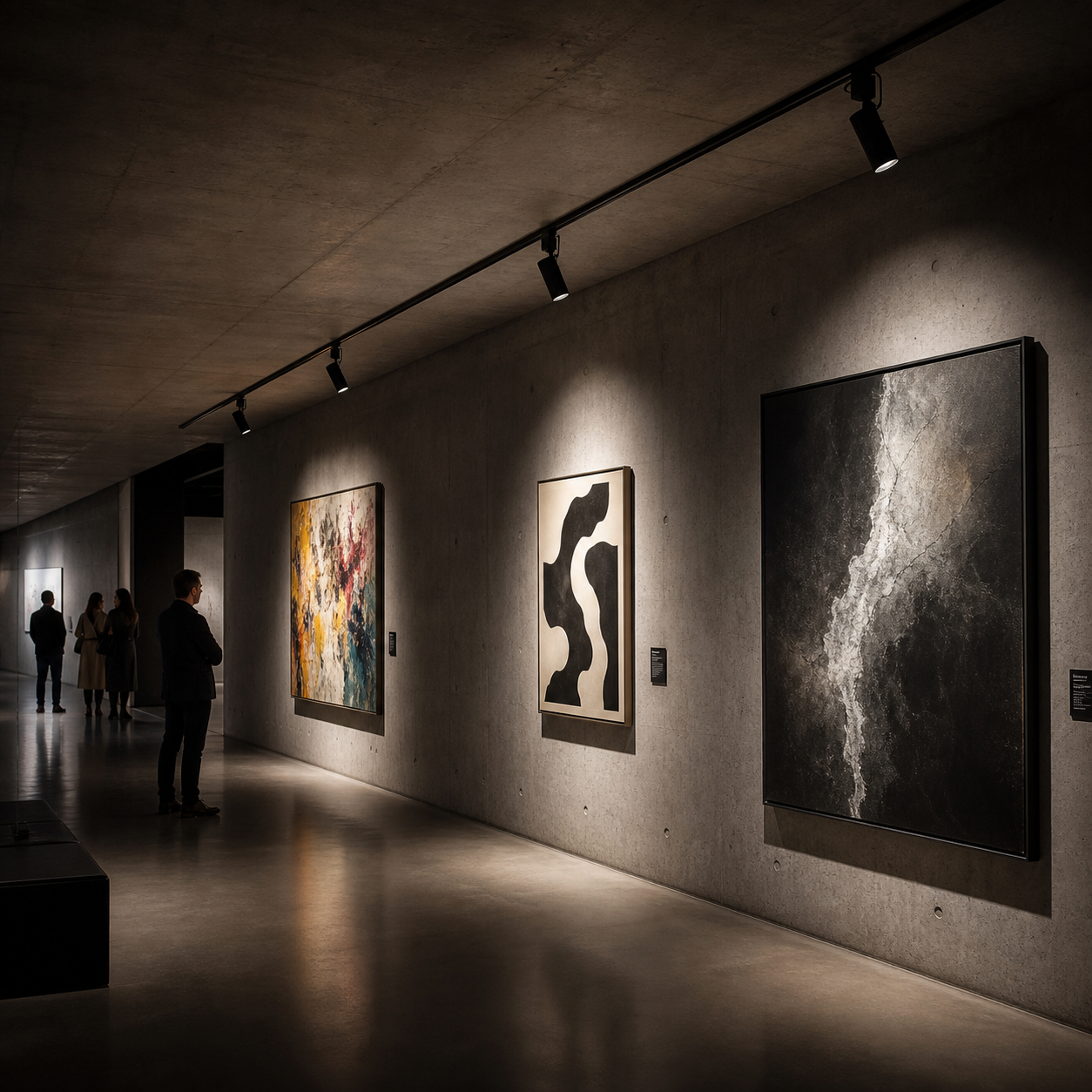
Track lighting is the standard choice for art illumination. A narrow-beam (15°–24°) adjustable track head with a high-CRI (CRI 90+) LED gives you the control to aim light exactly at the canvas, adjust as pieces are moved, and avoid glare reflections off glazed works. Recessed gimbal lights can work for art in new construction, but offer less precision and are harder to re-adjust as the collection changes.
Energy efficiency is determined by the LED source, not the form factor. A well-specified recessed LED downlight and a well-specified track head at the same wattage and efficacy (lumens per watt) will consume the same energy. The efficiency question is really about whether the fixture delivers light where you need it — and here, track lighting wins. A single 7W track spot delivering 500 useful lumens to a painting is more efficient than three 10W recessed can lights delivering diffuse ambient light across the same wall.
Kitchens benefit from a layered approach: recessed downlights for general ambient illumination across the ceiling plane, and track lighting over the kitchen island, range hood, or breakfast nook for task and accent lighting. Track lighting alone in a kitchen can look busy if many heads are used; recessed downlights alone lacks the task-lighting precision over work surfaces. The best result is typically a combination of both.
There is no universal winner between track lighting and recessed downlights — the right choice depends on where you are in the project lifecycle and what your space needs to achieve.
Choose track lighting if: you need flexibility, you are retrofitting an existing ceiling, you are lighting artwork or retail displays, or you want the lighting to be part of the architectural aesthetic.
Choose recessed downlights if: you are in new construction, you want a clean minimalist ceiling, the space needs uniform ambient illumination rather than accent control, or you have low ceilings where surface hardware would be intrusive.
Use both if you have the budget and the ceiling space: recessed for your ambient foundation, track for your accent precision.
ENCORE offers a full range of commercial track lighting solutions for gallery, museum, retail, and hospitality applications — all available with CRI 90+ and CRI 95 options, in H-type, J-type, and L-type formats, and in magnetic track configurations for zero-recess installations.
Not sure which system is right for your project? Contact our lighting specification team for a project-specific recommendation.