Address
304 North Cardinal
St. Dorchester Center, MA 02124
Work Hours
Monday to Friday: 7AM - 7PM
Weekend: 10AM - 5PM
Address
304 North Cardinal
St. Dorchester Center, MA 02124
Work Hours
Monday to Friday: 7AM - 7PM
Weekend: 10AM - 5PM
European gallery lighting case study in numbers: rail setback, tilt and beam angle set the pool on each painting, taking 12 heads down to 2 and UGR 42 to 19.
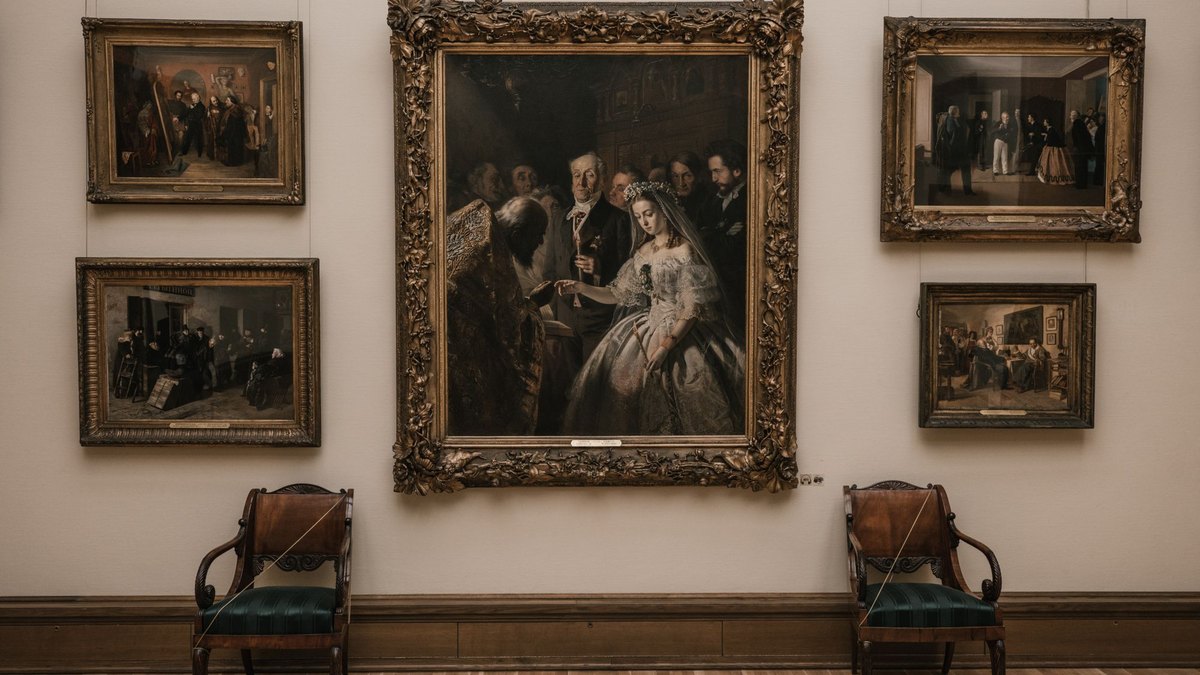
A gallery lighting scheme is judged on one thing: whether each work gets the light it needs and nothing else. This European gallery lighting case study works through a three-room commercial gallery in Rotterdam — 3.60 m ceiling, twelve paintings, three different sizes of work — and follows the problem from the day-one installation to the final aiming sheet. The short version: the room did not fail because the fixtures were cheap. It failed because the beam geometry was never calculated.
Every number below comes from the same arithmetic a specifier would use, and every figure on the drawings is computed, not typed. If you are specifying a gallery, a museum room or a dealer’s viewing wall, you can substitute your own dimensions and run the same steps.
The gallery occupies three connected rooms on the first floor of a 1930s building. The walls are a mid-dark blue (reflectance around 0.12), the floor is oak parquet, and the ceiling of the main room is crossed by a structural grid that allows track to be fixed, but only along its beams. Daylight arrives through a roof light over the stair, so the main room has no fenestration at all.
The collection that had to be lit:
The brief from the gallery was three sentences long: the paintings should be bright enough to read, the wall between them should stay dark so the room feels quiet, and the conservation budget is 150 lux on the panels for 3,000 hours a year. Those three wishes pull against each other, and the arithmetic below is how the tension gets resolved.
The installation the gallery inherited was not amateur. It was a 4.20 m track in the same place as the old picture rail, twelve adjustable heads, each with a bare lens, run at full output. The keepers had aimed every head at a painting and stopped there. Three separate failures followed from that one habit, and none of them is visible on the day of installation.
A 24° head at 2.00 m from the picture plane throws a pool 0.85 m wide. A 0.60 m panel therefore sits inside a spill halo that is twice the width of the painting. Instead of a picture and a dark wall, you get a bright lens, a bright cone of air, a bright pool on the wall and a picture somewhere in the middle of it — the opposite of the “quiet room” the gallery asked for. This is the single most common gallery lighting mistake, and it is a projection problem, not a lamp problem.
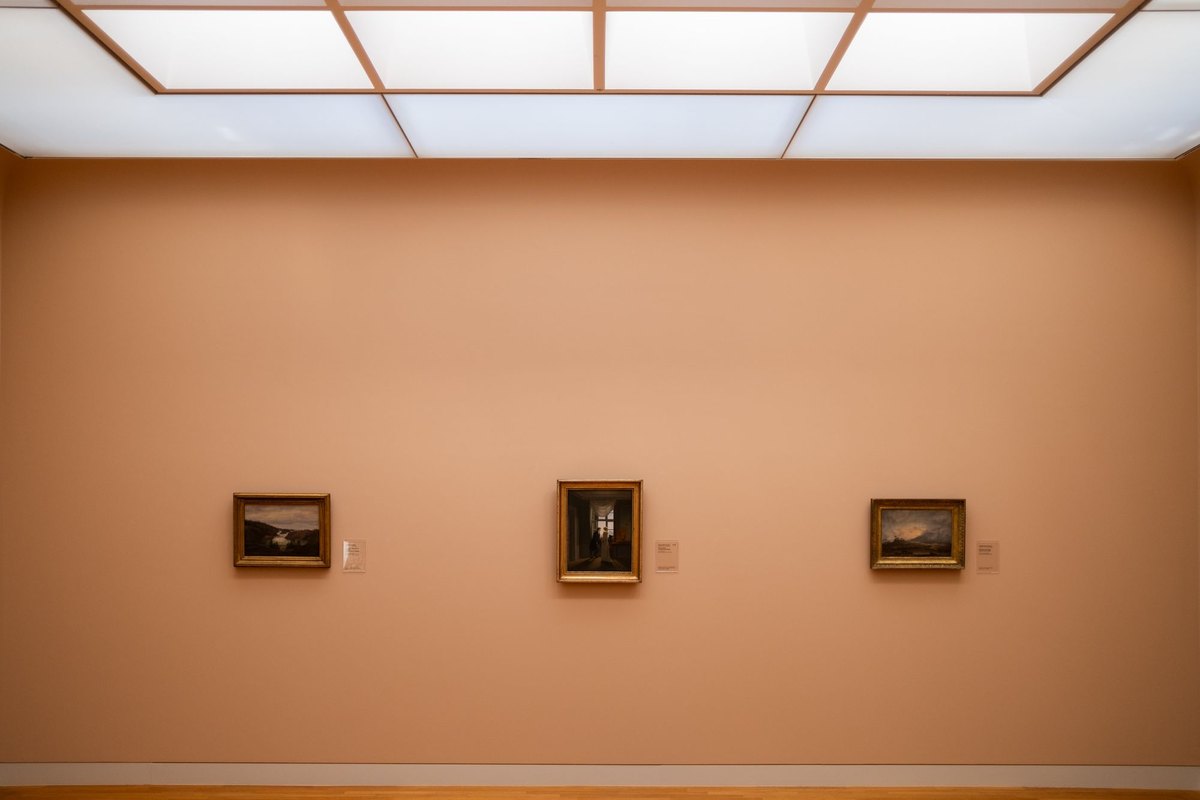
A bare lens running at 2,400 cd on a 0.075 m² aperture has an aperture luminance of 32,000 cd/m². Against a wall reading 15 cd/m², a visitor standing 2.60 m from the head sees a contrast of more than 2,000:1. Put that into the CIE 117 glare equation with a background luminance of 15 cd/m² and the room measures UGR 42. Visitors describe it as “the lights are in your eyes”, and they move through the rooms faster than the curator wants. The UGR explained guide walks the same calculation term by term.
Twelve 4,000 K heads at CRI 82 put a cold cast across warm varnish and left the reds in the nineteenth-century canvases flat. A gallery does not need daylight in the room; it needs the painting to look like itself. CRI and TM-30 explains why CRI 97 is the starting point for fine art rather than an upgrade.
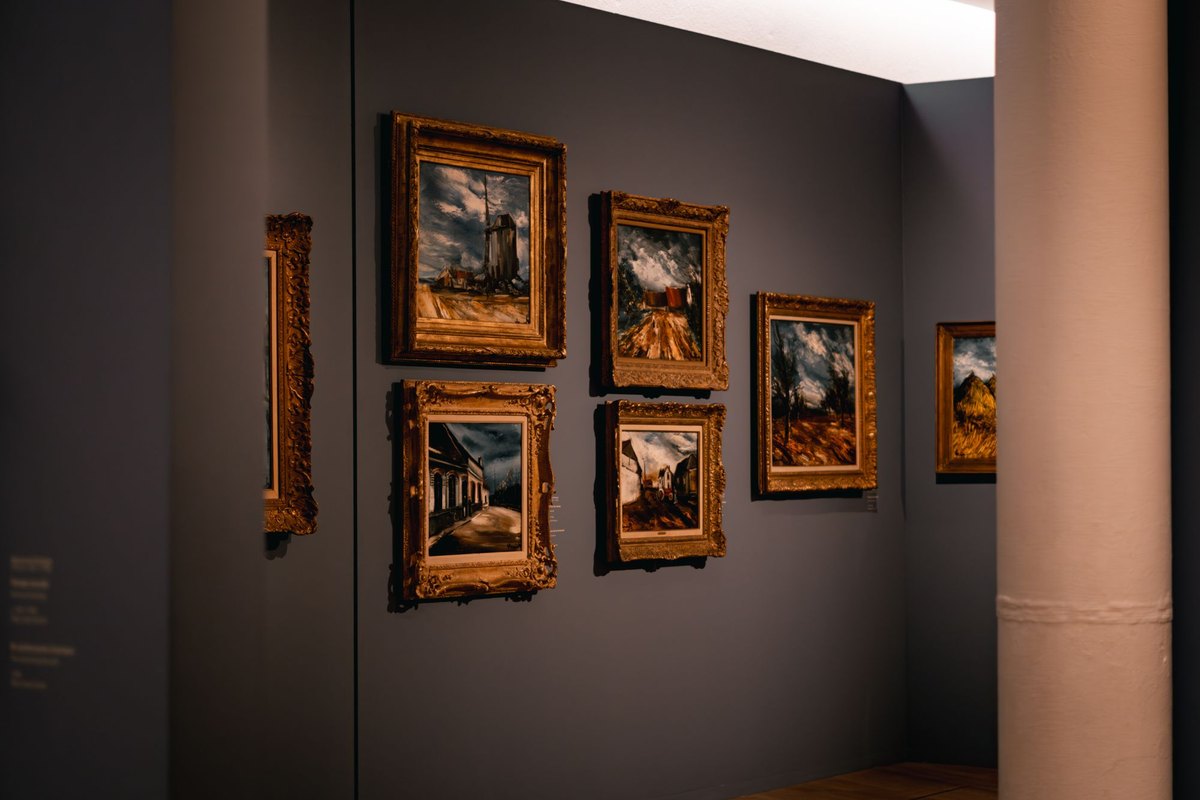
Beam control is the whole discipline in five lines of geometry. Every practical decision in a picture gallery — which head, how far back on the ceiling, at what angle, how many — falls out of these.
Pool width on the picture plane: W = 2 · D · tan(θ/2) ÷ cos(α), where D is the distance from the lens to the picture plane along the beam axis, θ is the beam angle and α is the tilt off the wall normal. The cos α term is the one people forget: on a tilted head the pool grows on the wall even though nothing about the fixture changed.
Intensity for a target illuminance: I = E · D² in candela, from the inverse-square law. A flat 150 lux at 2.44 m needs 894 cd — and that is whether the fixture can produce it, not whether it should run there.
Vergence: V = 1/D in inverse metres. This is the term that makes a rail on a high ceiling useless: at 4.20 m the beam arrives with low vergence, so it is still broad and still diverging when it reaches the wall.
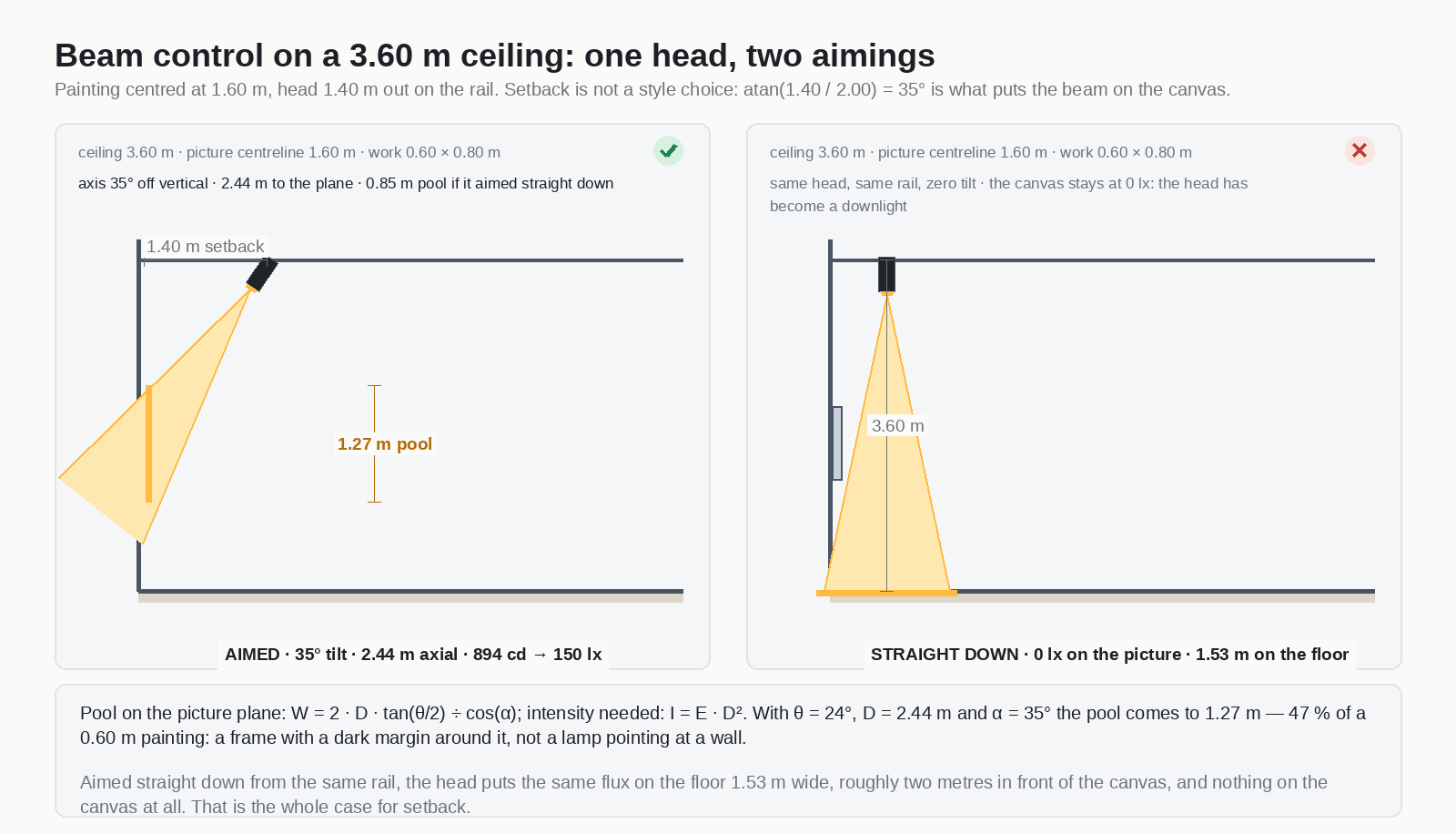
Read the two panels together and the reason for the setback is obvious. A 24° head directly over the wall does not light the painting at all; it puts a 0.85 m pool on the floor 2 m in front of it. To get the beam onto the canvas the head has to move out on the ceiling until the axis crosses the picture plane at an angle — here 1.40 m out, giving a 35° tilt and a 2.44 m axial distance. That setback is a number, not a preference: atan(1.40 / 2.00) = 35°. Change the ceiling height and it changes.
At that distance a 24° head throws 1.27 m of pool on the plane, and a 0.60 m panel fills 47 % of it. That is the working range for a small work with a visible dark margin. For a 1.20 m canvas a 40° head at 2.60 m setback gives 2.92 m of pool, which floods the frame completely — the correct answer for a large work, and exactly why one head cannot do both jobs.
| Head and aiming | Distance to plane | Pool on the picture | Coverage of the work | Verdict |
|---|---|---|---|---|
| 24°, 1.40 m setback, 35° tilt | 2.44 m | 1.27 m | 47 % of a 0.60 m panel | Small works — dark margin retained |
| 24°, vertical, 0 m setback | 2.00 m | 0.85 m on the floor | 0 % of the panel | Wrong: a downlight, not a picture light |
| 40°, 2.60 m setback, 52° tilt | 3.28 m | 2.92 m | Floods a 1.20 m canvas | Large works only |
| 40° used on a 0.60 m panel | 3.28 m | 2.92 m | 20 % of the pool is the painting | Wrong tool: 79 % of the light hits wall |
The fourth row is the compromise nobody makes on purpose and everybody makes in practice: take the wide heads you already own and point them at the small works. Two thirds of the light lands on wall, and the room stops looking like a gallery.
The rail is fixed to the structural grid 1.40 m out from the picture wall for the small works, and a second run sits 2.60 m out for the large ones. That is a compromise with the building, not with the optics: the grid gave two usable lines and both happen to fall inside the useful setback range. On a project with a free ceiling the setback would be set by the geometry first and the structure second.
The load figure changed shape as well: the 24° heads sit on a DALI dimming group per room, so the 150 lux target is a commissioning value a technician can hold, not a number in a folder.
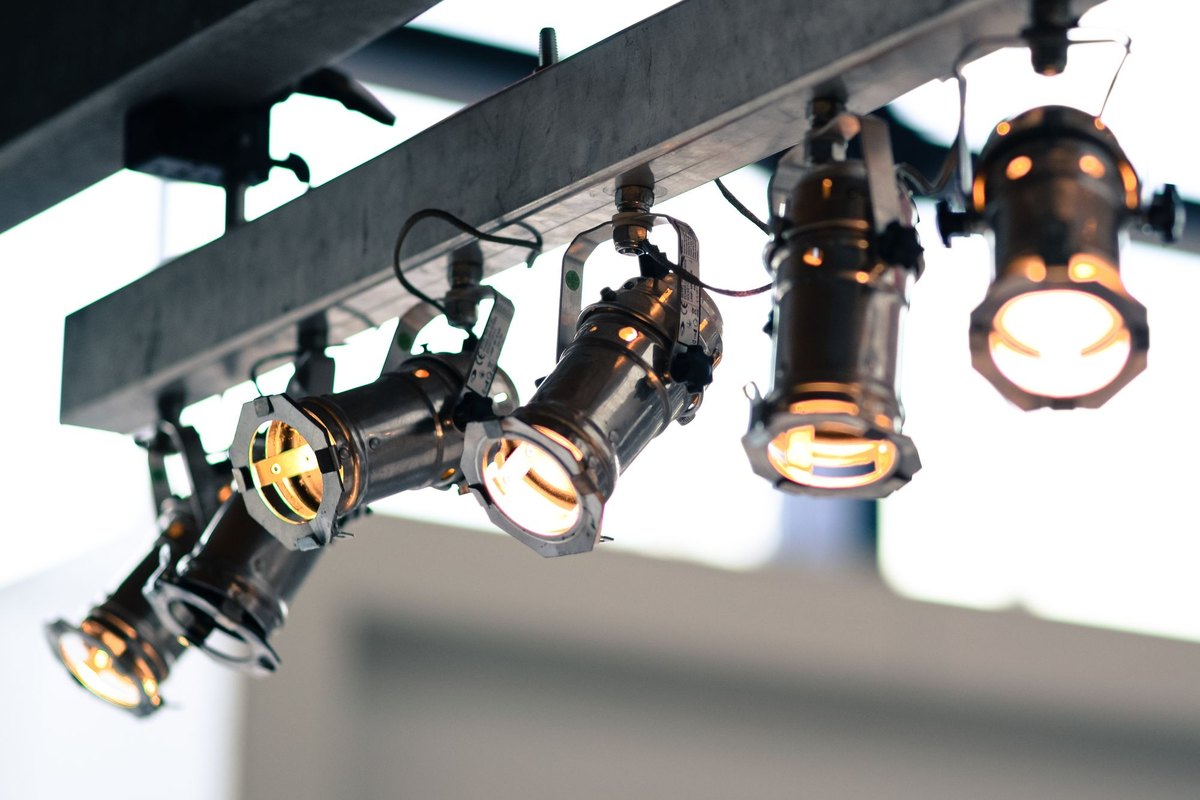
Two things about the mounting are worth copying. First, the heads sit on a rail parallel to the wall, so re-aiming is a rotation about one axis and the setback stays fixed. Second, each head is locked off with a marked position, and the aiming sheet records the angle. When a work is swapped, a technician sets the head back to its mark rather than starting from scratch.
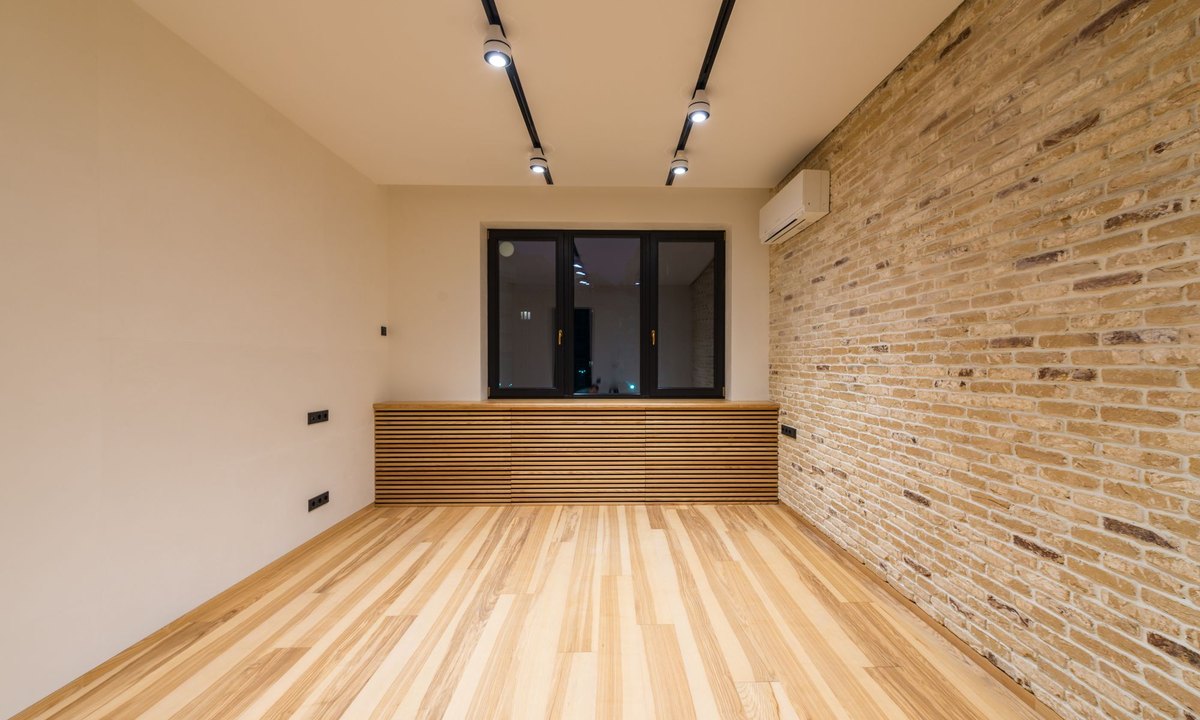
The final scheme runs two heads for the twelve works in the main room, not twelve. Not because the other ten were unnecessary, but because the original installation used one head per painting as a substitute for geometry: a head per frame hides the fact that each head is throwing a pool three times too wide.
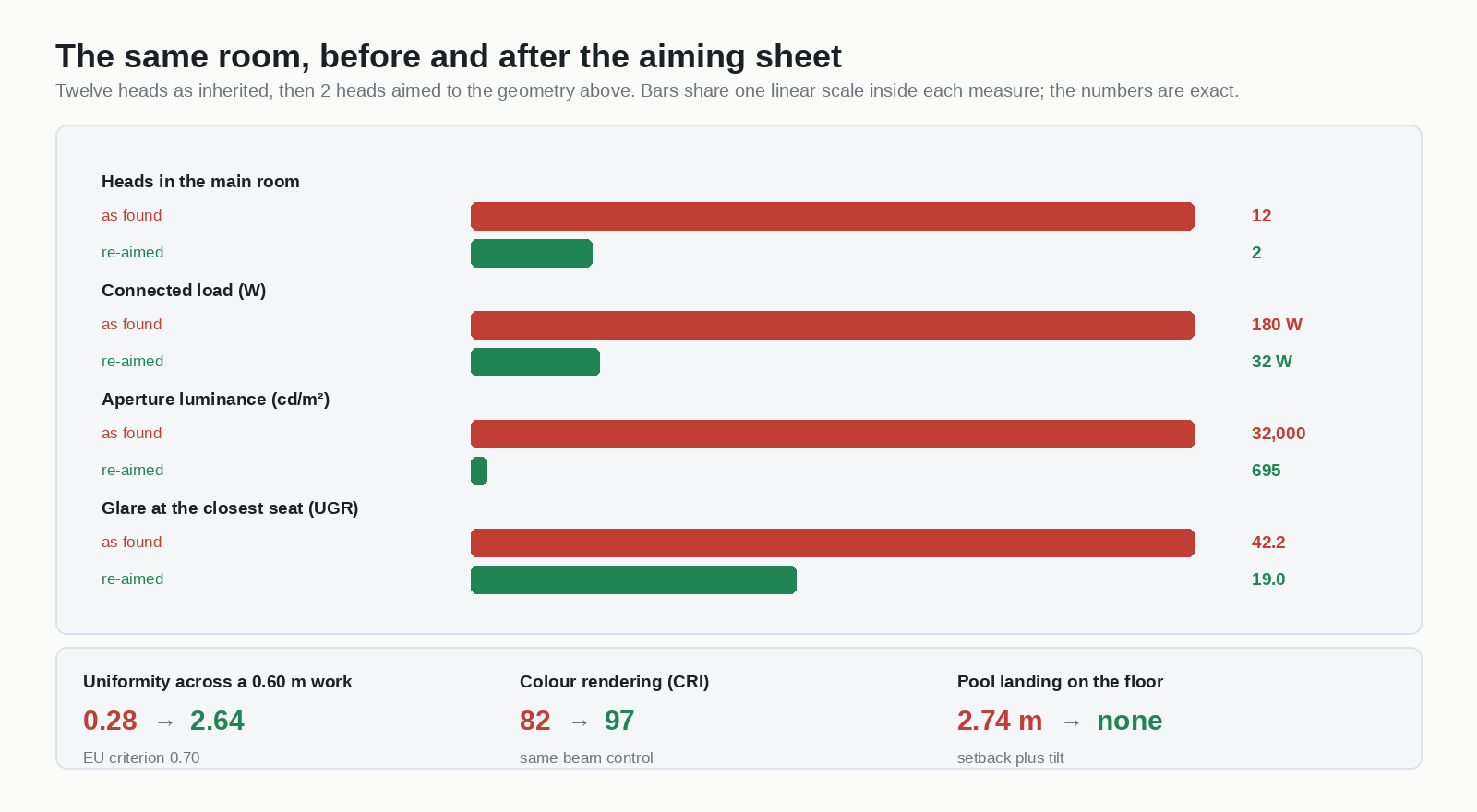
| Measure | As found | After re-aiming | What moved it |
|---|---|---|---|
| Heads in the main room | 12 | 2 | Pool width per work, not head count per frame |
| Connected load | 180 W | 32 W | Smaller heads, aimed instead of flooded |
| Illuminance at the canvas | 174 lx (uneven) | 150 lx (held) | On-axis intensity matched to the target |
| Uniformity across a 0.60 m work | 0.28 | 2.64 | One pool sized to the frame, not a wide one over it |
| Pool landing off the picture | 2.74 m on the floor | No floor pool in the sight line | Setback plus tilt |
| Glare at the closest seat | UGR 42 | UGR 19 | Aperture luminance, 32,000 to 695 cd/m² |
| Colour rendering | CRI 82 | CRI 97 | Different LED, same beam control |
| Energy over a 10-hour day, 52 weeks | 94 kWh | 17 kWh | Same as the load figure, spread over the year |
The energy result tends to surprise people: 80 % less connected load, and the paintings are brighter where it matters. Not because the lamps are more efficient, but because nine out of ten of the old heads were spending their light on the wall around the frames and on the floor in front of them. Aim first, then choose output.
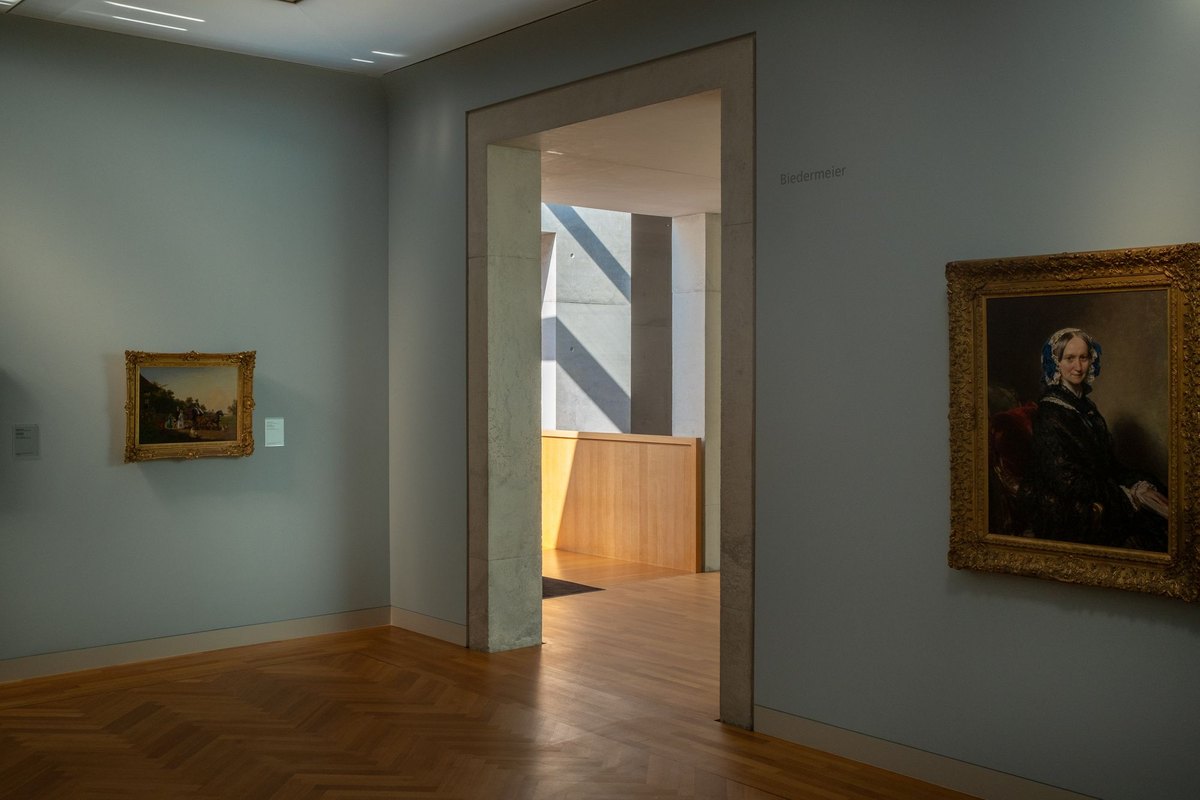
Glare is where a gallery scheme is usually lost, because the fix is not “less light”. Re-aiming dropped the glare for two reasons, and only one of them was aiming. Aiming put the bright cone across the wall instead of down the room, and dimming dropped the aperture luminance from 32,000 to 695 cd/m². Either alone would have helped; together they took the closest seat from UGR 42 to UGR 19, and the doorway sight line to 13.3.
The lever that is still unused is the one the gallery asked for without knowing it: wash the wall. The same head, from the same seat, measures UGR 15.6 once the surrounding wall reads 40 cd/m² instead of 15, because background luminance sits in the denominator of the glare equation. Washing the wall between the pictures is not decoration — it is glare control.
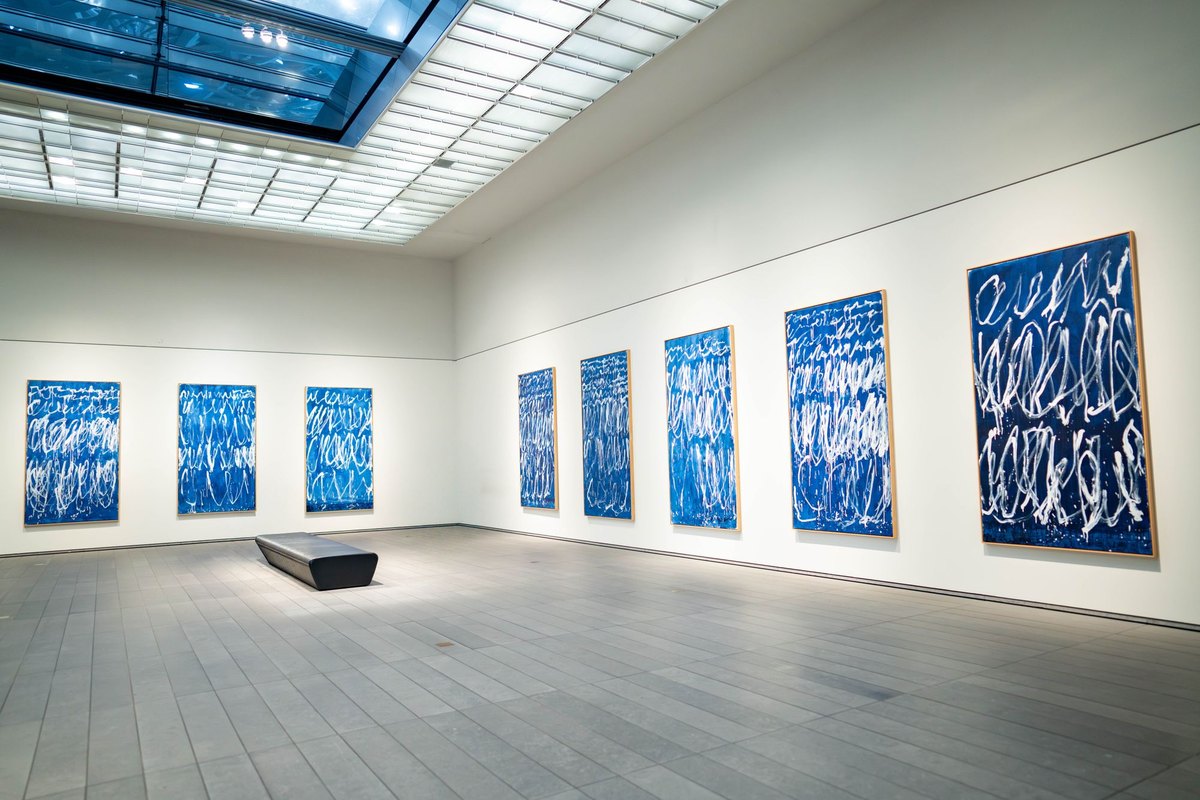
Not one of the decisions above was made on a product page. They were made on a photometric file, then matched to hardware, against the glare limit in EN 12464-1 for spaces where people look at things for a living (the Illuminating Engineering Society publishes the equivalent guidance for North American projects). What to ask any supplier for a picture gallery:
The fixtures used on the project were the range’s aimable 24° and 40° heads. If you are putting a similar scheme together, start from the aimable track head for the accent work and the track light range for the rail itself; exchangeable lenses and a deep cell matter more here than extra lumens.
The gallery’s 150 lux on oil panels for 3,000 hours a year is a reasonable envelope, but the number moves with medium:
Ultraviolet is a separate line item: keep it under 75 µW/lm, a limit set in the same EN 16168 framework for museum lighting, and one that rules out unfiltered daylight through a roof light long before it rules out a decent LED. The museum lighting design guide works through lux-hours and UV load together, and the Sanxingdui case study shows the same geometry at bronze-sculpture scale.
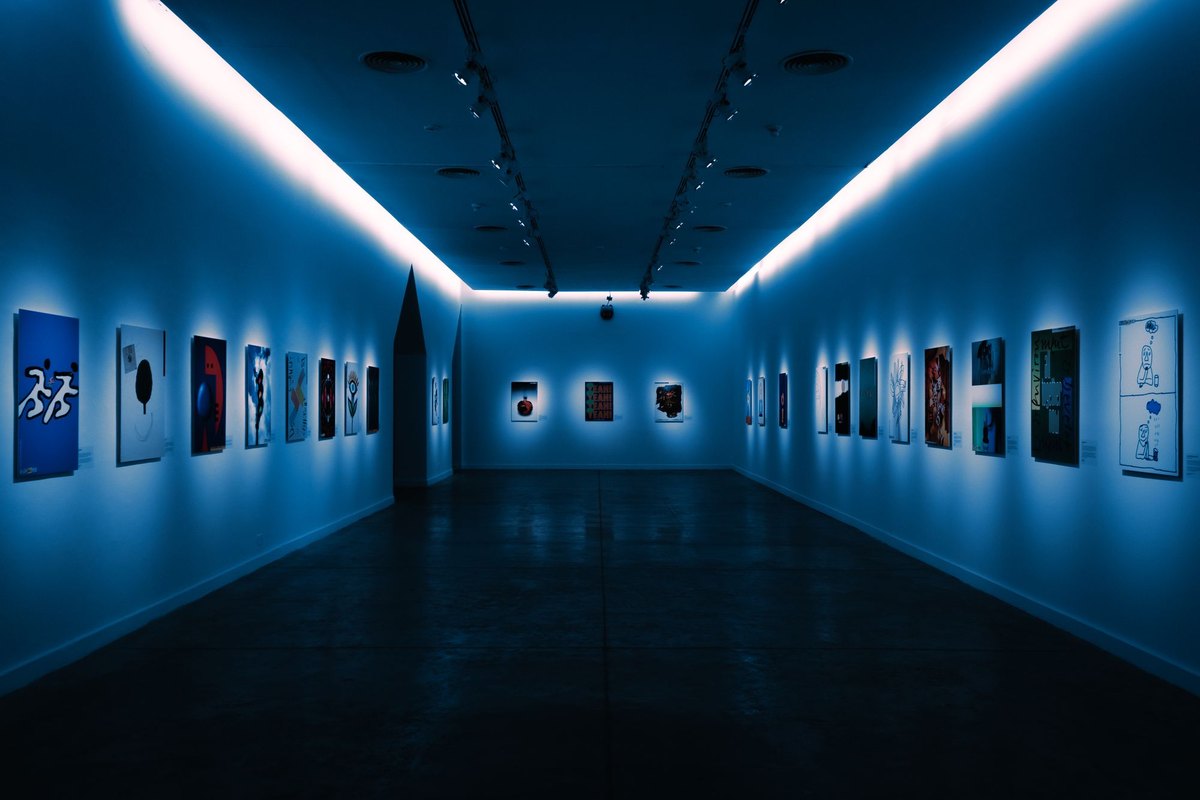
Count pools, not paintings. A head throws a pool whose width is 2 · D · tan(θ/2); if that pool is wider than the work, you need fewer heads than frames, and if it is narrower you need two or three per frame with a 25 % overlap. On this project one head covered each small work at 47 % fill, and one wide head covered each large canvas.
Far enough that the beam axis crosses the picture plane at the angle the pool width requires — on a 3.60 m ceiling with a 1.60 m picture centreline, 1.20 to 1.60 m gives a workable 31–39° tilt. Closer than about 1 m and a narrow head simply becomes a downlight: the beam lands on the floor in front of the work.
Narrow enough that the pool stays close to the frame size at your distance. At 2.44 m axial distance, 24° gives 1.27 m and suits a 0.60–0.90 m work; 40° gives 2.92 m and suits a 1.20 m canvas. See the beam angle guide for the full angle-versus-distance table.
3000 K for traditional oil and gilt; 3500 K where the collection is mixed and some daylight is present; 4000 K only where the work itself is cool or the room has to read as neutral. Anything above that starts to read as a shop rather than a gallery.
Only if they can be aimed and set back from the wall. A fixed downlight 0.30 m from the wall lights the floor and the top of the frame, and its pool has no relationship to the size of the work. That is not a beam control problem a lamp change can solve.
A European gallery lighting case study is easy to write and hard to copy, because the result never comes from the fixtures alone. Twelve heads ran at 32,000 cd/m² of aperture luminance and UGR 42; two heads run at 695 cd/m² and UGR 19, on a fifth of the power, with the paintings held at exactly the 150 lux the conservator asked for. The difference was a setback, a tilt and a pool width — three numbers that can be computed before a single fixture is ordered.
If you are specifying a gallery, a museum room or a private collection and want the aiming sheet checked before the ceiling goes in, browse the track light range, or send us the plan and the ceiling height and we will work the geometry with you.