Address
304 North Cardinal
St. Dorchester Center, MA 02124
Work Hours
Monday to Friday: 7AM - 7PM
Weekend: 10AM - 5PM
Address
304 North Cardinal
St. Dorchester Center, MA 02124
Work Hours
Monday to Friday: 7AM - 7PM
Weekend: 10AM - 5PM
TRIAC vs DALI dimming for track lighting, decided with numbers: conductor count, a 10 % against 0.1 % dimming floor, and which protocol fits which project.
TRIAC vs DALI is not a fair fight. Here is the arithmetic that tells you which one your project actually needs.
TRIAC vs DALI is not a fair fight, and that is exactly why it keeps coming up in spec meetings. Triac is a mains dimmer that costs almost nothing and needs no wires you do not already have. DALI is an addressable bus where every individual track head is a device with its own address, its own scenes and the ability to report back when it fails.
They solve different problems. Pick TRIAC because the wall switch already exists and one dimmer is the whole control strategy. Pick DALI because the merchandising plan changes, the artwork moves, or the client wants to know from a desk which head has gone out — before a customer notices.
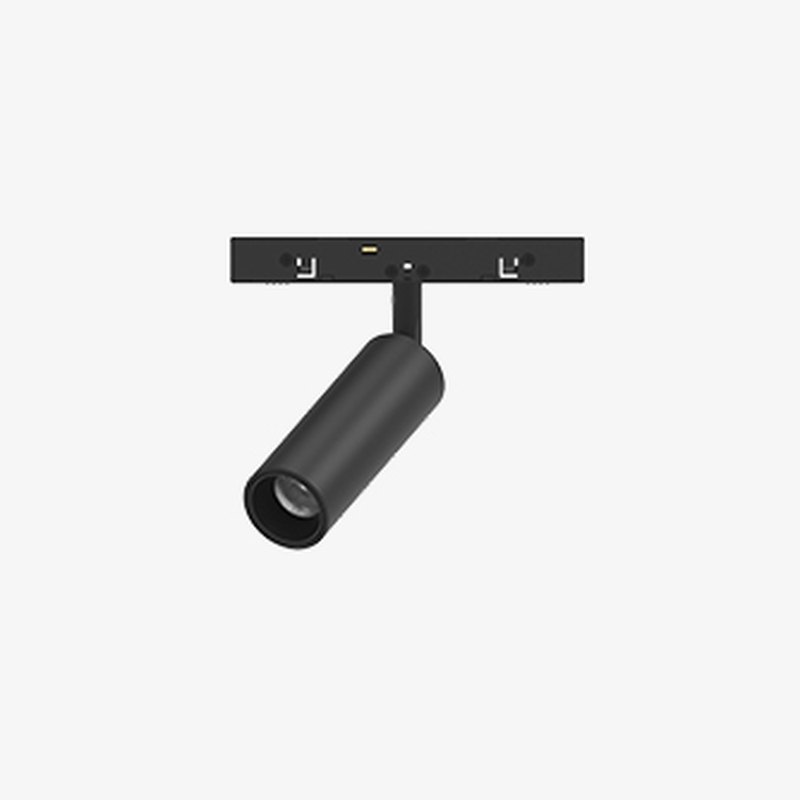
This guide draws the line between the two: what each protocol physically needs, where each one stops dimming, and which of the two earns its money by project type. Every number below is worked out from a real 300 W track circuit and the Encore AIMER 25–35 W track light, which supports Triac, 1–10V and DALI in the same body.
Strip the marketing away and the DALI vs TRIAC difference is one sentence long. Triac dimmers work on the power going to the lamp. DALI works on information going to the driver. Everything else — the cost, the wiring, the dimming floor, the commissioning time — follows from that one split.
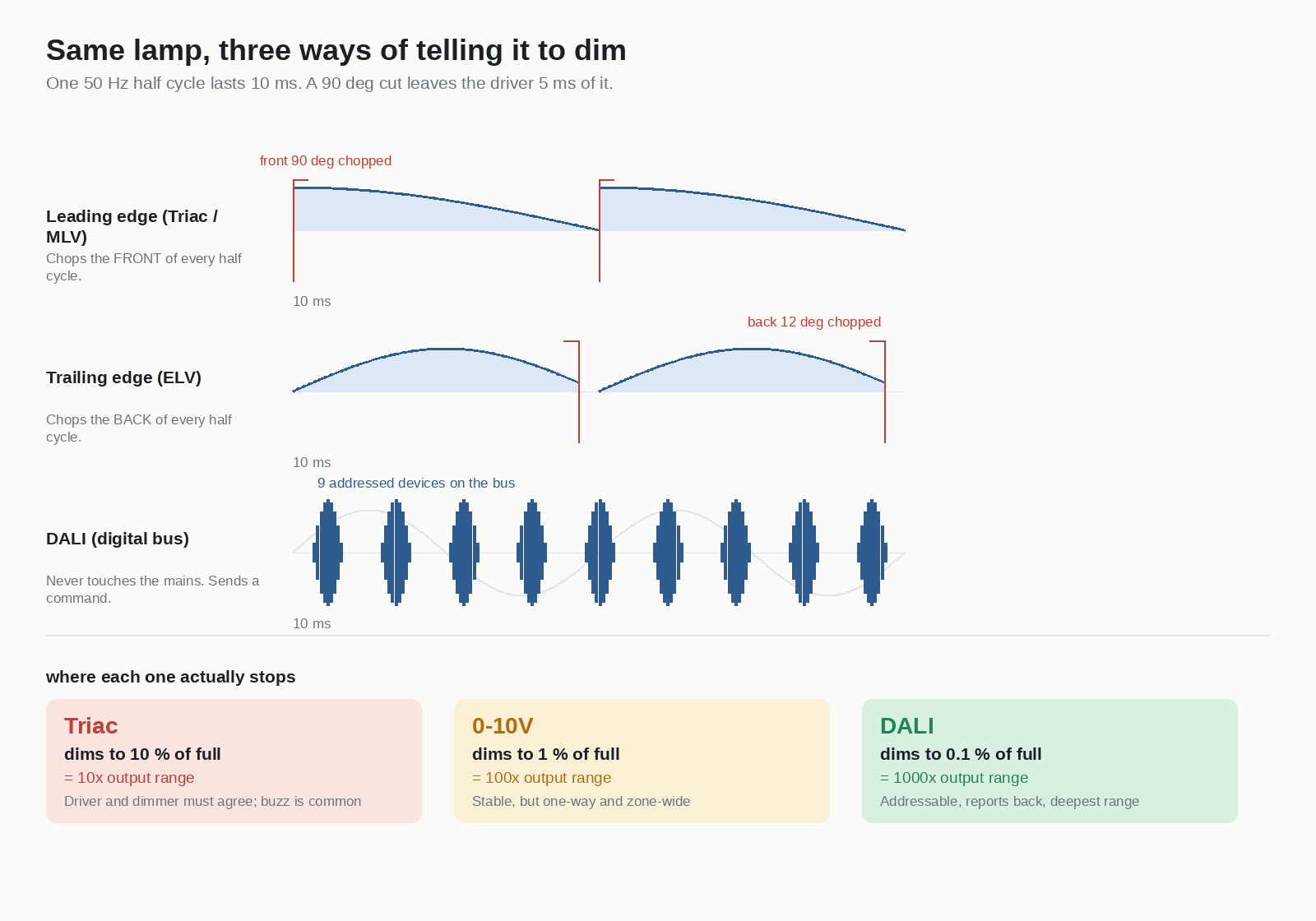
A Triac dimmer sits in the wall box where the light switch used to be. Inside, a semiconductor switch holds back the mains voltage for part of every half cycle, then lets it through for the remainder. The LED driver sees a waveform with a bite taken out of it and interprets the size of that bite as a brightness instruction.
On a 50 Hz supply a half cycle is 10 ms. A 90-degree cut leaves the driver 5 ms of each half cycle to work with. That is the whole protocol. There is no data, no addressing and no way for the driver to answer back.
It also means the dimmer and the driver have to agree on what that bite looks like. This is why Triac has a reputation for buzzing and flickering: it is not the protocol failing, it is a specific dimmer meeting a specific driver and disagreeing about the shape of the waveform.
DALI never touches the mains waveform. Each driver has a small microcontroller and a short address, and it listens on a two-wire bus for commands like go to 40 percent or recall scene 3. The bus is polarity-free, so a reversed pair still works, and it carries replies as well as commands.
That two-way channel is the part clients actually feel. A DALI system can be interrogated: which heads are running, what level, and which lamp has failed. The bus also carries the power for the controller electronics, so the number of devices it can feed is a real design constraint rather than a footnote.
The dimming floor is the number that decides whether a space can do a low-level scene at all. It is also where the two protocols diverge most sharply, and where a specification written as “dimmable” quietly fails.
| Property | TRIAC (phase-cut) | DALI / DALI-2 |
|---|---|---|
| Dimming floor | 10 % (typical), 1 % on premium drivers | 0.1 % (1 % on some gear) |
| Output range | 10x | 1000x |
| Control signal | Modulated mains waveform | Digital command over a 2-wire bus |
| Direction | One-way | Two-way, with status replies |
| Addressing | None — the whole circuit follows the dimmer | 64 addresses per bus supply |
| Extra conductors | None | 2 (bus), plus mains |
| Commissioning | Swap the wall switch | Address, group, program scenes |
Read the first two rows together. A 10 percent floor sounds acceptable until you try to hold a restaurant at 3 percent while the room turns over between services. That is not a dimming curve problem, it is a protocol problem: below roughly 10 percent, many phase-cut drivers simply cannot regulate, so they flicker or drop out.
Where Triac genuinely earns its place is retrofit. Ten heads at 30 W is a 300 W circuit, and the Encore AIMER head clears a 10 W minimum-load dimmer on its own — there is no minimum-load trap on a run this size. The failure usually runs the other way: a dimmer name-plated for the old incandescent load meets a much smaller LED current and misbehaves.
Trailing-edge (often called ELV) dimming cuts the back of each half cycle instead of the front. It generates less audible noise and suits drivers with capacitive front ends, which is most modern low-voltage LED gear. It is still Triac-family phase-cut dimming — same two wires, same lack of addressing — but it is materially quieter, and it is what a competent spec means by “Triac dimmable” on a premium track light.
Eight specifications decide almost every track lighting dimming question in a tender. Laid out side by side, the pattern is obvious: DALI is better at seven of them, and loses the two that matter most to a value retrofit.
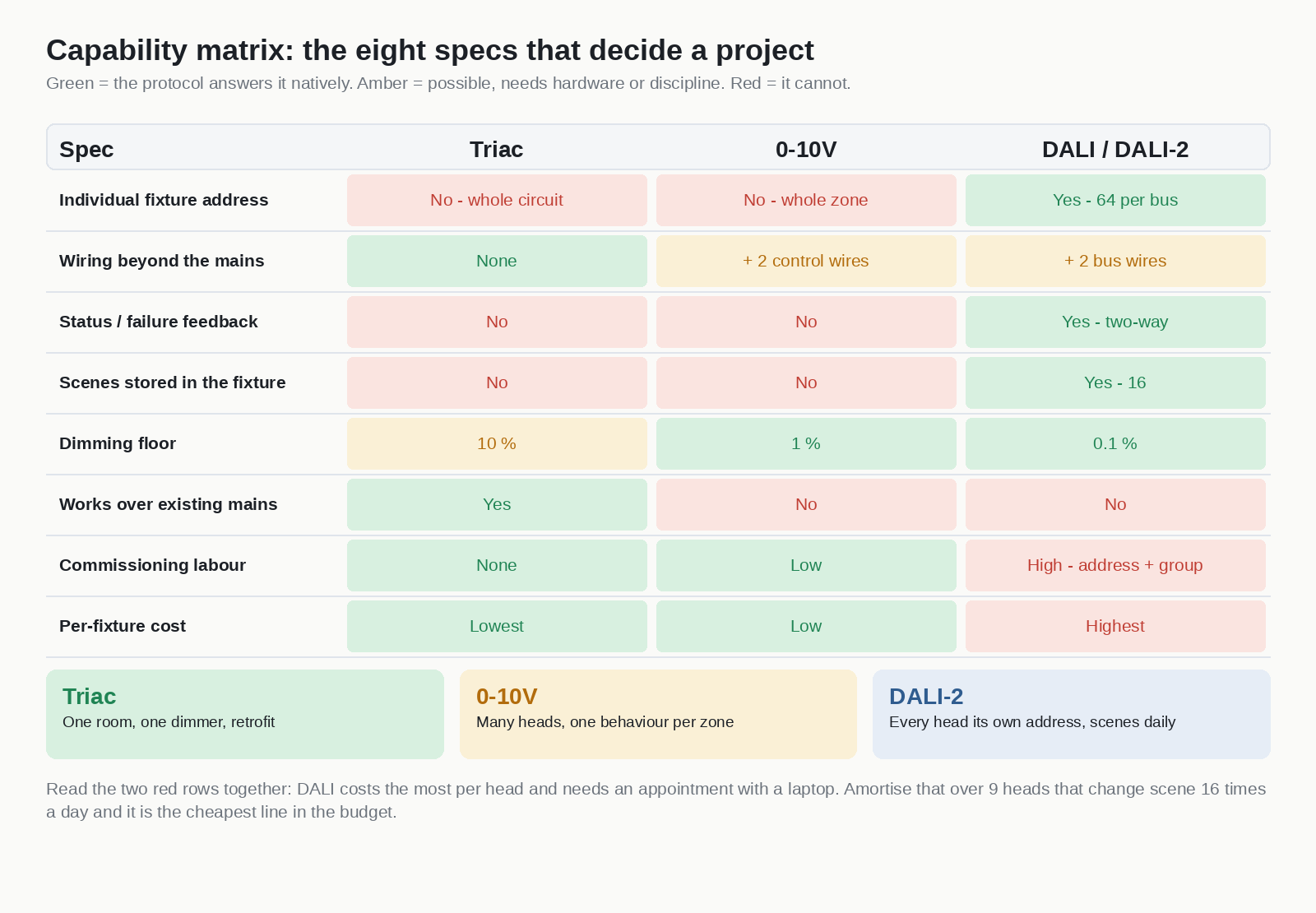
Look at the last three rows together, because they are where projects actually go wrong. DALI carries the highest per-fixture cost and the heaviest commissioning load. That is a real number, and on a run of nine heads it is not worth arguing about — it is amortised the first time the display layout changes and nobody has to touch the wiring.
The row worth arguing about is status feedback. Triac cannot tell you anything. If a head fails in a two-storey retail atrium, someone has to go and look. On a DALI bus the failure shows up as an unresponsive address, which is a fundamentally different operating cost from a ladder and a lift.
With DALI, once a driver is certified to the standard it will work with any other certified controller. Interoperability is the entire point of the standard, and it is why DALI-2 certification exists as a separate mark from DALI.
With Triac there is no equivalent guarantee. Every combination of dimmer and driver has to be verified, because the protocol is defined by a waveform shape rather than a data format. A driver that dims perfectly on one dimmer can buzz on another with the same rating printed on the tin. This is the single most common cause of a track lighting dimming complaint, and it is why a verified compatibility list is not optional paperwork.
Here is the same ten-head, 300 W circuit run three ways. What changes is not the lighting — the heads are identical — but who can change the light, and how often someone will actually want to.
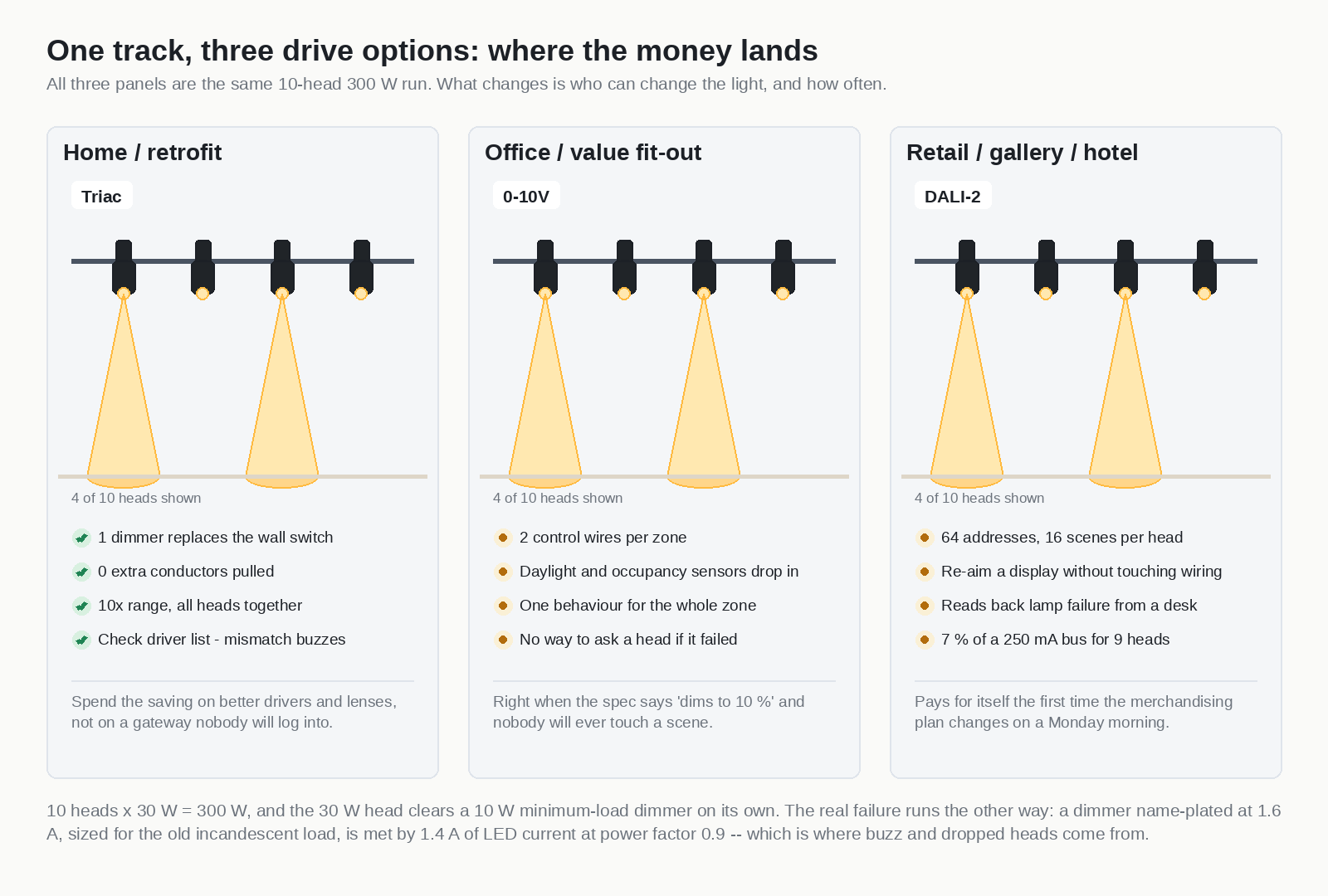
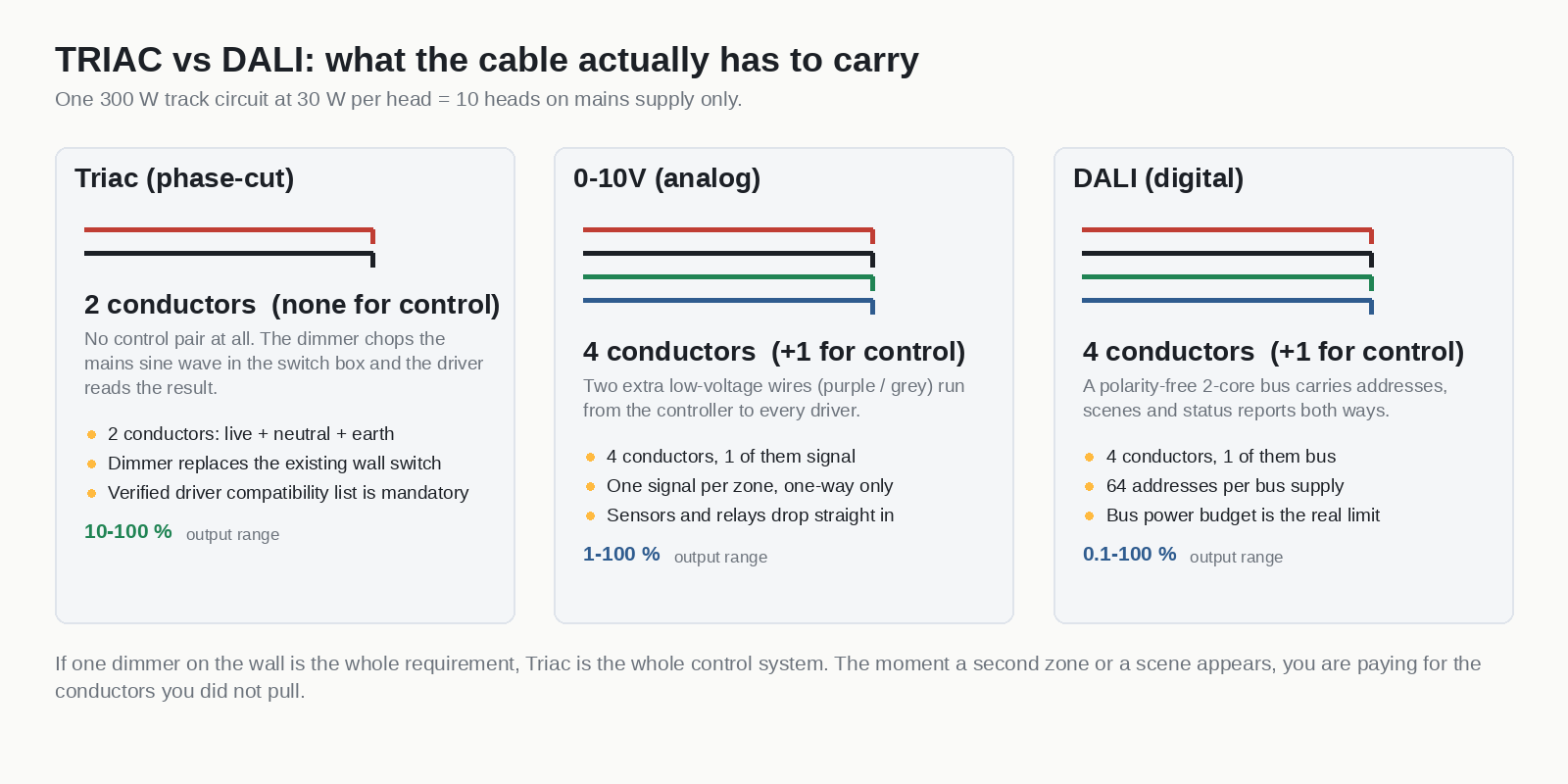
One dimmer replaces the wall switch. No extra conductors, no gateway, no commissioning. Ten heads at 30 W sit comfortably on a single 300 W circuit, and a 10x output range is more than enough for a living room or a dining space.
Spend the money you saved on better drivers and optics rather than on control hardware nobody will log into. Verify the driver compatibility list, and prefer trailing-edge dimming if the budget allows.
0-10V adds two low-voltage control wires per zone and gives you daylight and occupancy sensing with almost no commissioning. You lose individual addressing and status feedback, but for a floor plate where every fixture will do the same thing all day, that is not a loss anyone notices.
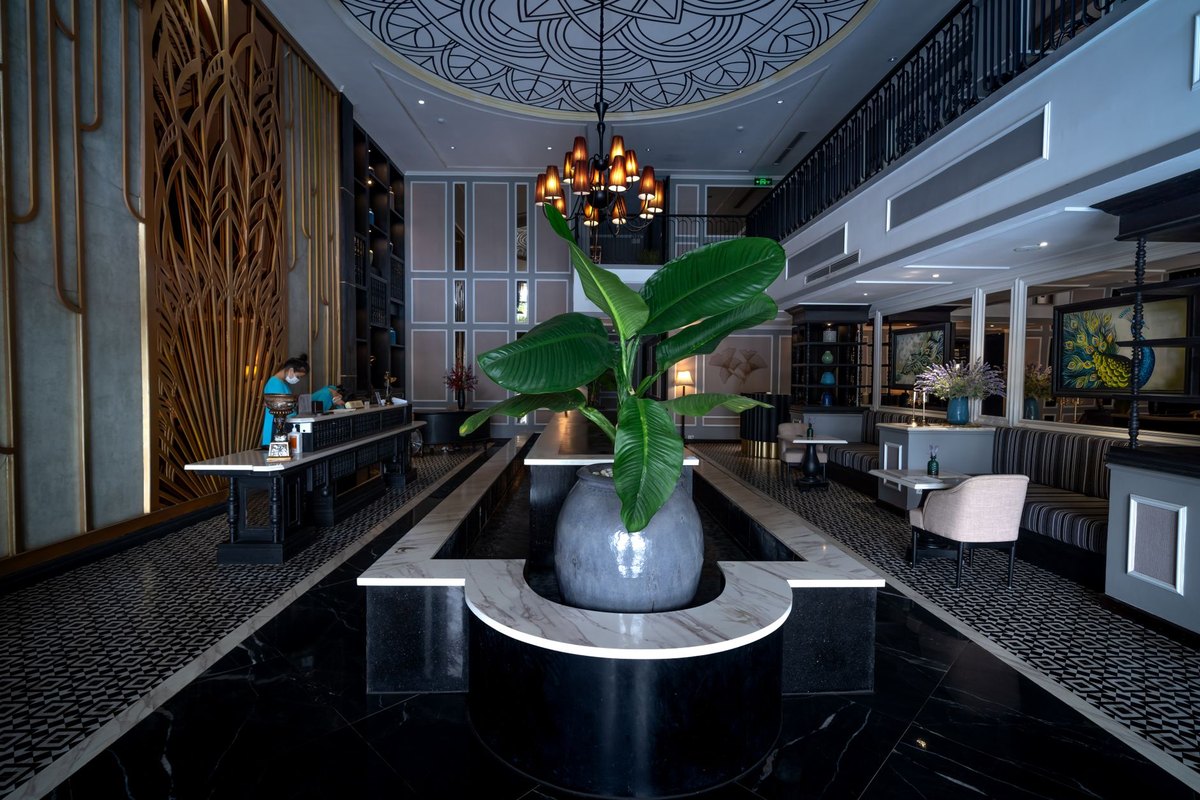
Individual addressing and stored scenes are worth paying for exactly where the lighting plan is a working document. A display that changes weekly, an exhibition that re-hangs quarterly, a lobby that shifts from daytime to evening — these are all cases where re-purposing the light without touching the wiring pays back the commissioning cost.
Nine heads occupy one bus and one address block, well inside the 64-address limit and nowhere near the bus current budget. That headroom is the point: a retail run can grow without re-engineering the control layer.


DALI is more capable on almost every axis: individual addressing, two-way status feedback, 16 scenes per device and a dimming floor of 0.1 percent versus roughly 10 percent. It is also more expensive per fixture and needs commissioning. DALI is better when the lighting plan changes or when knowing about failures matters. TRIAC is better when one dimmer is genuinely the whole requirement.
Yes, if the driver is built for it. The Encore AIMER 25–35 W track light accepts Triac, 1–10V and DALI in the same independent driver housing, which is what makes a protocol decision reversible at the specification stage. Some heads, such as the CADIO 20–30 W track light, support Triac and 1–10V but not DALI — so always confirm per product, not per family.
Nine times out of ten it is a dimmer-load mismatch rather than a faulty head. The dimmer and the driver disagree about the waveform, and the disagreement shows up as audible noise or unstable regulation. Check that the dimmer is rated for LED and for a low minimum load, that the total load is inside its range, and that the specific dimmer-driver combination is on the manufacturer’s verified list.
IEC 62386 allows 64 addresses on one bus with one bus power supply, and each address typically draws around 2 mA. That is 128 mA of a 250 mA budget for a fully populated bus, leaving headroom for controllers. The address limit usually arrives before the current limit, and in practice most projects split into several smaller buses for wiring convenience rather than capacity.
DALI-2 is the certification programme built on top of the original DALI standard. The important practical difference is that DALI-2 covers control devices — sensors, push-button couplers, application controllers — not just the drivers, and it enforces interoperability testing across those device types. Features like instance reporting for sensors and detailed diagnostics are part of the DALI-2 generation rather than the original.
No. If the requirement is a single dimmer controlling a run of heads with no scene changes and no failure reporting, TRIAC does the job with two conductors and no commissioning. DALI becomes worth its cost when the requirement includes re-purposing the light, zoning that changes, or knowing which head has failed.
TRIAC vs DALI for track lighting comes down to one question: will the lighting plan ever change, or will anyone need to know when a head fails?
If the answer is no, TRIAC is not a compromise — it is the correct engineering answer. Two conductors, a wall dimmer, no commissioning, and a 10x range that covers residential and small commercial spaces comfortably. Spend the difference on driver quality and optics, and verify the dimmer-driver pair before you buy.
If the answer is yes, the DALI bus pays for itself the first time a display is re-planned or a failed head is identified from a desk instead of a ladder. DALI earns its premium where lighting is a working tool rather than a fixed installation.
Whichever way a project goes, confirm the driver on the specific product rather than the product family. The Encore AIMER track light supports all three protocols in one body, so a change of mind at specification stage does not have to become a change order on site.
Browse the full track lights range or talk to our lighting team about the right dimming protocol for your project.