Address
304 North Cardinal
St. Dorchester Center, MA 02124
Work Hours
Monday to Friday: 7AM - 7PM
Weekend: 10AM - 5PM
Address
304 North Cardinal
St. Dorchester Center, MA 02124
Work Hours
Monday to Friday: 7AM - 7PM
Weekend: 10AM - 5PM
Have you ever walked into a room with beautiful recessed downlights, only to feel a sharp, uncomfortable glare whenever you looked up? That discomfort isn’t in your head — it’s measured. The Unified Glare Rating (UGR) is the international standard that quantifies exactly how much visual discomfort a luminaire causes. If you are speccing downlights, track lights, or commercial LED lighting, reading the UGR number on a datasheet is the difference between a space people can work in comfortably and one they quietly dread. This guide explains what UGR means, how it is calculated, what UGR values you should spec for every room, and how to choose low-glare fixtures that protect eyes while still lighting a space beautifully.

UGR stands for Unified Glare Rating, a single-number scale developed by the International Commission on Illumination (CIE) and published in CIE 117. It rates the discomfort glare produced by a lighting installation from the observer’s point of view. Discomfort glare is different from disability glare: disability glare physically reduces how well you see (like driving into low sun), while discomfort glare is the nagging brightness that makes you squint or look away, even when you can still see perfectly well.
The scale runs from roughly 10 to 30. The lower the number, the less glare and the more comfortable the space:
Every UGR value you see on a fixture datasheet was computed according to the CIE’s standardised tabular method, so the number is directly comparable between different brands and different downlight and track-light models.
Not every fixture type struggles with glare equally, which is why UGR is so central when you are choosing recessed downlights and track lights. Both are small, bright sources mounted where the eye naturally scans — across a ceiling, along a wall of shelving, or right at the edge of your field of view. A bare LED chip shining straight out of a reflector is exactly the sort of concentrated luminance that drives discomfort glare up.
Downlights are especially prone to glare because the light source is a compact, intense disc visible in the ceiling plane. When you sit under a grid of downlights, dozens of bright discs sit within your peripheral vision. Track lights add the complication of aiming: a head pointed toward a wall can throw a bright edge back into the eye of someone seated nearby. This is why the highest-quality downlights and track-light heads are engineered with anti-glare features — deep reflectors, baffles, honeycomb lenses and recessed optics — all designed to push the UGR down.
You do not need to run the mathematics yourself — it is embedded in IES and CIE software used by lighting designers. But understanding the inputs helps you interpret the number and see what lowers it.
The UGR formula, based on the work of Loe and Hopkinson and refined by CIE, combines four physical quantities for each luminaire in view:
The brightness of the luminous surface in candelas per square metre. Smaller, dimmer visible surfaces glare less. A deep anti-glare downlight hides the LED chip up inside a reflector so the eye sees a softly lit ring, not a blazing diode.
How large the bright area appears in the observer’s field of view. A source that looks bigger — or one closer to the line of sight — produces more glare. Optics that narrow the visible source reduce this term.
Where the glare source sits relative to the observer’s viewing direction. Sources close to the line of sight create more glare than those high up and away. This is why glare is worst for ceiling lights when you are sitting, working and looking across a room at your natural reading height.
The average brightness of the whole room behind the fixtures. A well-lit, bright room raises the background luminance and makes the same fixture feel less glaring — one reason lighting designers balance downlights with wall and ambient washes instead of relying on pools of light in a dark ceiling.
When all four factors are combined across the standard glare evaluation of a space, you get the single UGR figure stamped on the spec sheet.
Reading a UGR value means understanding the thresholds that design standards recommend. The table below summarises what every UGR band is suited for, based on the guidance in CIE 117 and European workplace standard EN 12464-1, which many commercial projects follow.
| UGR Value | Recommended Applications | Typical Visual Task | Downlight / Track Light Use |
|---|---|---|---|
| ≤ 16 | Technical drawing, precision labs | Very demanding, long duration | Deep-baffle downlights with micro-optics |
| ≤ 19 | Offices, schools, reading areas | Writing, reading, screen work | Anti-glare recessed downlights |
| ≤ 22 | Meeting rooms, retail, dining | Conversation, display | Louvered track heads, shallow downlights |
| ≤ 25 | Corridors, lobbies, warehouses | Movement, rough tasks | Standard downlights and track heads |
| ≤ 28 | Areas used only occasionally | No visual demand | General, non-critical lighting |
For most home and boutique settings, a downlight rated UGR < 19 is the sweet spot — comfortable to live under while still feeling bright and clean. For commercial offices, schools and gallery installations, spec nothing above UGR 19, and reach for UGR ≤ 16 where people do fine close work all day.
Two numbers dominate residential and light-commercial spec sheets: UGR 19 and UGR 22. Here is the honest difference:
The price difference between a UGR 19 and a UGR 22 downlight usually comes down to optic quality — deeper housings, better baffles and higher-grade reflectors. For the few euros of difference per fixture, there is rarely a reason to save money on glare in a room where people actually spend time.
If you are comparing fixtures, here are the optical design features that separate a low-UGR luminaire from a glare-prone one:
The single most effective trick. Burying the LED chip high inside a deep reflector means the eye only sees the soft back of the reflector cone, not the source. Deep anti-glare downlights routinely hit UGR < 13 even at high wattages.
Black baffles and hexagonal honeycomb grids physically block the rays that would otherwise escape at glare angles. They cut UGR dramatically while barely affecting the light straight below the fixture.
A fixture with a tight cut-off angle (the angle above which no light escapes) simply cannot put bright light into a seated observer’s eyes. This is a defining spec of premium architectural downlights.
Spreading the same lumen output over a larger, diffused emitting area reduces luminance and therefore glare — the logic behind reflector designs that turn a pinpoint chip into a soft wide glow.
In practice, the fastest way to guarantee a comfortable result is to choose a fixture family that publishes its anti-glare UGR on the datasheet — like Encore Lume’s ELLA-Deep anti-glare downlight, engineered with a deep recessed optic for low-glare comfort in living rooms, offices and hospitality alike.
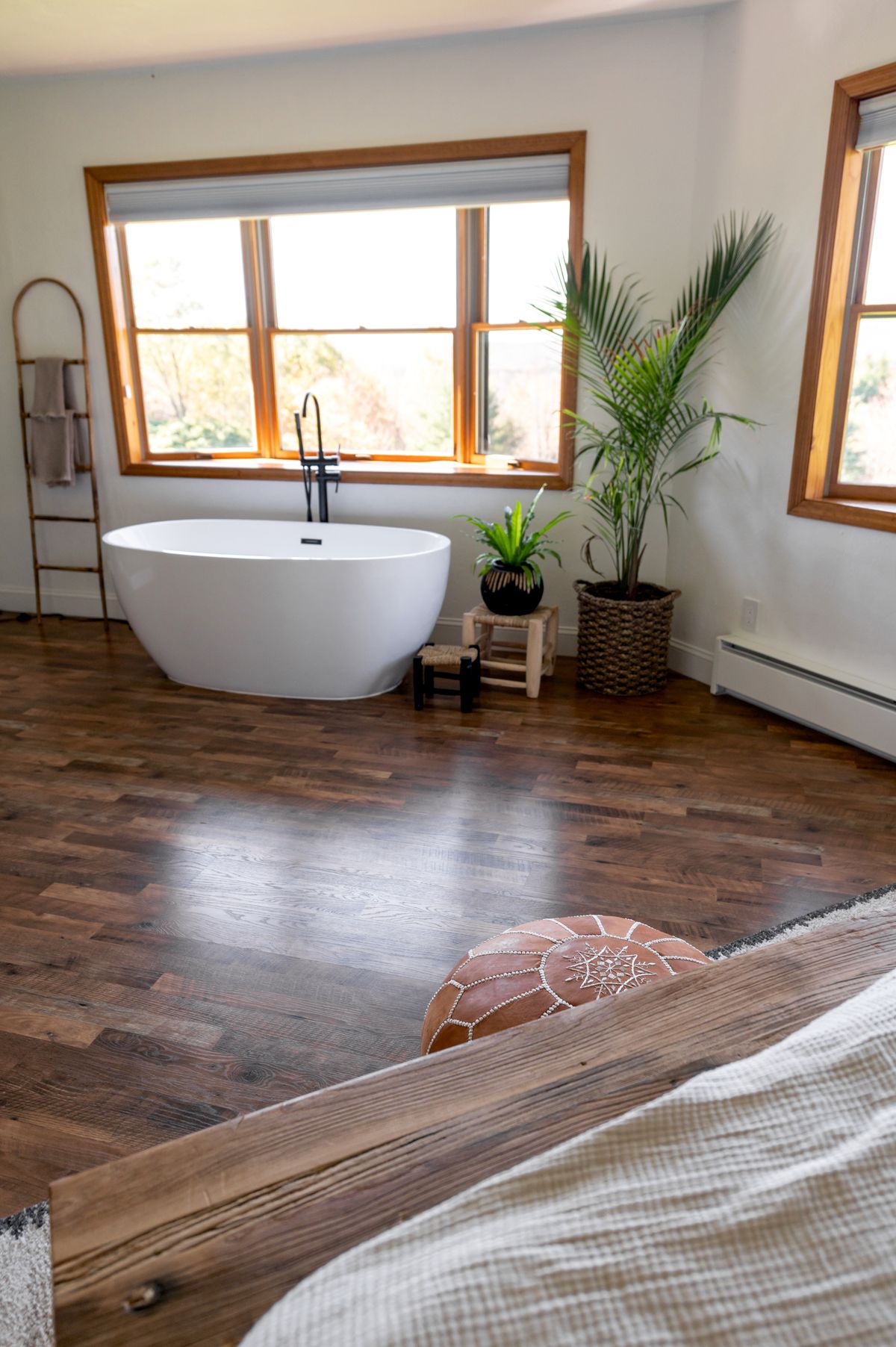
To see why UGR matters in daily life, picture a modern bathroom — the most glance-prone room in the house. You stand at the mirror, wash hands, sit in a warm bath, and look up at a ceiling of small downlights. Because a bathroom is full of glossy tiles, white fixtures and mirrors that reflect light back into the eye, a fixture with poor glare control turns a calming space harsh within seconds.
In a cozy bathroom — think warm beige stone, a deep freestanding tub, brushed brass and flickering candles — lighting should flatter, never assault. This is exactly where anti-glare downlights with a low UGR earn their keep. A UGR 19-rated fixture tucked into the ceiling floods the vanity and tub with comfortable, even light; a UGR 25 fixture turns every glance upward into a small wince.
Layered with a soft wall-washer accent behind the mirror and a warm glow washing the textured wall, the bathroom becomes that Pinterest-worthy, spa-like retreat — warm, inviting and completely glare-free.
Here is a practical room-by-room UGR target that balances comfort, cost and aesthetic warmth:
Target UGR ≤ 19. Use recessed anti-glare downlights over the vanity and tub, keep them on a dimmer, and avoid placing a bare bright source in the mirror’s reflection line. A wall washer adds diffused ambience that softens shadows.
Target UGR ≤ 19. Because people sit and look up while relaxing, low-glare recessed spots and adjustable track-light heads let you accent artwork without blinding anyone on the sofa.
Target UGR ≤ 19, ideally ≤ 16 over desks. Screen work makes you highly sensitive to reflected and direct glare. Position any accent heads so their beam never points toward a seated worker’s eyes.
Target UGR ≤ 22 for general, with UGR 19 for anything near a till or consultation point. Narrow-beam track spots on merchandise are fine — just keep them off the customer’s line of sight.
UGR is a computed value, and not every published figure is measured the same way. When you read a spec sheet:
Specifiers sometimes mix up related but distinct terms. Here is the shorthand:
If a fixture is described simply as “anti-glare” without a UGR number, treat it as a claim, not a spec — the rating is what lets you compare it honestly against alternatives.
A good UGR for most interiors is 19 or lower (UGR ≤ 19). For dedicated reading, office and precision work, spec UGR ≤ 16. UGR ≤ 22 is acceptable only for circulation and non-critical spaces.
Lower UGR always means less discomfort glare, which is better for eye comfort. The trade-off is cost and sometimes a marginally less “sparkly” look. For rooms where people relax or work, choose the lowest UGR you can afford — typically 19.
UGR 19 means the lighting installation falls on the boundary below which discomfort glare is considered acceptable for general office, classroom and home applications under CIE and EN 12464-1 guidance. A UGR of 19 is comfortable; values above start to become noticeable.
Yes. Track-light heads are rated for UGR just like downlights, and the value depends on the reflector and optics of each head. Adjustable track lights are especially valuable for glare control because you can aim the beam away from people’s eyes — a key reason specifiers choose tiltable track-light heads for living spaces and galleries.
Partly. UGR is driven by source luminance and position, so mounting height, spacing and aiming all affect the real value in a room. Using dimmers and adding ambient background light also lowers perceived glare. But the fixture’s intrinsic optic quality sets the ceiling on how low you can go.
UGR — Unified Glare Rating — is the single most useful number on a downlight or track-light spec sheet if you care about eye comfort. The lower the value, the gentler the fixture is to live and work under. For any space where people sit, read, bathe or linger, spec a fixture rated UGR ≤ 19, engineered with deep anti-glare optics rather than marketing claims.
When you are ready to light your project without the glare, explore ELLA-Deep anti-glare downlights, flexible CADIO track lights and the wider track light collection — each fixture engineered for comfortable, low-glare illumination. Unsure which UGR suits your room? Talk to our lighting team and we will help you spec it right.