Address
304 North Cardinal
St. Dorchester Center, MA 02124
Work Hours
Monday to Friday: 7AM - 7PM
Weekend: 10AM - 5PM
Address
304 North Cardinal
St. Dorchester Center, MA 02124
Work Hours
Monday to Friday: 7AM - 7PM
Weekend: 10AM - 5PM
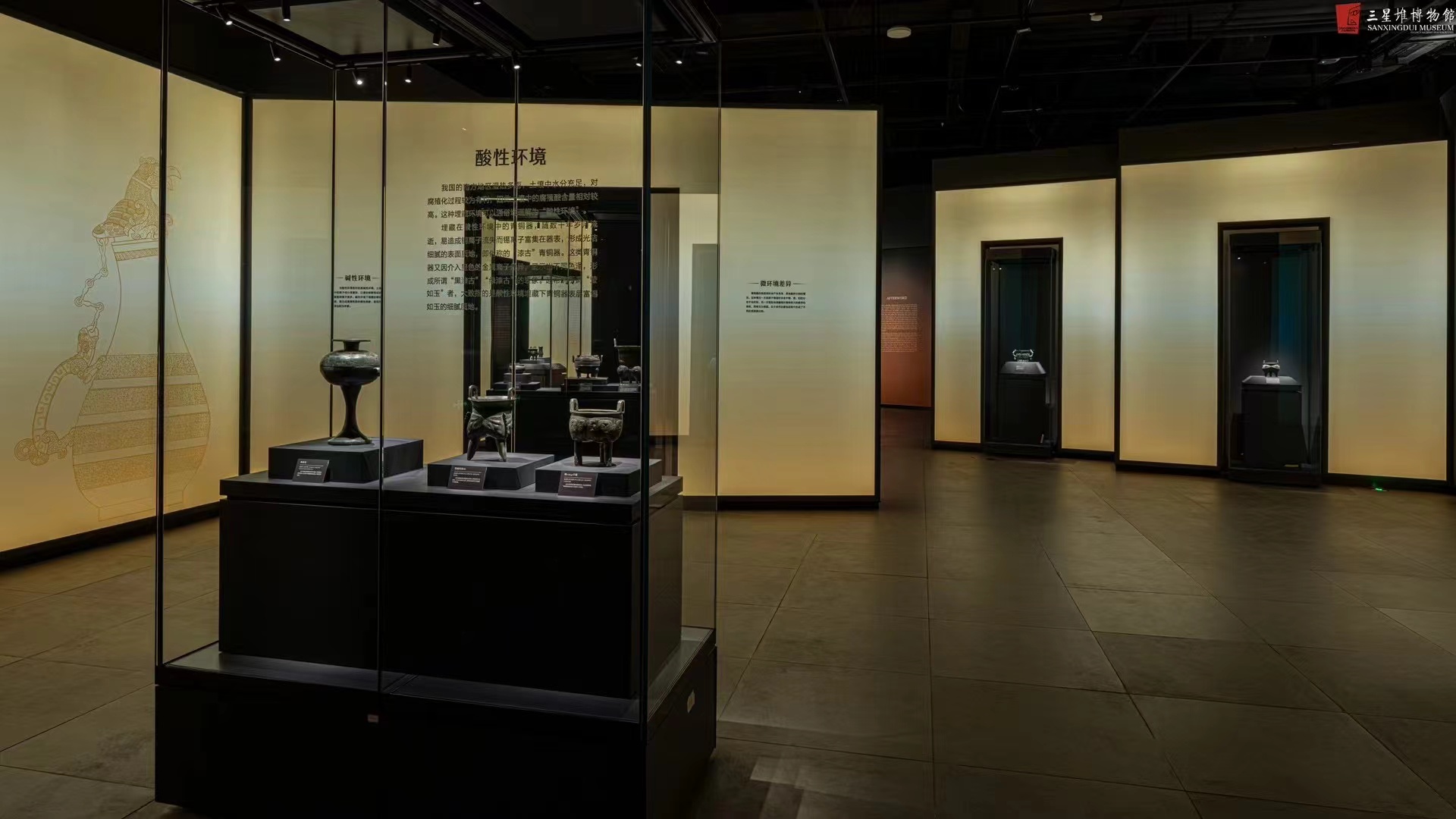
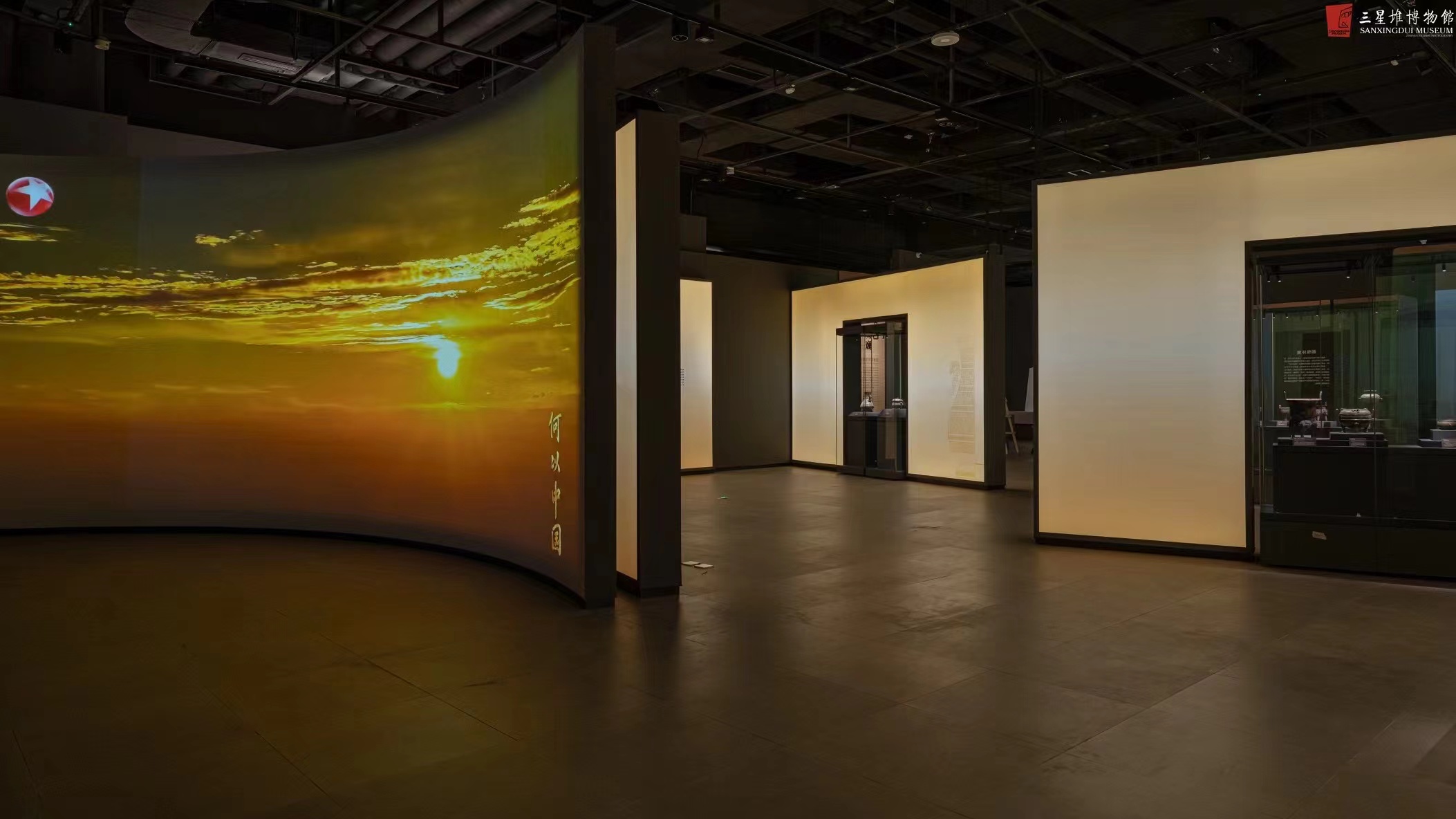
When the Sanxingdui Ruins Museum unveiled its new exhibition halls, the world got a fresh look at some of China’s most extraordinary bronze artifacts — and at the museum track lighting and downlights that make them legible. In a bronze gallery, lighting is not decoration; it is conservation, storytelling, and optical engineering at once. This case study breaks down the lighting techniques visible across the Sanxingdui installation and shows how specifiers can recreate them with ENCORE architectural LED fixtures.
The consistent strategy across every hall is a deliberately dim ambient field with bright, tightly controlled accent light on the artifact itself. This protects light-sensitive bronzes while letting the eye lock onto the object. Narrow-beam track lights mounted in the ceiling grid carve each vessel out of a near-black surround, producing the silhouette contrast that makes patina and form read clearly.
Unlike a generic “white-box” gallery, Sanxingdui uses chromatic architecture — amber, green, blue, and red backlit panels — to define chapters of the visit. Each zone pairs a saturated ambient color with a neutral ~3000K key light on the bronzes, so the warm artifact pops against the cool or colored architecture.
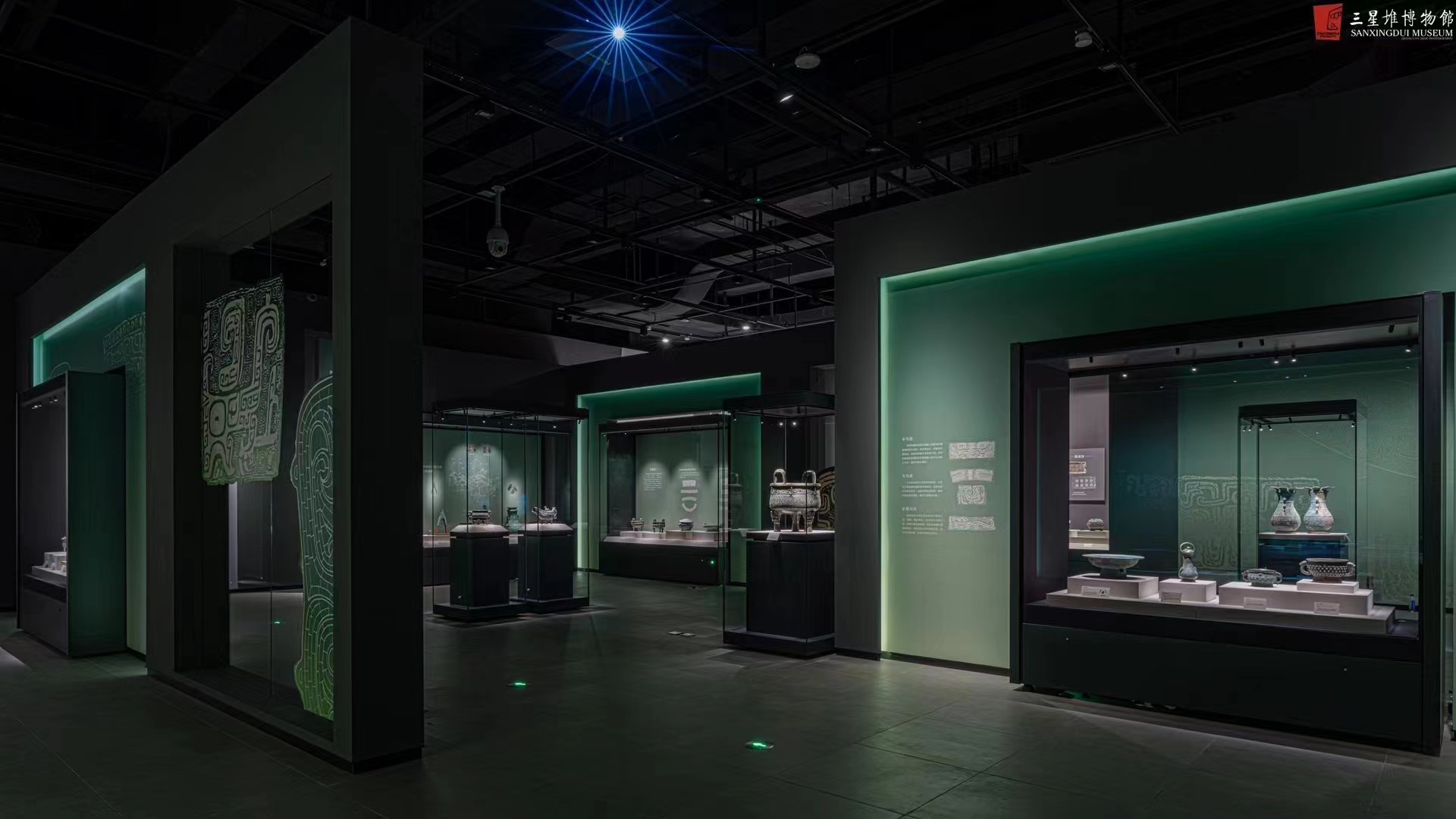
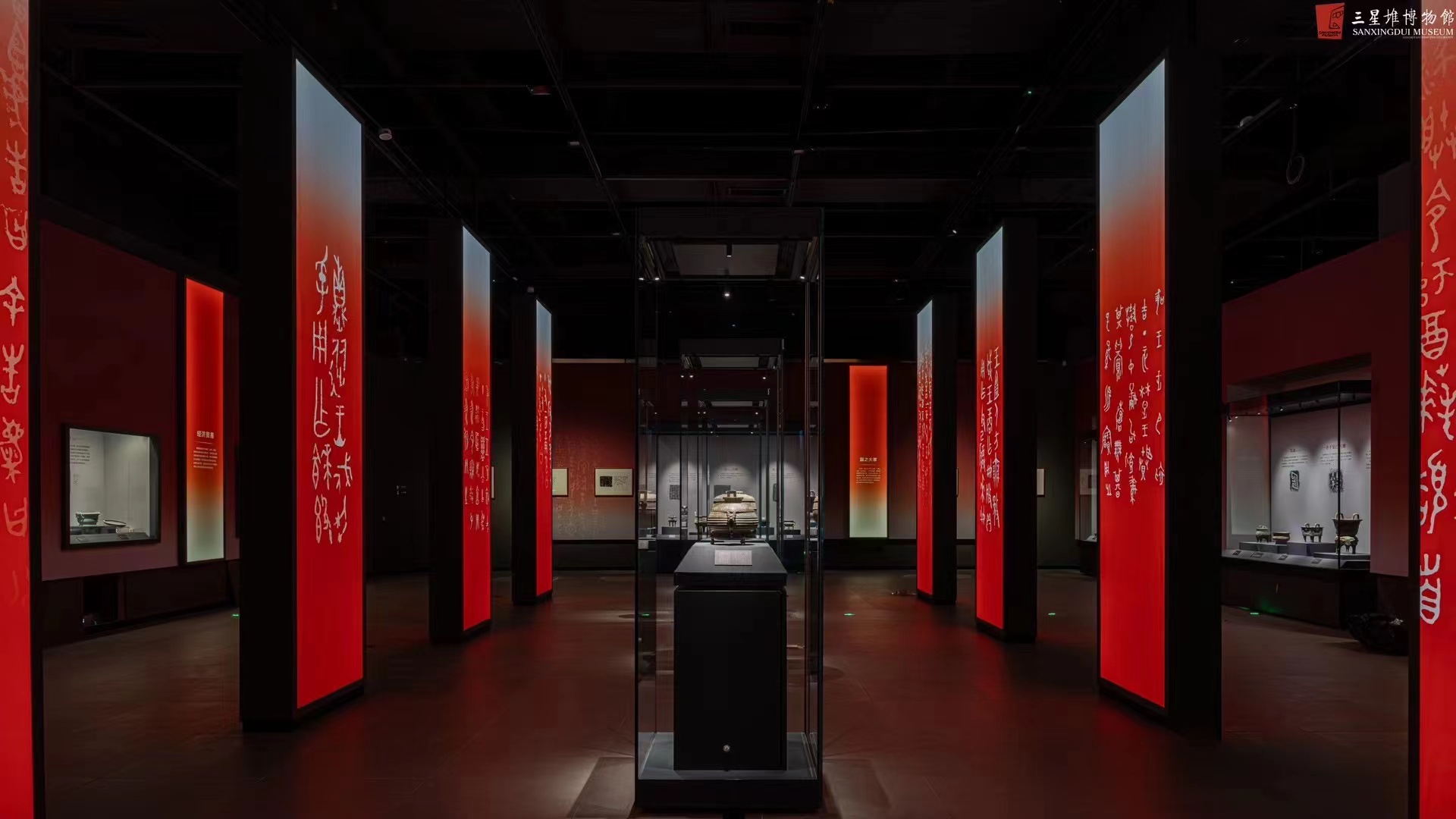
For “hero” pieces, the design uses a chromatic surround plus a focused narrow-beam key light at a low angle. The angle is deliberate: grazing light rakes across the surface so the taotie relief casts micro-shadows that make ornamental detail “pop.”
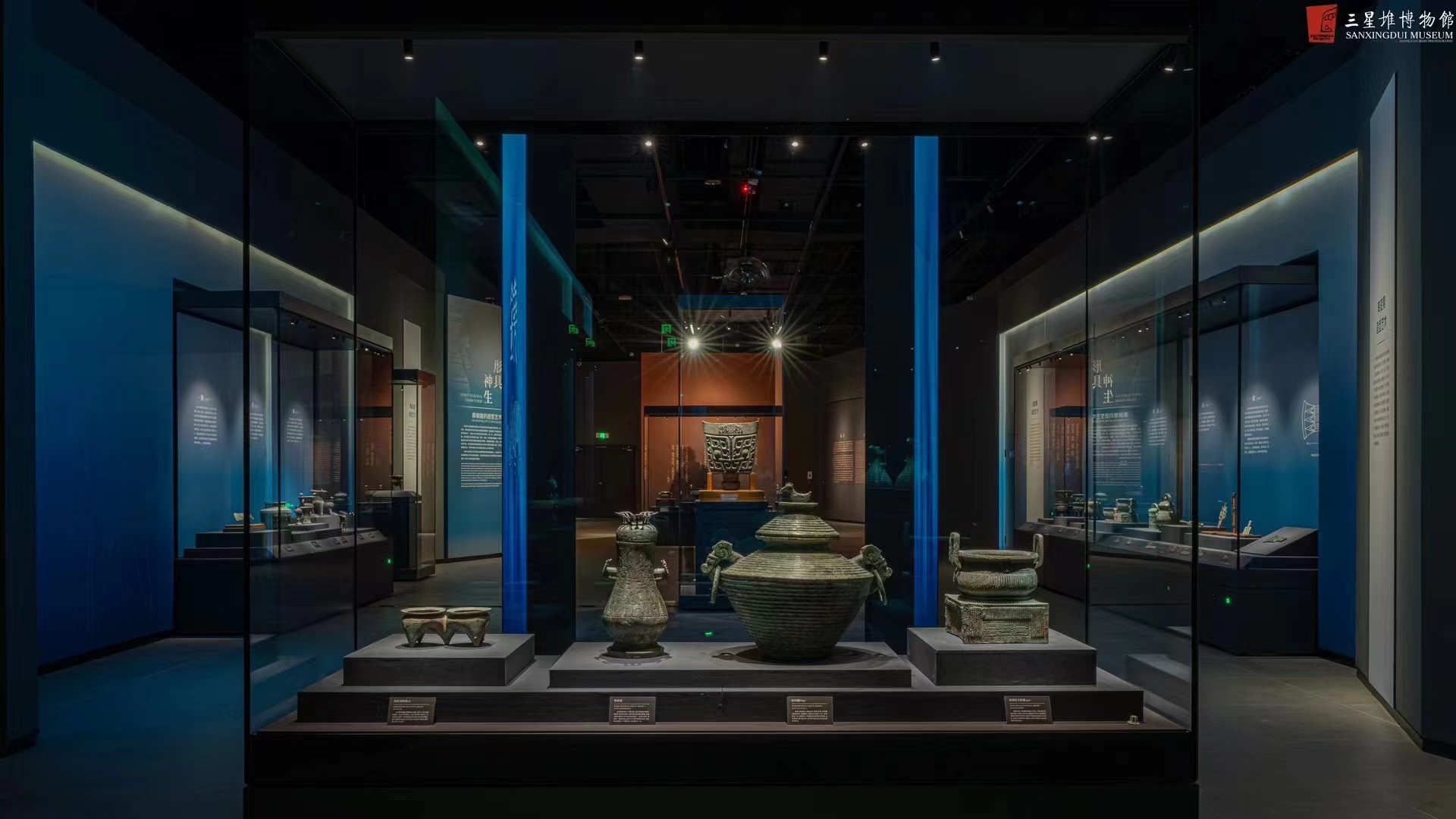
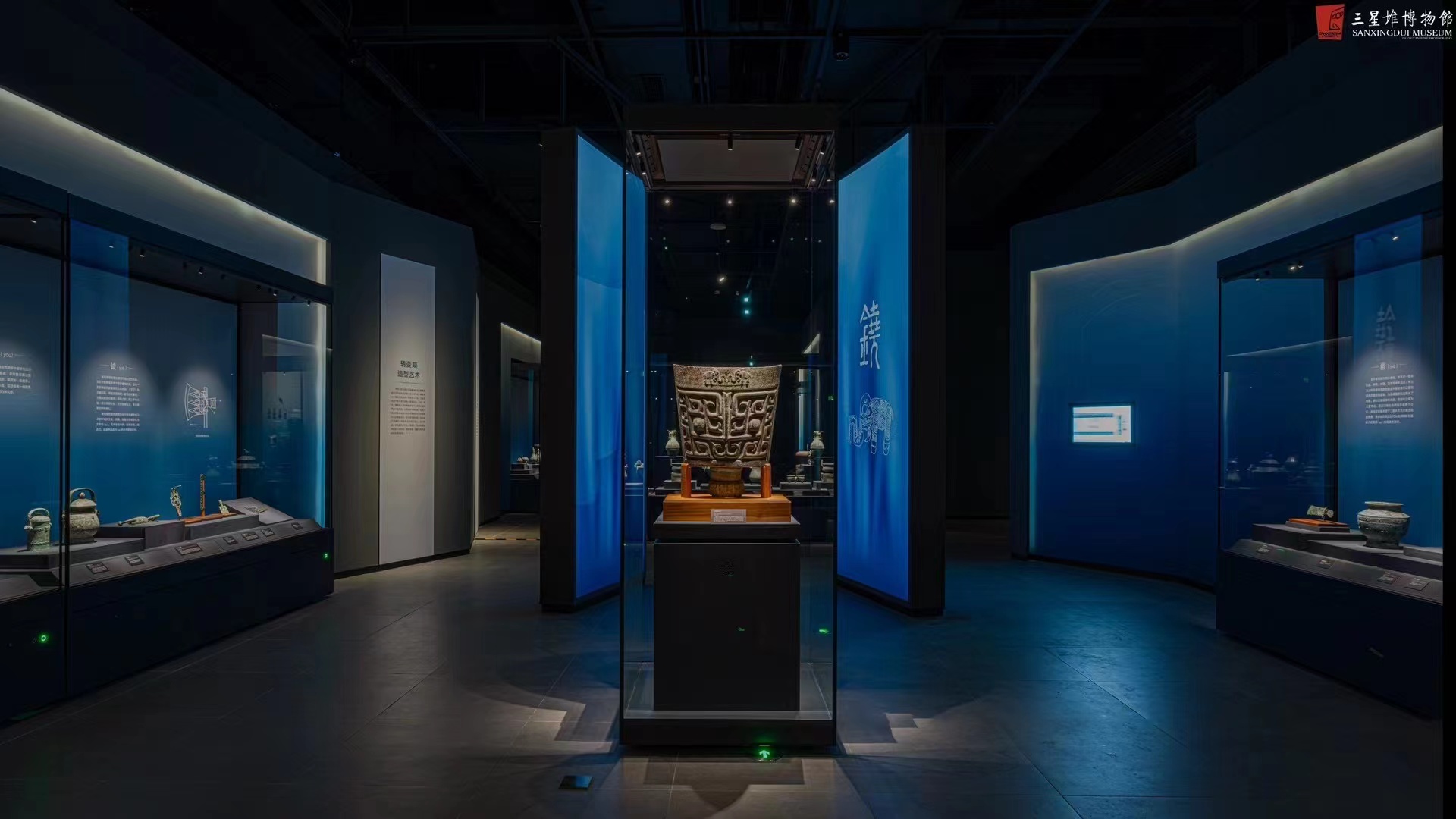
The installation layers multiple fixture types: ceiling track lights, recessed downlights, continuous linear LED cove lighting, and large-format LED media walls. This combination gives designers both the precision of accent spots and the atmosphere of indirect wash.
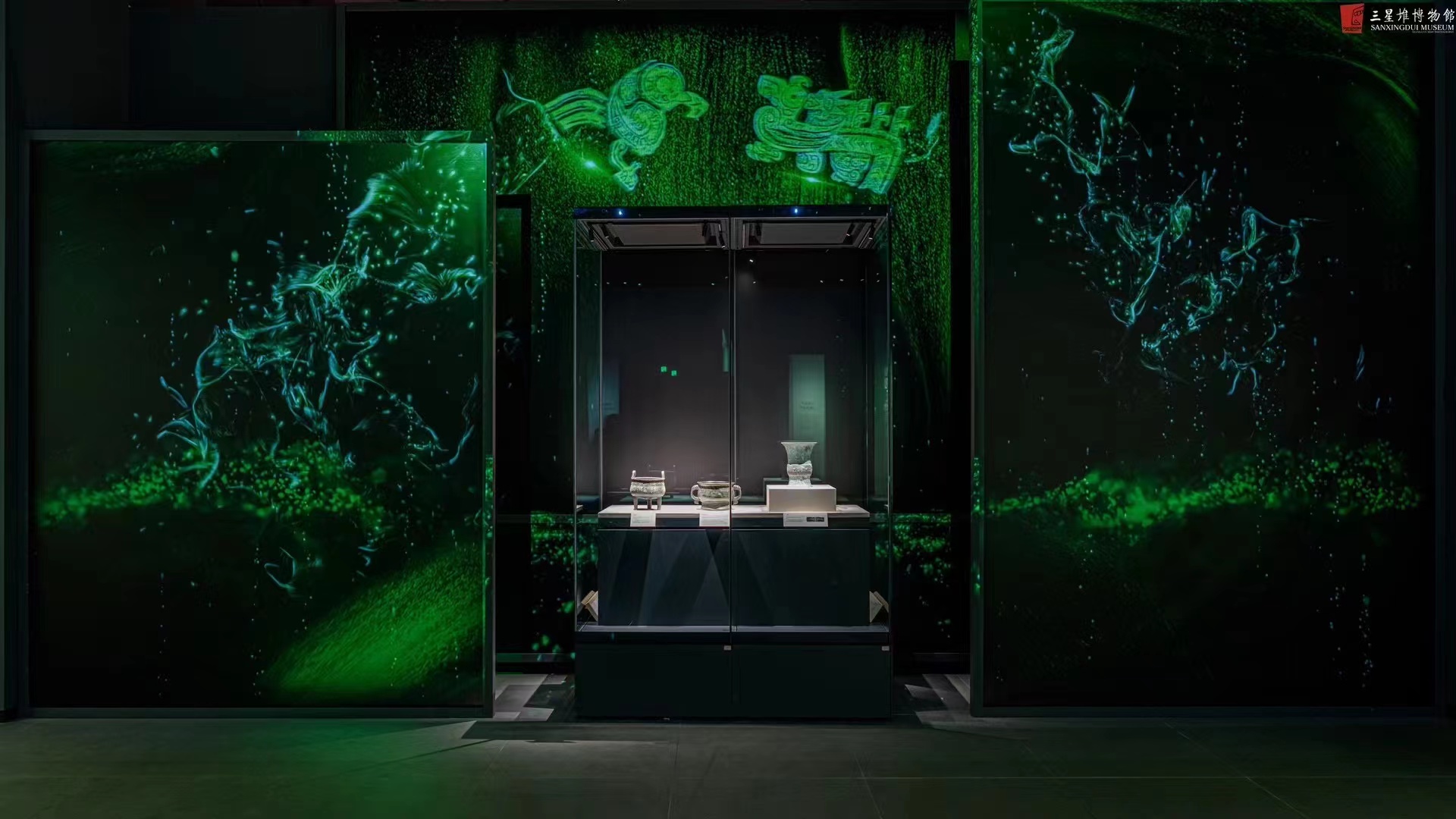
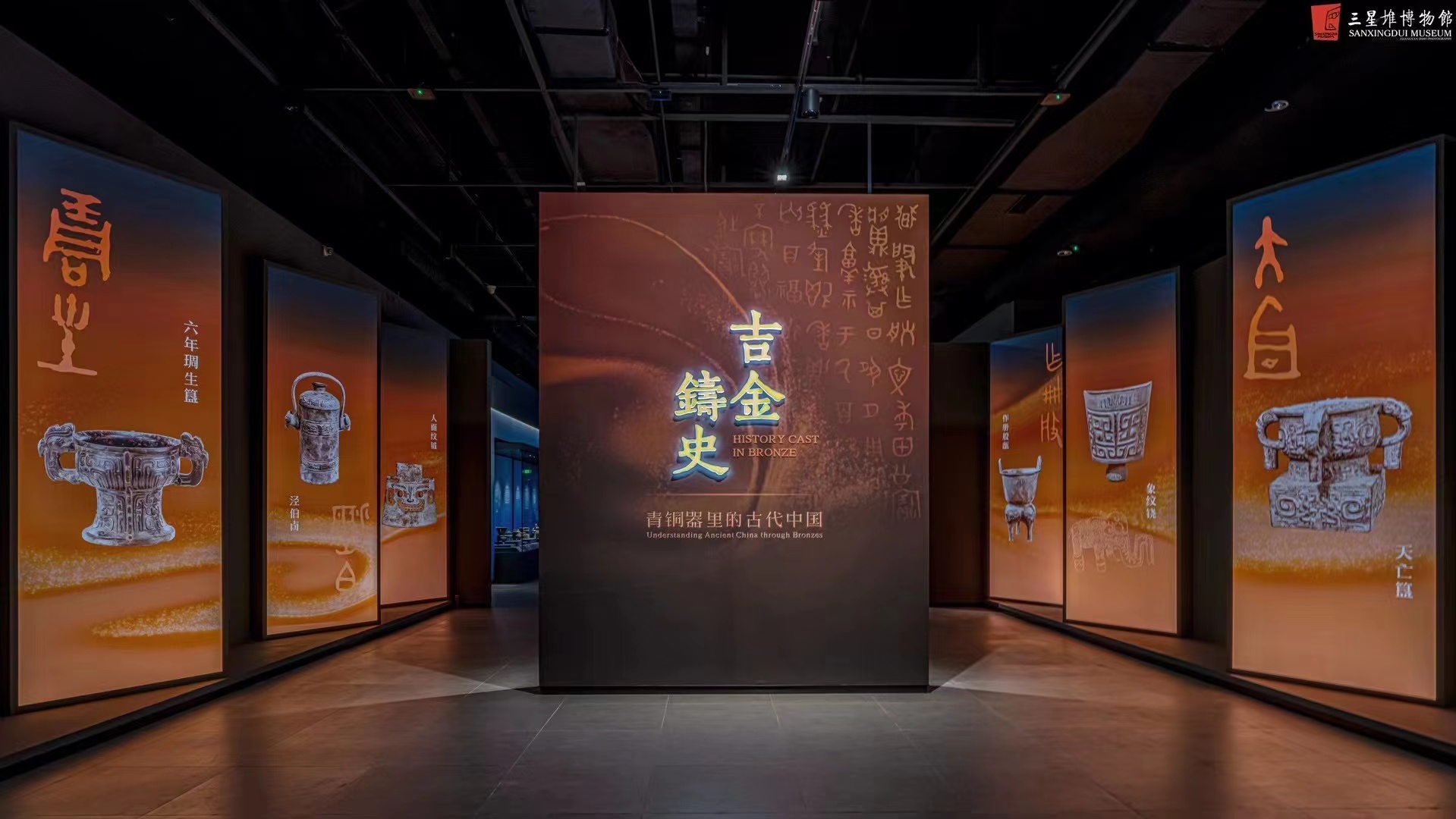
ENCORE engineers architectural track lights, downlights, and magnetic track systems with CRI 95+, flicker-free drivers, and UV/IR-filtered output for artifact safety. Book a free lighting design consultation to plan your next gallery or museum project.
Bronze is not one surface. A single Sanxingdui vessel can present polished highlights, oxidised patina, corroded crust, and dust-bearing crevices at the same time. Each of those reads differently under the same beam, which is why a bronze gallery cannot be lit with a single flood of even illumination. The lighting has to separate the surfaces optically before the eye can separate them at all.
Three physical properties drive every decision that follows:
That third point is the one that catches specifiers out. A single object at 200 lx is a modest number on paper, but raising illuminance to compensate for a low-reflectance surface also raises the exposure dose and the heat load on the object. The two have to be traded against each other rather than set independently.
Museum lighting is governed by an annual exposure budget rather than by a lux figure alone. The budget is illuminance multiplied by the hours an object is lit, and it is the product — not either factor — that conservation departments track.
Bronze, being metal, is among the most light-stable materials in a museum. That is the good news. The bad news is that the casework, mount, backing board, textile, and any associated organic material are not, and they share the same room. In practice the bronze sets the look and the surrounding materials set the limit.
Take a large vessel on a plinth, lit 8 hours a day, 300 days a year, viewed from a rail 3.20 m above the floor with the object’s centre of interest at 0.90 m.
Half a million lux-hours would be reckless on paper or textile. It is defensible on metal, but only if the light is confined to the object and the adjacent sensitive material is either shielded or exhibits on a shorter schedule. This is the reason accent lighting in a bronze hall is so tightly controlled: the narrow beam is not an aesthetic preference, it is the mechanism that keeps the dose on the object and off everything else.
Once the drop distance is fixed at 2.30 m, the beam angle determines the pool width, and the pool width determines what fraction of the plinth is lit. Using the standard photometric relation:
A 0.98 m pool from a 24° head is the working choice for a plinth that is roughly 0.9 m square: the pool sits just inside the plinth edge, so the plinth itself stays dark and the object appears to float. A 15° head would leave the outer edges of a large vessel unlit; a 36° head would spill onto the mount and the label.
The distinction matters and is routinely blurred. Both techniques use a low beam angle, but they do different jobs.
| Technique | Typical beam elevation | What it reveals | Best for on bronze |
|---|---|---|---|
| Grazing | 10–25° above the surface | Surface texture, tool marks, micro-relief | Flat plaques, cast seams, inscriptions |
| Raking | 5–15° above the surface | Deep relief, silhouette separation, dust and damage | Vessels, masks, ritual forms with heavy relief |
| Key / accent | 30–45° | Overall form, mass, colour | Hero objects, establishing the primary read |
Raking is powerful and unforgiving at the same time: at a shallow angle, every particle of dust casts a shadow longer than the particle itself. If a raking installation looks dirty in a photograph, the lighting is doing its job and housekeeping is not.
The three-hundred-kelvin question comes up in every bronze project. The answer is less about warmth and more about colour rendering, because patina lives in the red-adjacent part of the spectrum where ordinary LEDs are weakest.
| Parameter | Typical value | Effect on bronze | Specification advice |
|---|---|---|---|
| Correlated colour temperature | 3000 K | Warm metallic highlights read correctly | Prefer 2700–3000 K; avoid 4000 K on warm patina |
| CRI (Ra) | 90+ | General colour fidelity across eight mid-tones | Treat CRI 90 as the floor, not the target |
| R9 (saturated red) | 50+ | Copper-rich patina keeps its depth | Ask for R9 explicitly; a weak R9 renders metal grey |
| Rf / Rg (TM-30) | Rf 90+, Rg 95–105 | Honest saturation without oversaturation | The most informative pair for metal and patina |
The practical instruction is to specify on R9 and TM-30 rather than on the CRI headline, because two luminaires both labelled CRI 90 can differ substantially in the red channel — and bronze is precisely the material where that difference is visible.
Sanxingdui’s halls are deliberately dim. That is a conservation decision and an experience decision at the same time, and it has an optical consequence: in a dark room the eye adapts to a low background luminance, which makes any bright source in the field of view dramatically more uncomfortable. A luminaire that would pass unnoticed in a 300 lx office will dominate a 50 lx gallery.
Glare is quantified by the unified glare rating, and for gallery work the useful targets are:
On a track system the single most effective glare control is aiming. A head aimed away from the visitor’s line of sight costs nothing and does more than a louvre, which is one reason adjustable aiming is worth specifying even when the layout is nominally fixed. Our guide to UGR ratings works through the classification in more detail.
Across the halls, four luminaire types carry the design. Reading them as a hierarchy is more useful than treating them as interchangeable.
| Layer | Fixture type | Job on this project | Typical optics |
|---|---|---|---|
| Ambient | Cove / linear | Lifts the architecture so the ceiling is not black | Wide, indirect, no object lighting |
| Accent | Track spot | Puts the pool on the object and nowhere else | 15–24°, CRI 90+, R9 50+ |
| Wash | Wall washer | Even vertical illuminance on backdrops and murals | Asymmetric, 20–35° vertical |
| Reveal | Linear grazing | Texture and relief on flat panels | Narrow, close-set, high uniformity |
Getting the split wrong is the most common failure mode. A hall lit entirely with accent spots reads as a sequence of disconnected islands with no architecture between them; a hall lit entirely with ambient light reads as flat and the objects disappear into the field. The Sanxingdui installation works because the ambient layer is deliberately dim and the accent layer is deliberately narrow.
Four transferable rules come out of this project. Each one applies just as directly to a retail display, a hotel lobby, or a residential art wall.
If you want the arithmetic behind these rules rather than the conclusions, our guide to museum lighting design covers dose budgets and UV load, and the beam angle explainer works through the pool-width relation used above.
The fittings that suit this work share three properties: a genuinely narrow optic, an aim-adjustable head, and a documented colour specification. For accent positions on vessels and masks, the AIMER track light gives a controllable 15–35° optic with CRI 90+ and a useful R9, and mounts on the same rail as the wider heads used for the ambient layer. Where a backdrop or mural needs even vertical illuminance rather than a pool, the ELLA wall washer handles the wash layer. For cabinets and panel edges where the beam has to be narrowed on site as the object layout firms up, the OVEGA zoomable wall-mounted fitting allows the pool to be tuned without re-ordering optics.
See the full track light range for the accent layer, or start with the museum lighting standards reference if you are writing the specification document.
Bronze is a light-stable metal, so the illuminance is usually set by the surrounding materials rather than by the bronze itself. In practice a bronze hall runs 150–200 lx on the object with the ambient field held below 50 lx, and the actual ceiling is imposed by whichever accompanying material — textile, paper, painted mount — is most sensitive.
3000K is the usual choice. Warm white keeps the copper-rich highlights in the patina looking metallic, while 4000K tends to make oxidised bronze read cool and grey. CRI and R9 matter more than the exact kelvin, so a 3000K source with R9 below 40 will still render bronze poorly.
Multiply the illuminance by the hours the object is lit each year. A bronze at 200 lx for 2,400 hours a year accumulates 480,000 lux-hours, which is acceptable for metal but would be far too high for paper or textile in the same room. The budget is what conservation tracks, not the lux figure alone.
Most often the beam is too close to the specular angle or the beam is too wide. Move the head further off-axis so it rakes the surface at 5–15°, and narrow the optic so the light stays on the object. A 24° head at a shallow angle will resolve detail that a 36° head at the same position smears into flare.
Quality LEDs emit almost no ultraviolet — typically around 0.2 microwatts per lumen against a 75 µW/lm conservation limit — so the fittings are rarely the problem. The UV risk in a glazed gallery arrives as unfiltered daylight, which can exceed the limit several times over and is worth auditing before blaming the luminaires.
Set the centre-to-centre distance from the pool edge rather than from habit. With a 2.30 m drop and 24° optics the pool is 0.98 m wide, so adjacent objects need spacing at roughly the pool width or more if the pools must not overlap. Where pools should just touch, space them at one pool width; where they must stay separate, space them wider.
The illuminance and glare targets referenced here follow the general framework published by the Illuminating Engineering Society (IES), with the exposure-budget approach consistent with CCI conservation guidance on cumulative light dose.
Sanxingdui works as a lighting case study because every layer has a clear job: a dim ambient field for conservation, narrow accent pools for the objects, a warm 3000K key with a strong red channel for the patina, and an aim-adjustable head so glare stays out of the visitor’s line of sight. None of that is expensive to replicate. What it requires is running the arithmetic — drop distance, pool width, exposure budget — before choosing the fixtures, rather than after.
Send us your gallery drawings and object schedule and we will work through the drop distances, beam angles and colour specification for your own bronzes and cases.