Address
304 North Cardinal
St. Dorchester Center, MA 02124
Work Hours
Monday to Friday: 7AM - 7PM
Weekend: 10AM - 5PM
Address
304 North Cardinal
St. Dorchester Center, MA 02124
Work Hours
Monday to Friday: 7AM - 7PM
Weekend: 10AM - 5PM
DALI-2 and D4i on one page: what got certified, what moved into the driver, the 64-address bus budget, the dim curve and the 90 h emergency test. Spec it right.
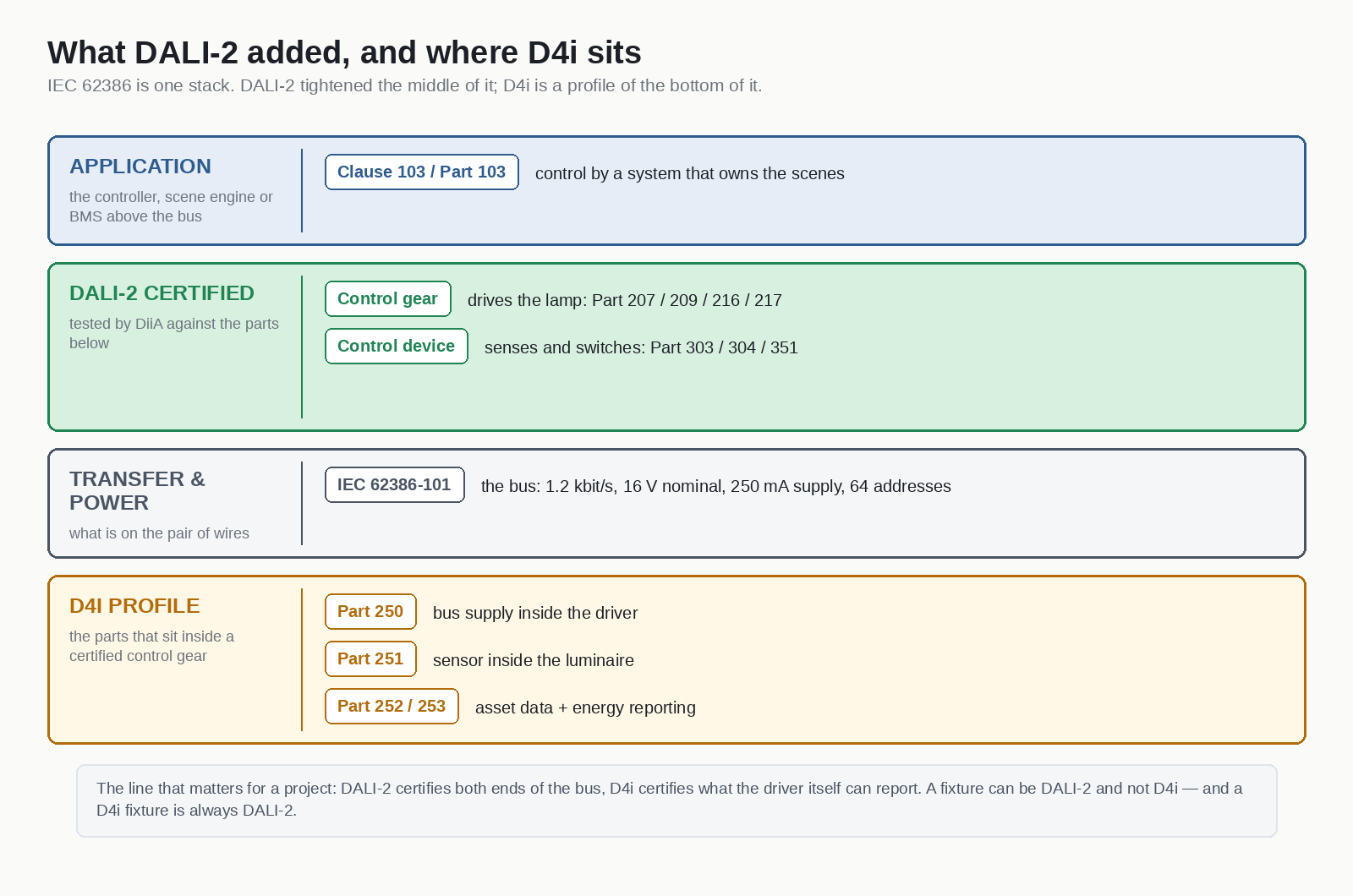
DALI-2 is the certification layer; D4i is the profile that puts the supply, the sensor and the energy meter inside the driver. If your track project needs scenes that change, fixtures that report themselves, or an energy figure the client can audit, the decision is not “DALI or not” — it is how deep into the stack you have to specify. This article prices that decision on one twelve-head run.
Most track lighting projects in retail, galleries and hospitality are still specified with a line item that says “DALI dimmable”. That line is not enough to buy from, and it is not enough to commission against. Between the bus and the ceiling there are three different depths: the transport standard (IEC 62386-101), the DALI-2 certification that tests both ends of it, and the D4i profile that moves the intelligence into the luminaire. A fixture can satisfy the first, fail the second and never reach the third.
DALI-2 did not arrive as a faster bus or a new voltage. The physical layer is what DALI always was: one pair of wires, polarity-free, 16 V nominal, 250 mA of supply, 64 addresses per line, 1200 kbit/s. What DALI-2 changed is the part that used to be a compatibility lottery — it made the parts mandatory, numbered them, and put a certification scheme (DiiA’s) behind them.
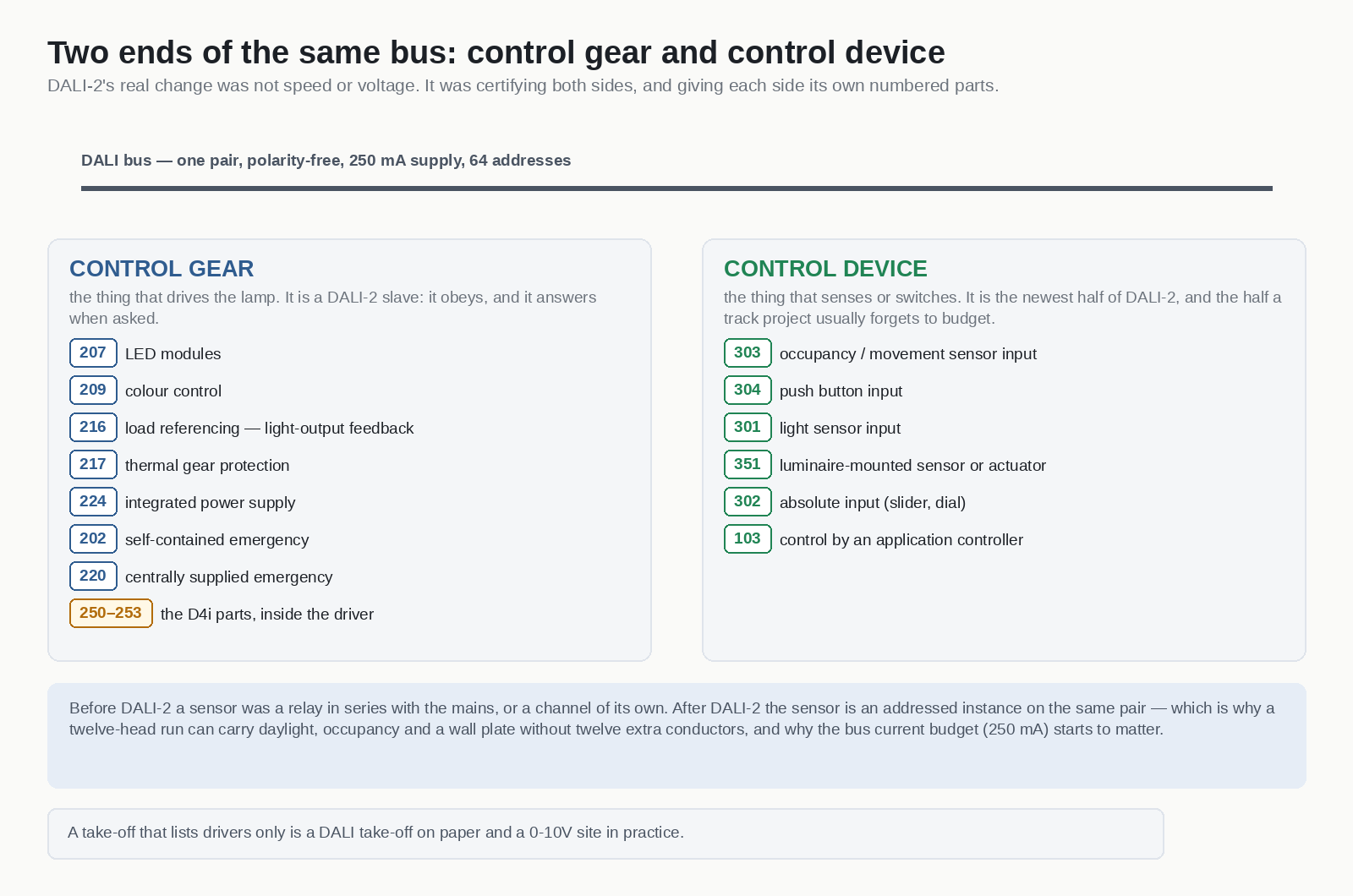
In the old DALI universe, “supports DALI” could mean almost anything. In DALI-2 every capability has a part number, and a driver or a sensor either passes the test for that part or it does not:
The second list is the one that quietly changes a track take-off. Before DALI-2 a daylight sensor was a relay in series with the mains, or a channel of its own. After DALI-2 the sensor is an addressed instance on the same pair the drivers already use. Twelve track heads with daylight, occupancy and a wall plate now need no extra conductors at all.
D4i is not a new protocol and not a competitor to DALI-2. It is a named profile: a specific combination of parts that a manufacturer can certify, aimed at luminaires that carry their own intelligence. Four parts do the work:
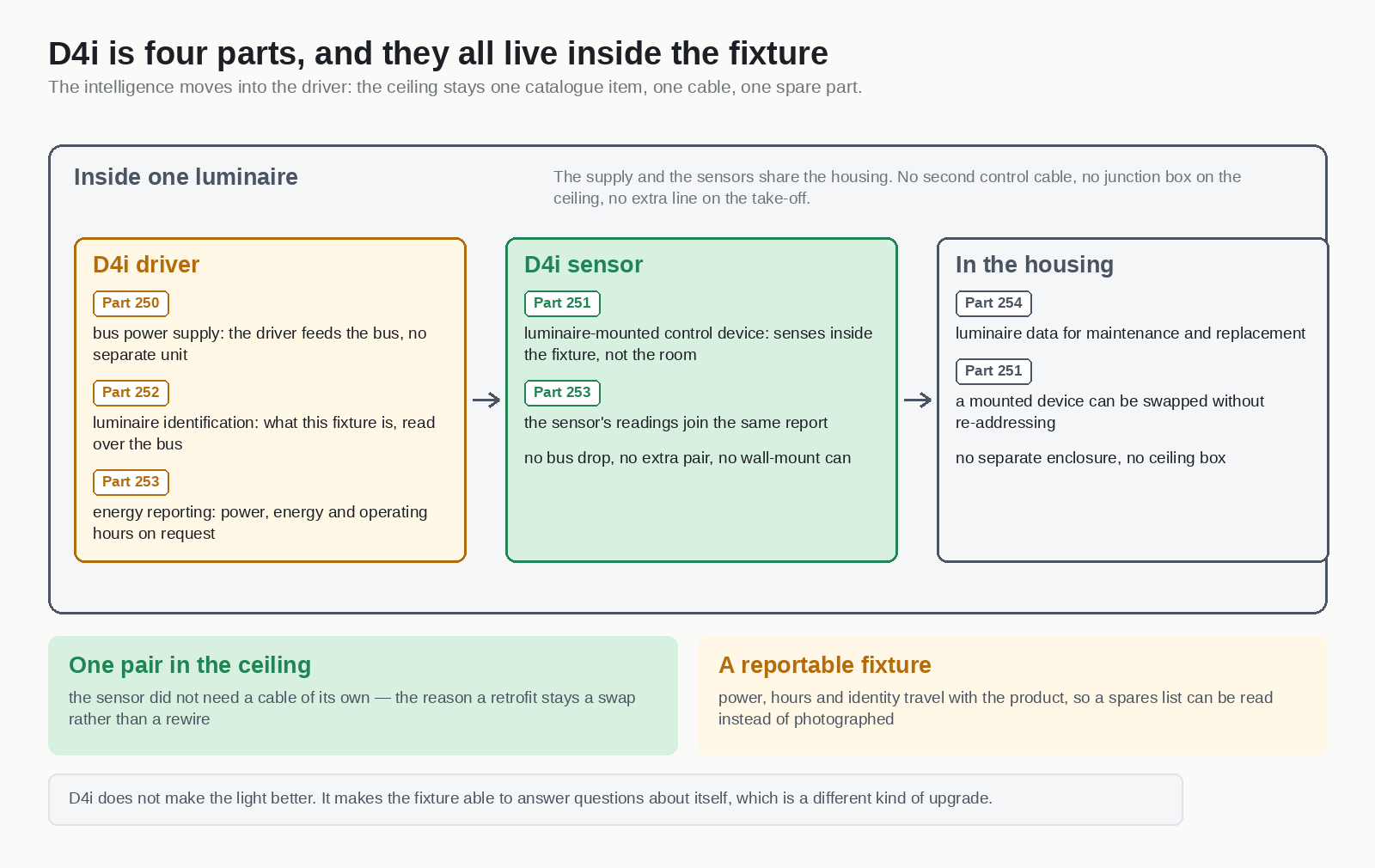
This is where the marketing language and the engineering diverge. A D4i fixture is always DALI-2 — Parts 250 to 253 sit on top of certified control gear. A DALI-2 fixture is not automatically D4i, and the gap between the two is exactly the gap most take-offs fall into: the project pays for addressing and gets it, then discovers at handover that nothing on the ceiling can report energy.
Two ceilings sit on every DALI line. The supply gives 250 mA at 2 mA per device, which is 125 bus units. The protocol allows 64 addresses. Whichever you reach first is the length of your line — and on a track project it is nearly always the addresses.
Run the numbers on a twelve-head circuit:
At twelve heads the supply is nowhere near its limit, and the address count is already twice as far along. Push the circuit towards that cap and the supply would only reach about half its rating at the point where the sixty-fifth head has nowhere to be addressed. Adding a Part 250 unit makes the current constraint close to irrelevant — one head powering the bus drops the draw to 0.80 % — and adds exactly zero addresses. That is the misconception that costs a project a second gateway: D4i buys you current, not capacity.
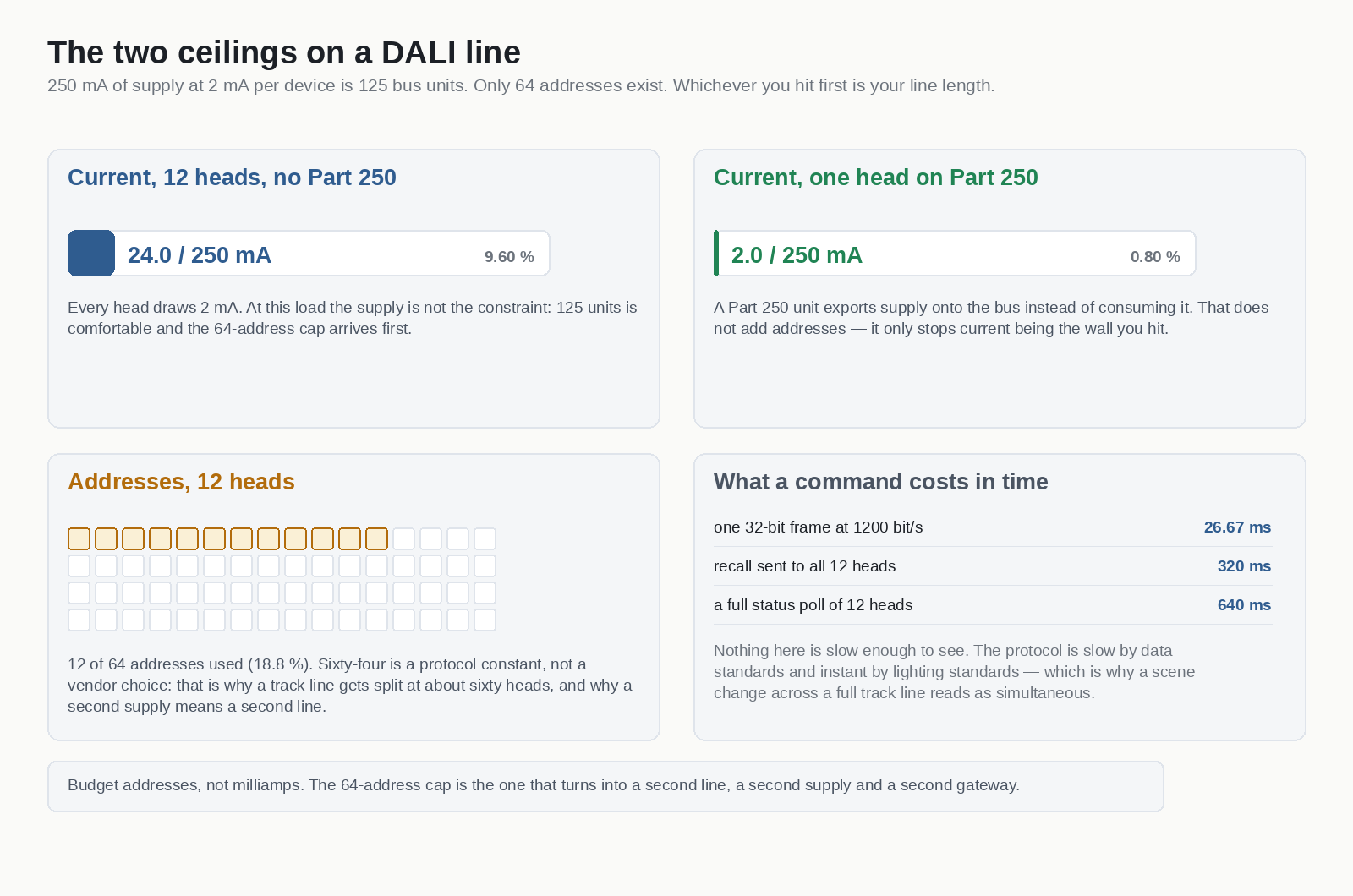
One frame is 32 bits at 1200 bit/s, which is 26.67 ms. A recall sent to all 12 heads takes 12 × 26.67 ms = 320 ms; a full status poll of the same line is about 640 ms. Nothing here is visible. The protocol is slow by data standards and effectively instant by lighting standards, which is why a scene change across a full track line reads as simultaneous to everyone standing in the room.
The row most often left out of a comparison is the shape of the control law, and it is the one a client notices. DALI-2 maps arc power 0–254 onto a logarithmic curve from 1 % to 100 %: a 100:1 range in which every adjacent step is the same relative size, ×1.0183, or about 1.8 %.
An analog 0-10V control is not the same curve, and the difference shows up where it hurts. The nominal span is 10 V, but the bottom 1 V switch the driver off rather than dim it, and the top 0.3 V do nothing. That leaves 8.7 V of usable range, 87 % of nominal, and it is not evenly distributed: on a log axis the voltage sags into the bottom of the range, then stops. Two heads on the same channel — one with 0.3 V of extra drop, one without — will visibly disagree at the bottom of the fade.
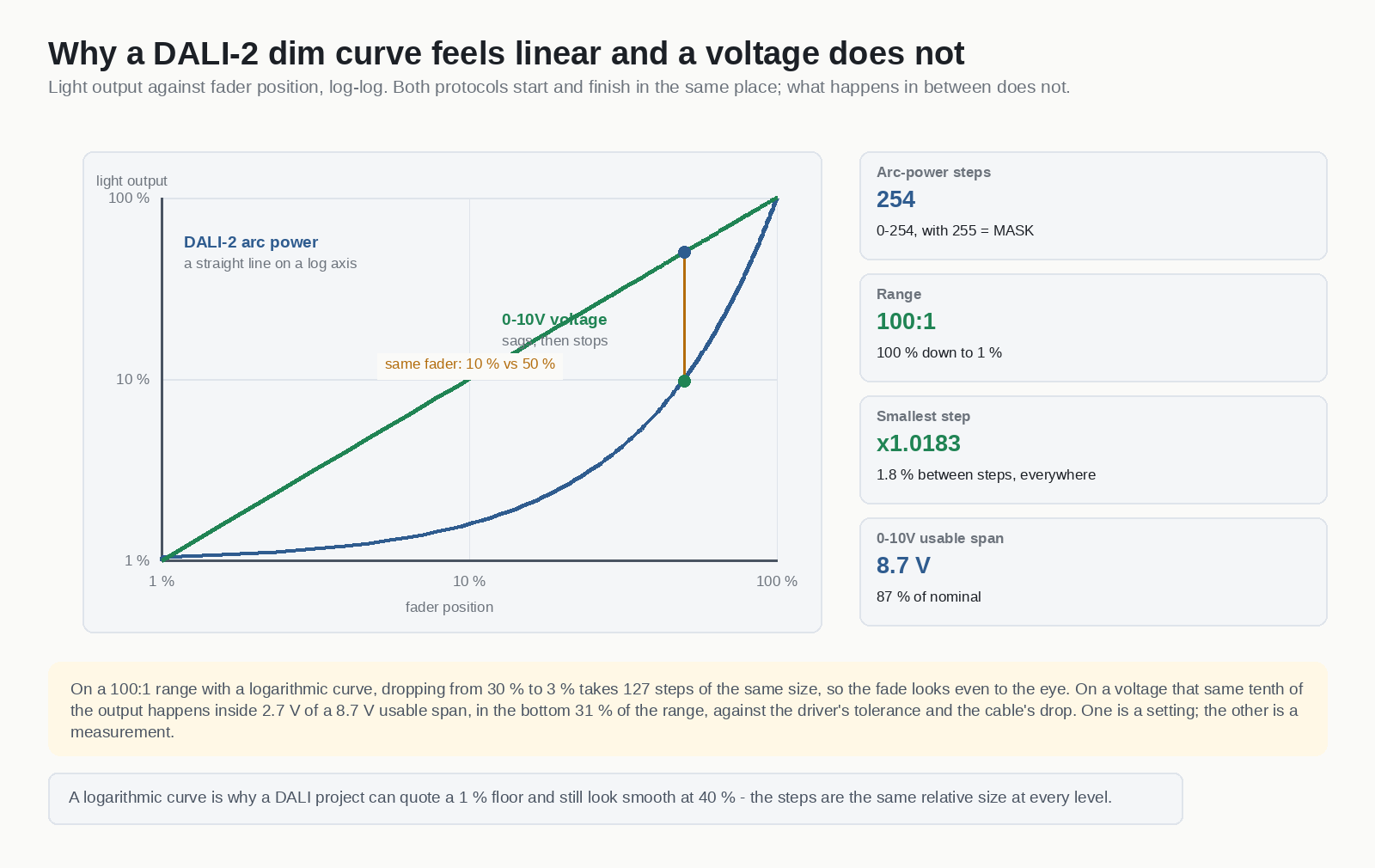
For a retail or hospitality brief that asks for “1 % dimming”, this is the whole argument. A 1 % floor on a logarithmic curve stays smooth all the way down. A 1 % floor expressed as a voltage is a measurement being taken at the very bottom of a range, against the driver’s own tolerance and the resistance of the cable.
Tunable track heads are usually sold on a CCT range, and the range is not the number that matters. What matters is how many steps sit inside it. A Part 209 colour-control group holds 5 discrete values across the tune range: over a 900 K spread that is one step every 225 K.
That granularity decides whether a scene can hold a mixed installation together. A gallery lighting warm paper and cool stone in the same room needs both heads to land on the same white, and it needs that white to be recallable six months later. Discrete, addressable values do that. A continuous slider does something else — which is why two fixtures on the same preset never quite match under a slider and do under a group.
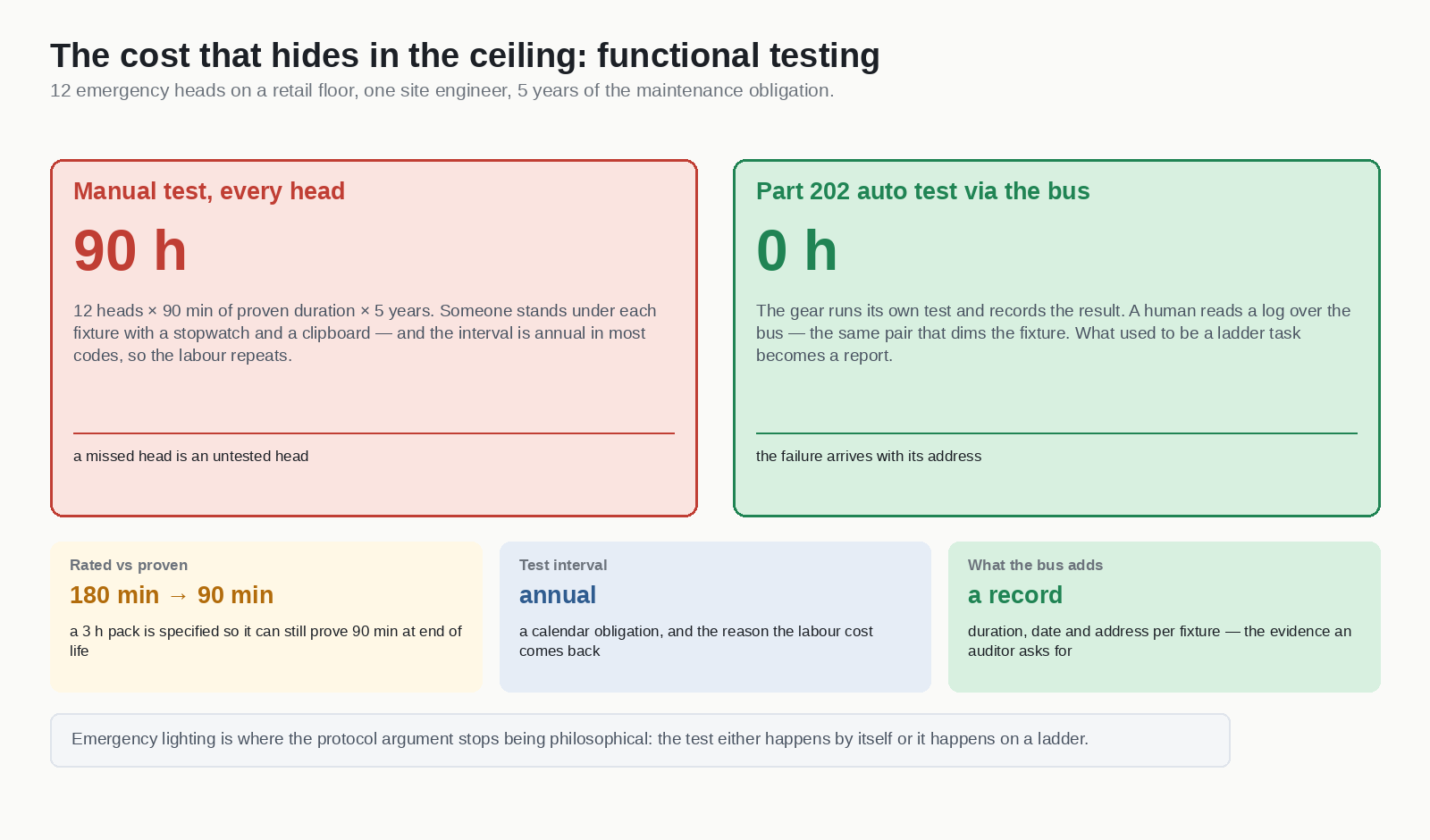
Emergency is where the protocol argument stops being philosophical. A 180 min battery pack is specified so that it can still prove 90 min at end of life, and the functional test is an annual, calendar obligation. On 12 emergency heads, proving each one by hand is 12 × 90 min × 5 years = 90 hours of somebody’s time under a ceiling. A Part 202 or Part 220 system runs its own test over the bus and records the result: the fixture either answers or it does not, and the log already knows which address failed.
Part 253 is the reason D4i exists as a named profile rather than a footnote. A plain DALI-2 driver can be asked what it is doing, but not what it is delivering — it has no idea what the lamp port is doing. A driver with Part 253 reports power, energy and operating hours for its own fixture.
Put a number on it. Twelve 25 W heads is 300 W at the lamp port; at 88 % driver efficiency that is 340.9 W from the mains. Over 4200 hours of trading a year, 1,432 kWh. The aux supply a D4i driver holds for its sensor — budgeted here at 0.5 W on the powered head — moves that to 341.4 W and 1,434 kWh: a difference of 2.1 kWh a year.
Two conclusions follow, and they point in opposite directions. The reporting costs almost nothing in energy — 0.15 % — so “D4i wastes power on the sensor” is not a serious objection. But 2.1 kWh a year is not a business case on its own either. The business case is that the figure exists at all: a reportable zone can be benchmarked, an un-reportable one can only be estimated. Price the metering as a management tool, not as an energy saving.
DALI-2 costs more per head than 0-10V and less per problem. The fixture is the same; the driver costs more; the control layer costs less per zone, because a zone is a group rather than a cable pair. Whether that nets out depends entirely on how often the zones move — which is a question about the project, not about the protocol.
The pattern in the quotes we see: the D4i premium sits in the driver, so it scales with head count, while the 0-10V premium sits in the control cable, so it scales with the number of zones the client asks for at handover. Retail and hospitality projects almost always ask for more zones later. Offices with fixed zones rarely ask for any.
| Specification | 0-10V analog | DALI-2 | D4i (DALI-2 profile) |
|---|---|---|---|
| Control signal | 10 V to 0 V DC level | addressed commands, 1.2 kbit/s | same bus as DALI-2 |
| Direction | one-way | two-way, status replies | two-way plus fixture data |
| Individual addressing | none — one channel per zone | 64 per bus supply | 64 per bus supply |
| Scenes stored in device | no | yes — 16 scenes, 16 groups | yes — 16 scenes, 16 groups |
| Dimming floor | 1 % typical | 0.1 % typical | 0.1 % typical |
| Usable control span | 8.7 V of 10 V (87 %) | full range, log curve | full range, log curve |
| Failure reporting | no | yes — a silent address | yes, with fixture identity |
| Sensor on the same pair | no — one channel each | yes (Part 303 / 304 / 351) | yes, inside the fixture (Part 251) |
| Bus supply inside the driver | n/a | no — separate supply unit | yes (Part 250) |
| Energy reporting per fixture | no | no | yes (Part 253) |
| Emergency self-test over the bus | no | yes (Part 202 / 220) | yes (Part 202 / 220) |
| Wiring alongside mains | Class 2 separation in most jurisdictions | mains-rated bus cable | mains-rated bus cable |
| Best fit | fixed zones, one dimmer | retail, galleries, hospitality | retrofit at scale, metered buildings |
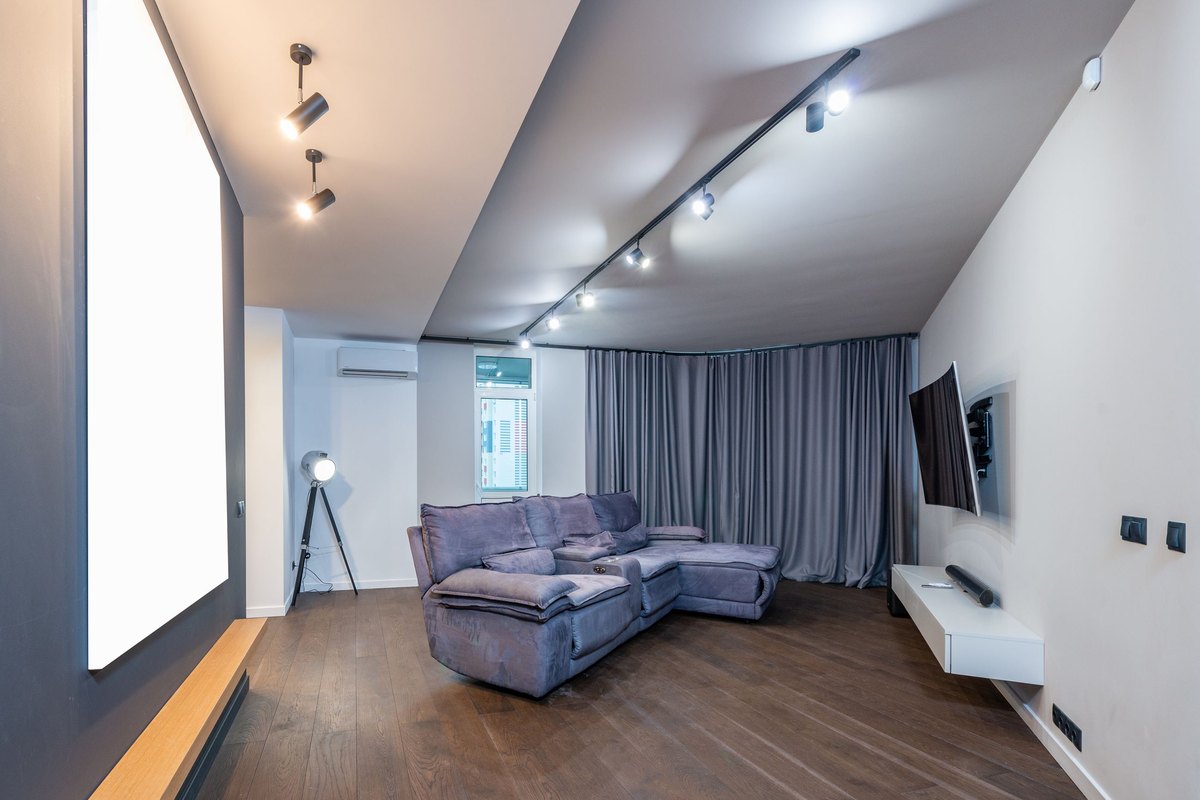
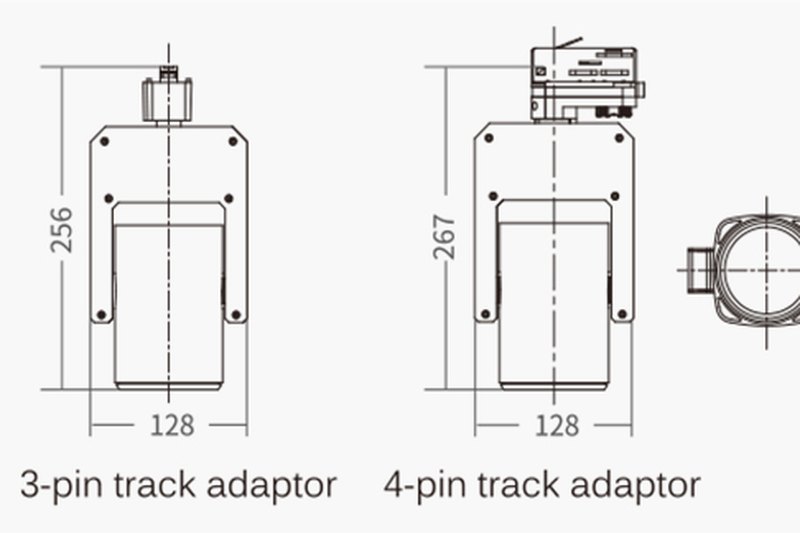
Five questions, in this order. A yes on any of the first four points to DALI-2 at minimum, and two of them point specifically at D4i.
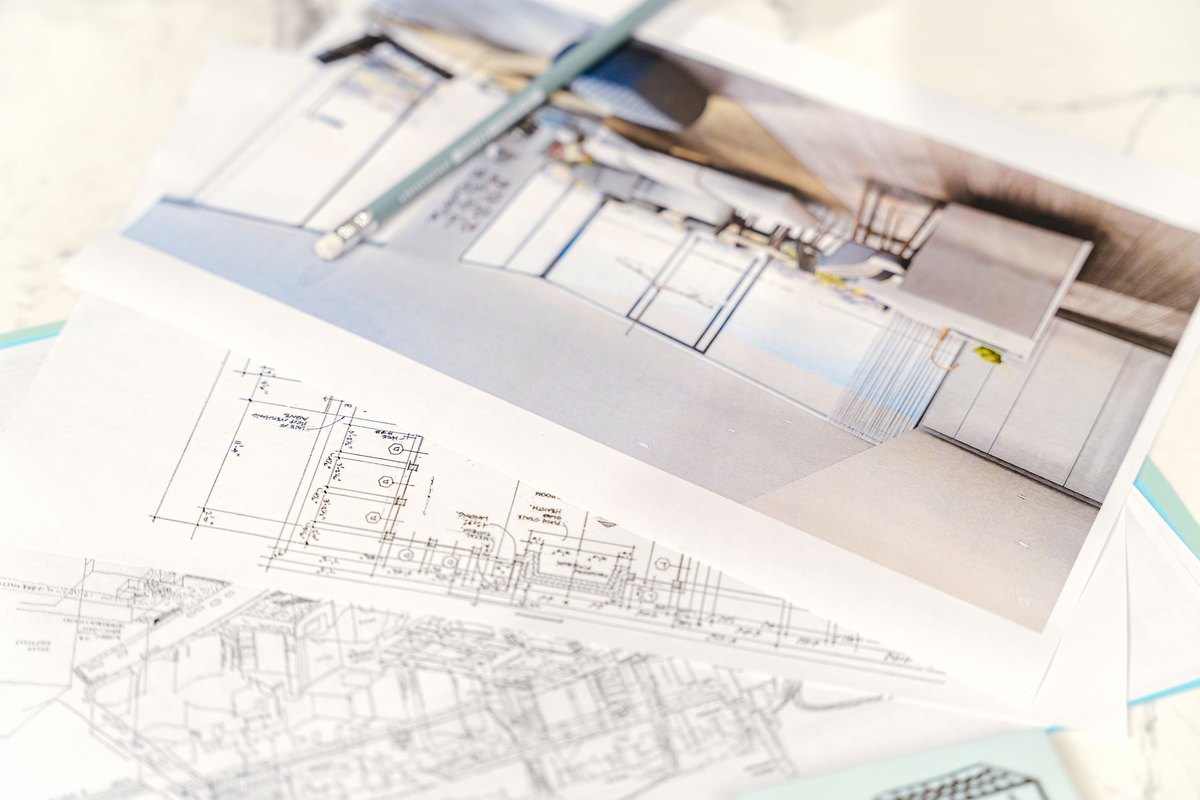
The fixture is the constant. We build the same AIMER 25–35 W track light and the same CADIO 20–30 W track light with a Triac, a 1-10V, a DALI-2 or a D4i driver inside, and the decision about which one goes in belongs to the specification stage, not the sample stage. That is deliberate: a project that changes its mind about control halfway through should not have to change its light.
Two practical notes from the sample room. Ask for the driver part number, not just the protocol name — that number is the only thing that tells you whether Parts 250 to 253 are actually in there. And ask what happens to addressing when a driver is replaced: on a properly specified D4i fixture the answer should be “the new driver inherits the address”, not “someone comes back with a laptop”.
No. DALI-2 is the certification scheme for the whole protocol, covering both control gear and control devices. D4i is a named profile inside DALI-2 that specifies a combination of parts — 250 to 253 — aimed at luminaires with a built-in supply, sensor and data carrier. Every D4i product is DALI-2 certified; not every DALI-2 product is D4i.
At 2 mA per device, a 250 mA supply supports 125 bus units, so current is not the limit for a normal track run. The hard limit is 64 addresses per line. Plan for about sixty heads and split the line, or use a second supply — a second supply does not extend one line, it starts another.
Usually yes, if the head has a replaceable driver and the driver fits the thermal and optical envelope. Get the driver’s part number and confirm which parts it is certified for. Going from a plain DALI-2 unit to a D4i unit does not need new cable — the bus pair stays — but it does need re-addressing and a check that the control system reads the new energy objects.
Marginally, because the driver holds an aux supply for its sensor. Budgeted at 0.5 W on one head in a twelve-head run, the delta is 2.1 kWh a year at 4200 trading hours — 0.15 % of the circuit’s consumption. It is not an energy-saving measure; it is a metering measure.
On a DALI-2 driver the arc-power curve runs 1 % to 100 %, a 100:1 range, and the steps are the same relative size throughout. On 0-10V the usable span is 8.7 V of 10 V, with a dead zone at the bottom where the driver switches off rather than dims. Promise 1 % for DALI-2, and promise 1 % for 0-10V only after measuring the installed run.
DALI-2 fixed the interoperability problem and D4i moved the intelligence into the luminaire. For a track project the practical question is not which protocol is better but how many of these you need: separate answers, a report back, a sensor in the fixture, an energy figure in a report. Each yes moves you deeper into the stack. Zero yesses means 0-10V is not a compromise — it is the right answer.
If you are specifying track for a retail, gallery or hospitality project and want the driver options laid out per fixture, look at our track lights range, or send the reflected ceiling plan and we will come back with a bus layout, an address count and a commissioning estimate. We quote the same head with a DALI-2 driver or a D4i driver, and we will tell you which one the drawing actually needs.
Talk to our lighting team for driver part numbers, photometric files and a sample with the protocol you intend to commission.