Address
304 North Cardinal
St. Dorchester Center, MA 02124
Work Hours
Monday to Friday: 7AM - 7PM
Weekend: 10AM - 5PM
Address
304 North Cardinal
St. Dorchester Center, MA 02124
Work Hours
Monday to Friday: 7AM - 7PM
Weekend: 10AM - 5PM
Track lighting is a mounting system, a spotlight is a fixture type. Compare installation, flexibility, beam geometry and five-year cost per head, with numbers.
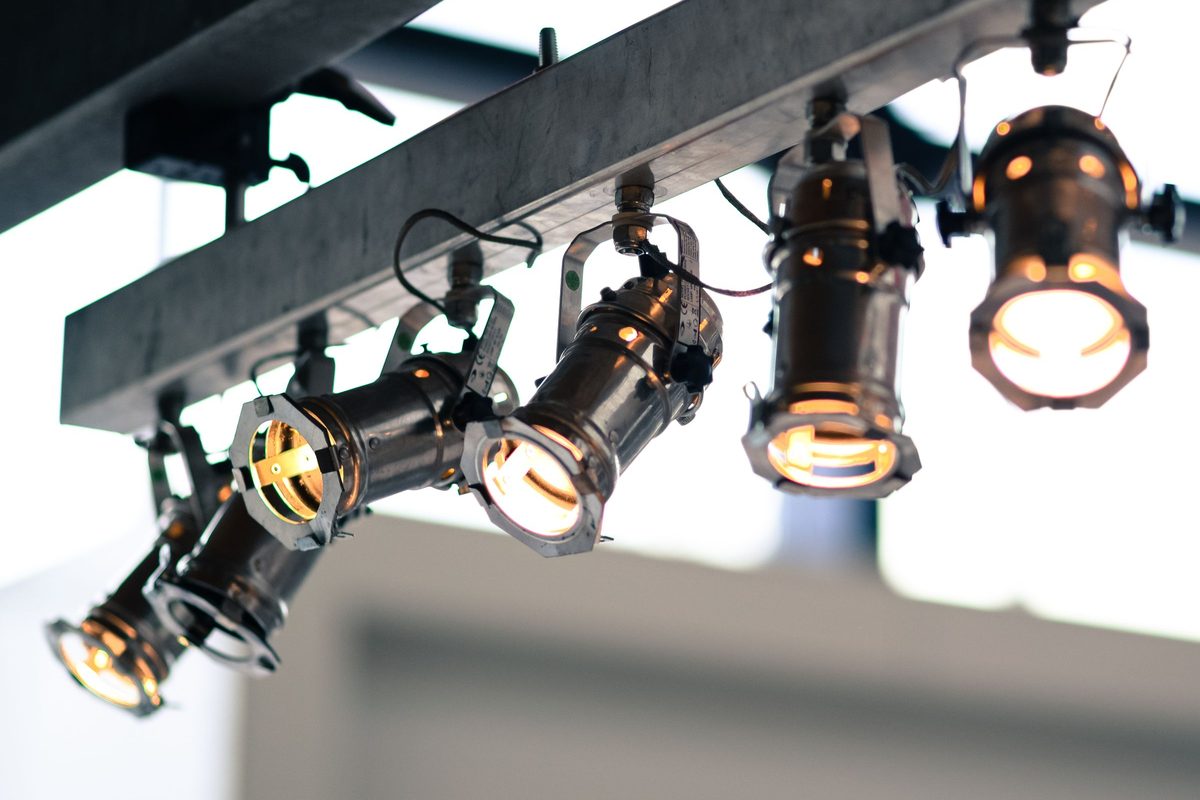
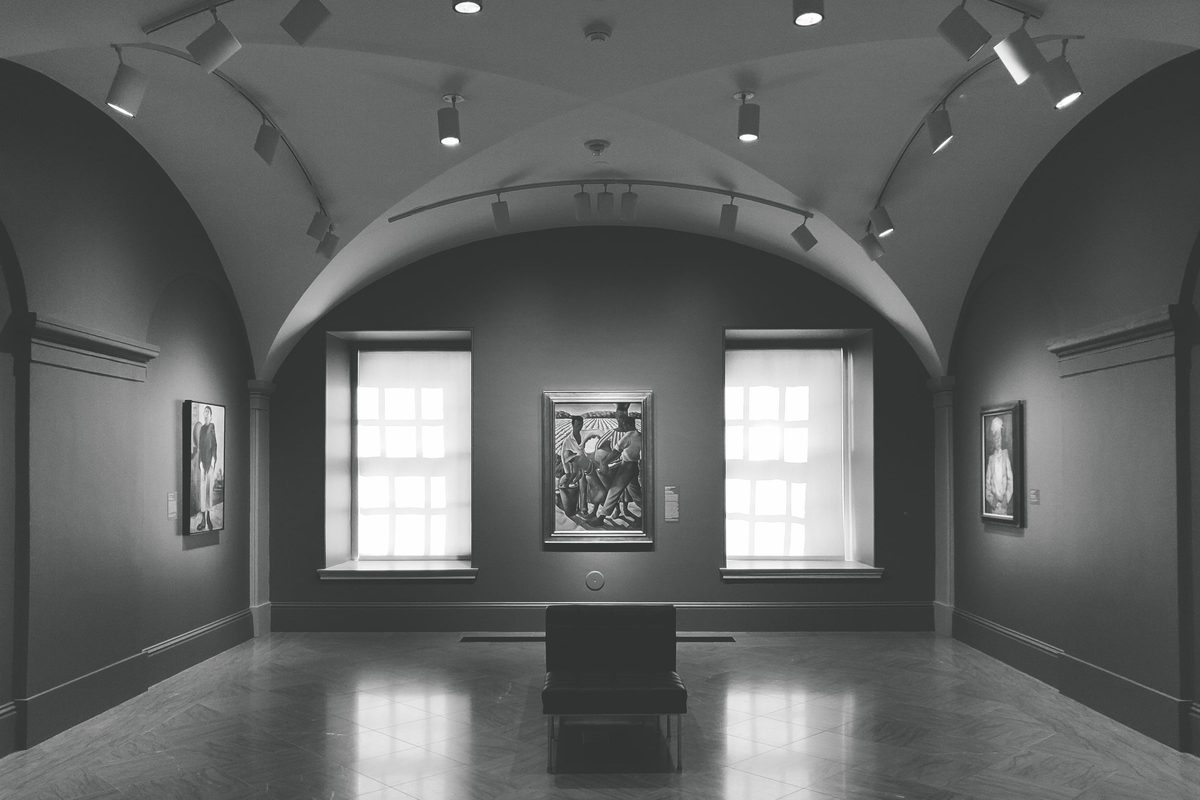
Track lighting and spotlights are not competing product categories. A track system is a mounting and power-delivery method; a spotlight is what the head does with the light. The confusion is real, though, because in a showroom the two look almost identical — a small black cylinder that you point at a wall. The difference only shows up once you try to change your mind about where that cylinder points.
Track lighting runs on a live rail, so the fixtures can be slid along that rail and re-aimed whenever you want, from a stepladder, without an electrician. A spotlight is the fixture itself — a narrow-beam, directionally adjustable head that can be mounted on a track, recessed into a ceiling, or hardwired as a stand-alone unit on a wall or ceiling box.
The practical test is not “which is brighter” but how often will this position change? Track wins when the answer is often. A fixed spotlight wins when the answer is once.
| Question | Track lighting | Stand-alone spotlight |
|---|---|---|
| What it is | A rail plus heads; a system | A fixture; a single unit |
| Moving it later | Slide the head, hand-tightened | New ceiling cut-out or a new box |
| Aiming it | Tool-free, per head | Tool-free on adjustable models |
| Adding a fourth light | Buy one head, clip it on | Open the ceiling again |
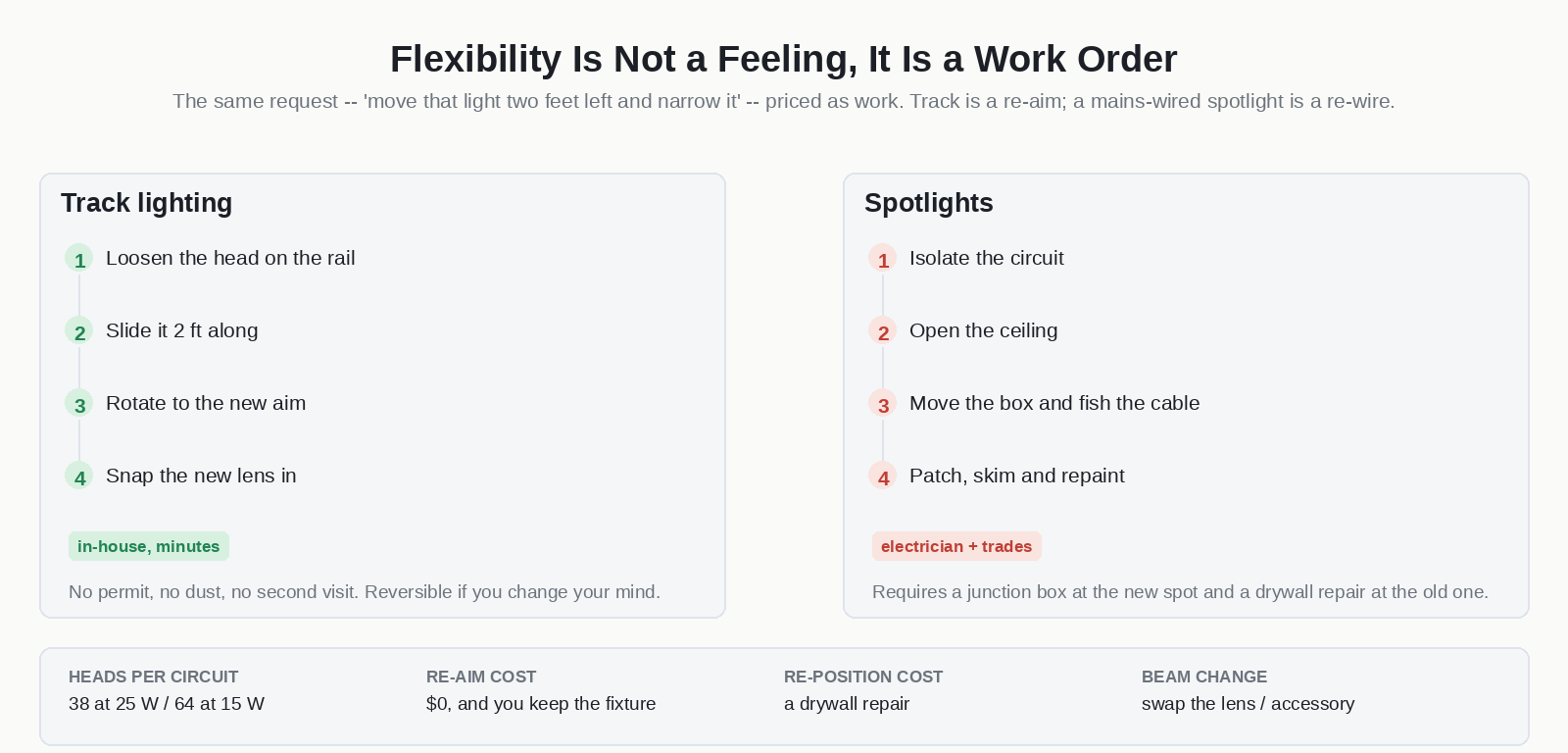
| Ceiling damage per move | None, the rail stays | A patch and a repaint |
| Best at | Retail, galleries, rented space, anything with changing displays | Hospitality, corridors, wet rooms, ceilings you will never touch |
| Weak spot | Visible rail breaks up a plain ceiling | Zero layout flexibility after install |
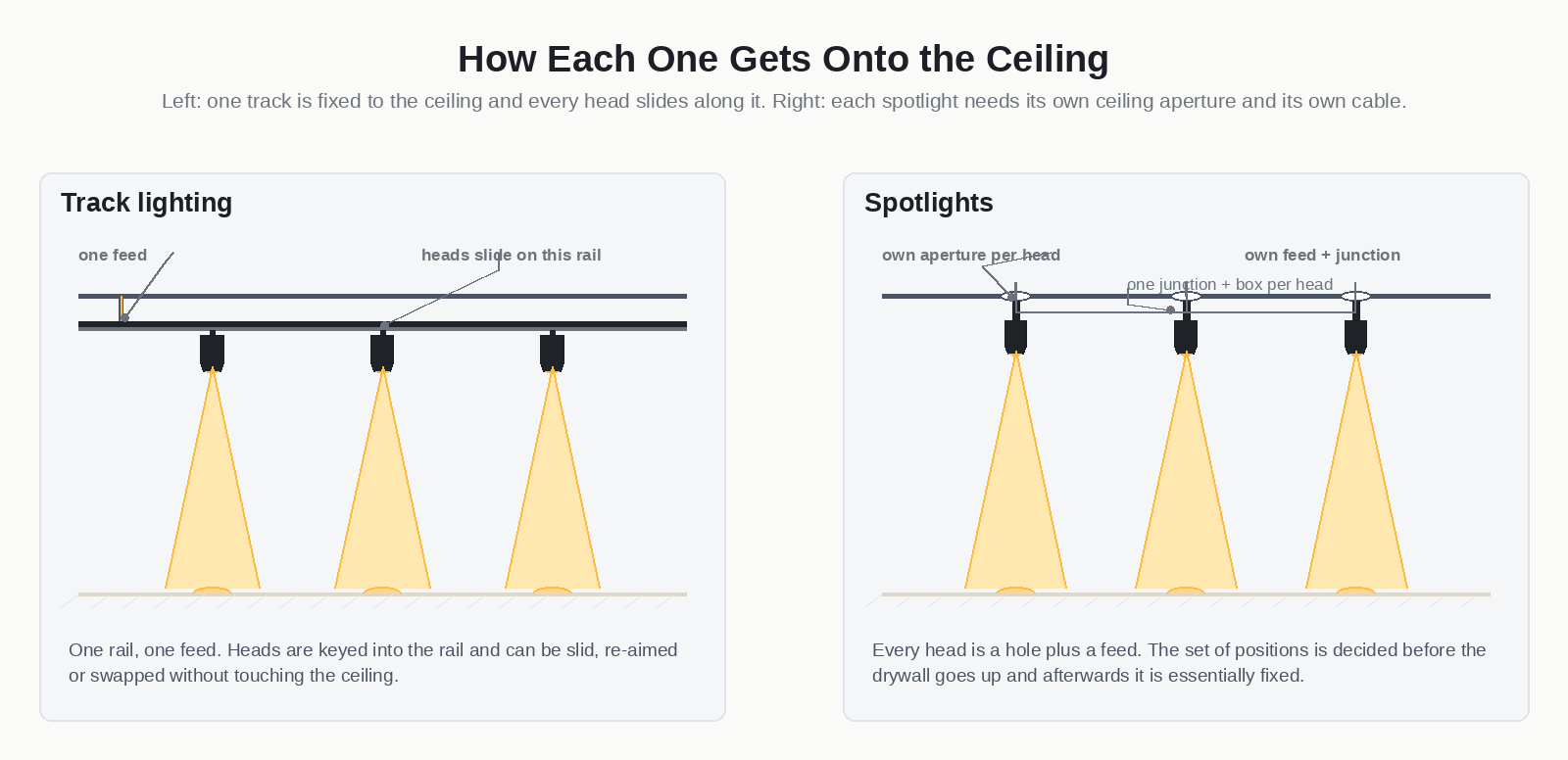
A track system is fed from a single junction point. Run a 12 ft rail, feed it once, and every head on that rail is powered. Four separate spotlights mean four ceiling penetrations, four junction boxes, and four cable runs that all have to be fished back to a supply.
In new construction that is annoying. In a finished ceiling it is the whole decision. Cutting a fourth hole is a different job from turning a thumb screw.
Consider a 12 ft rail with 24° heads at a 30% overlap. That is a pitch of 1.49 ft, which means 8 heads to fill the run evenly — and the floor between any two heads never drops below 97.8% of the peak, so the wall reads as a continuous wash rather than a row of scallops. Change your mind about the spacing next month and you slide the heads along the rail.
The same 8 positions as fixed spotlights are 8 pieces of ceiling you have now permanently committed to.
Both a track head and a spotlight are sold by beam angle, and beam angle drives how far apart they can sit. A 24° head aimed from 5 ft produces a 2.13 ft pool of light. A 60° head at the same distance produces 5.77 ft — 2.72× wider.
Which means a layout that works beautifully with narrow heads will look sparse and spotty with wide ones, on identical fittings, at identical spacing. If you are swapping a 24° head for a 60° head on the same rail, expect to more than double the count.
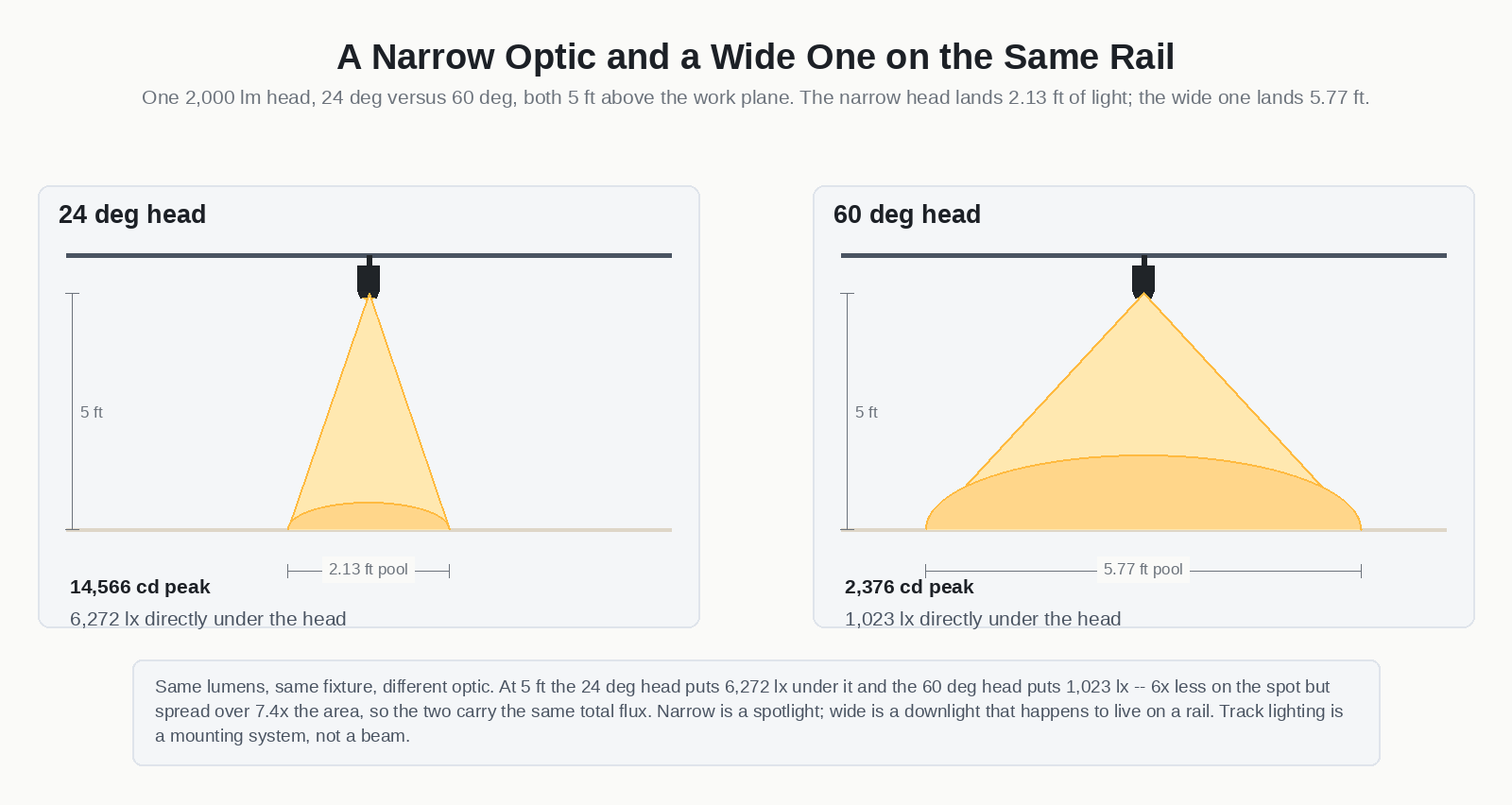
The trade works out in intensity too. A 2,000 lm fixture at 15° concentrates to about 37,207 cd, which is 16,020 lx at 5 ft. Open it to 60° and the same lumens spread to 2,376 cd — 1,023 lx. Roughly 16× less punch per head, which is exactly why wide-beam rooms need more of them.
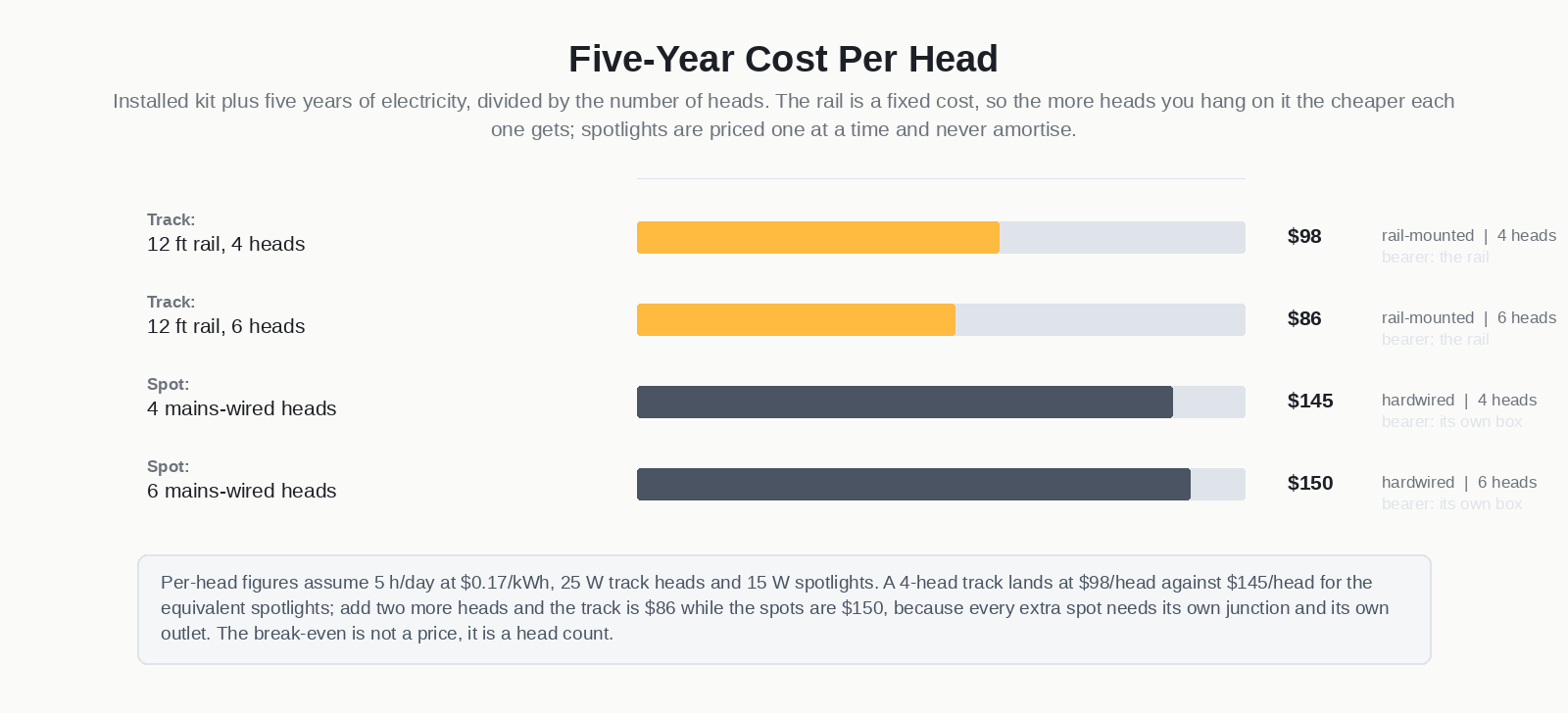
Up front, four hardwired spotlights are not obviously more expensive than a track kit. The labour is where the story changes, and a single re-layout is enough to flip the total.
A 12 ft rail with four 25 W heads lands around $392 — about $98 per head, materials only. Four hardwired 40 W spotlights, each needing its own junction box and rough-in, come to roughly $416, or about $104 per head. Track is cheaper before anyone touches a ladder.
Shop the AIMER Track Light 25-35W →
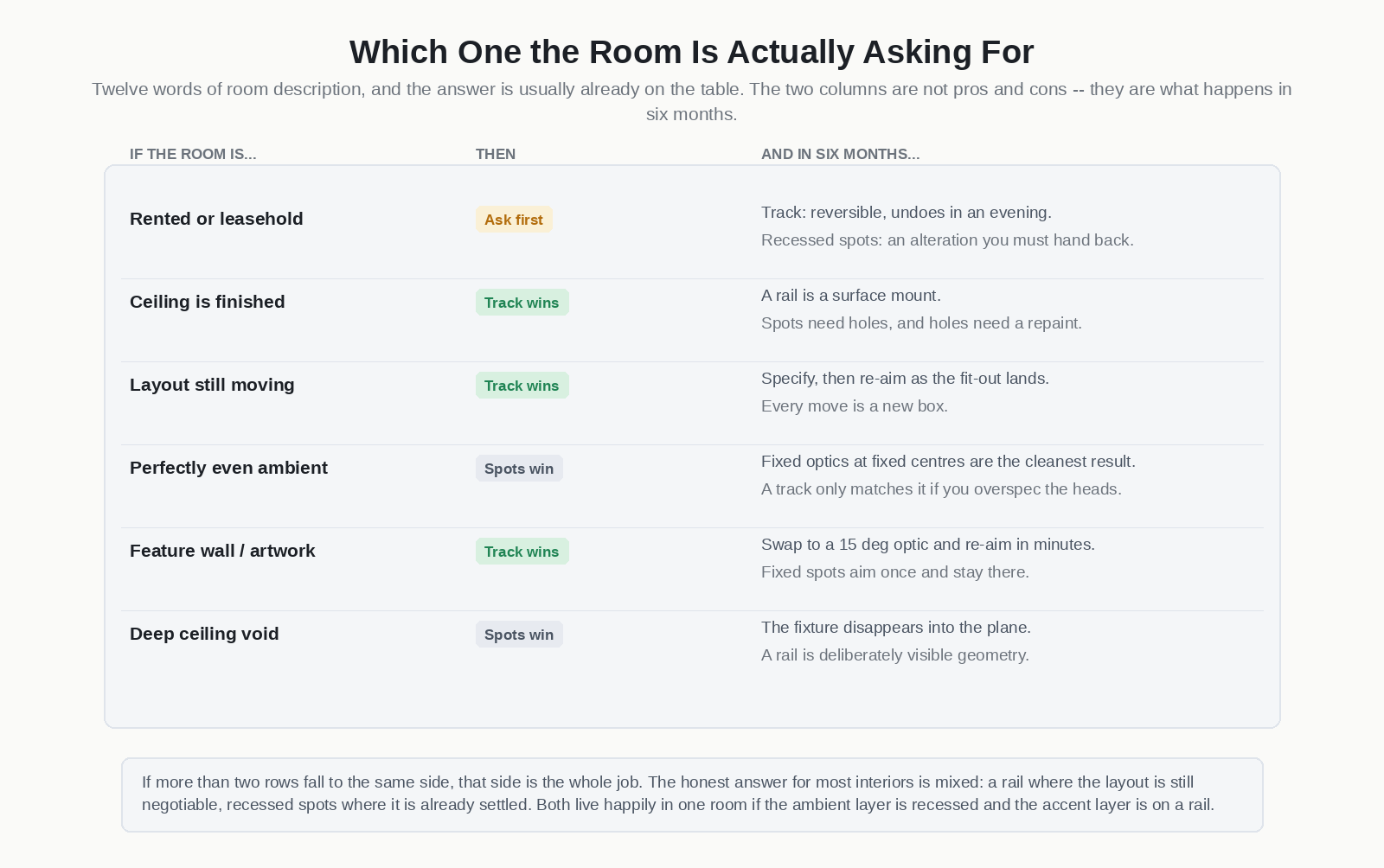
Track is not automatically right. Choose stand-alone spotlights when the plan is genuinely final, when the ceiling is a design feature you do not want a rail crossing, when the fixture must sit in a wet zone, or when the pitch is irregular — an off-centre feature wall, a corridor that dog-legs, a stairwell — and the heads on a straight rail would not land where they need to.
Recessed spotlights also win on appearance in calm interiors: no visible hardware, nothing to dust, nothing to accidentally knock out of aim.

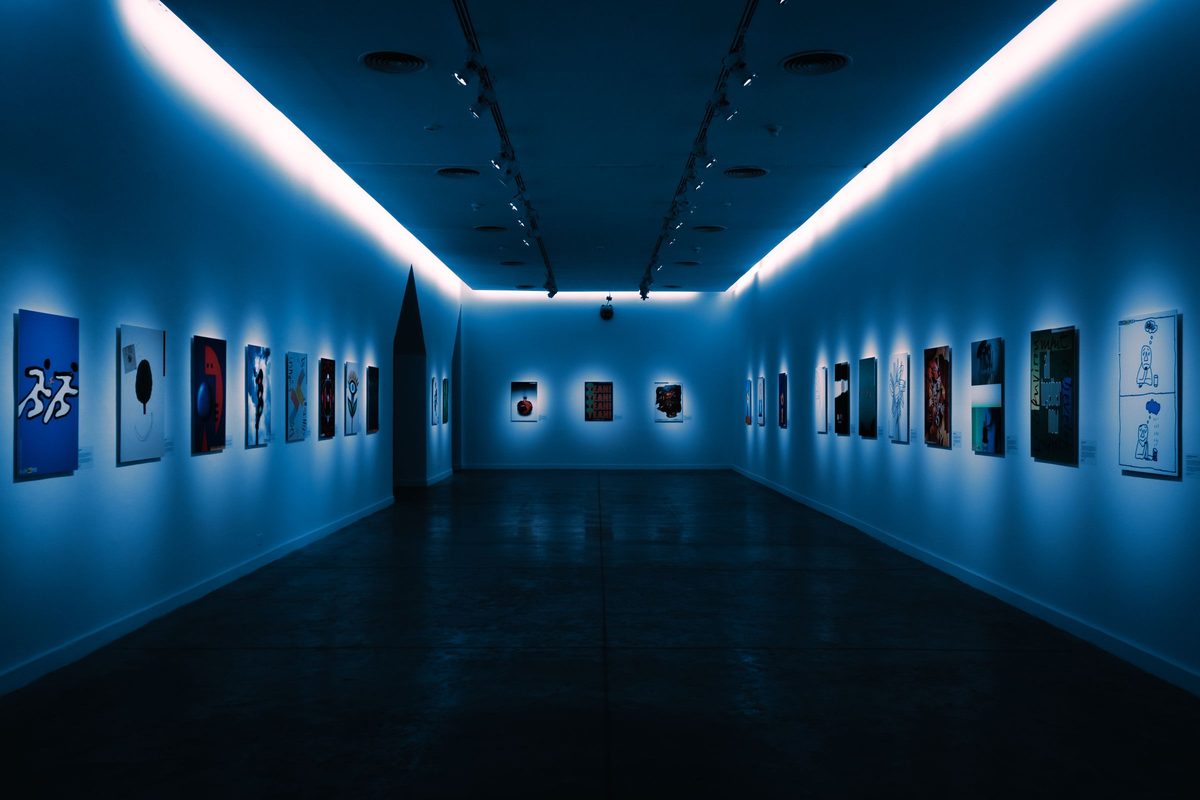
The strongest schemes usually mix. Put the general wash — the light that has to cover a room evenly for years — on fixed recessed or surface spotlights. Put the light that has to hit a moving target, the display wall, the artwork, the feature, on a short track run.
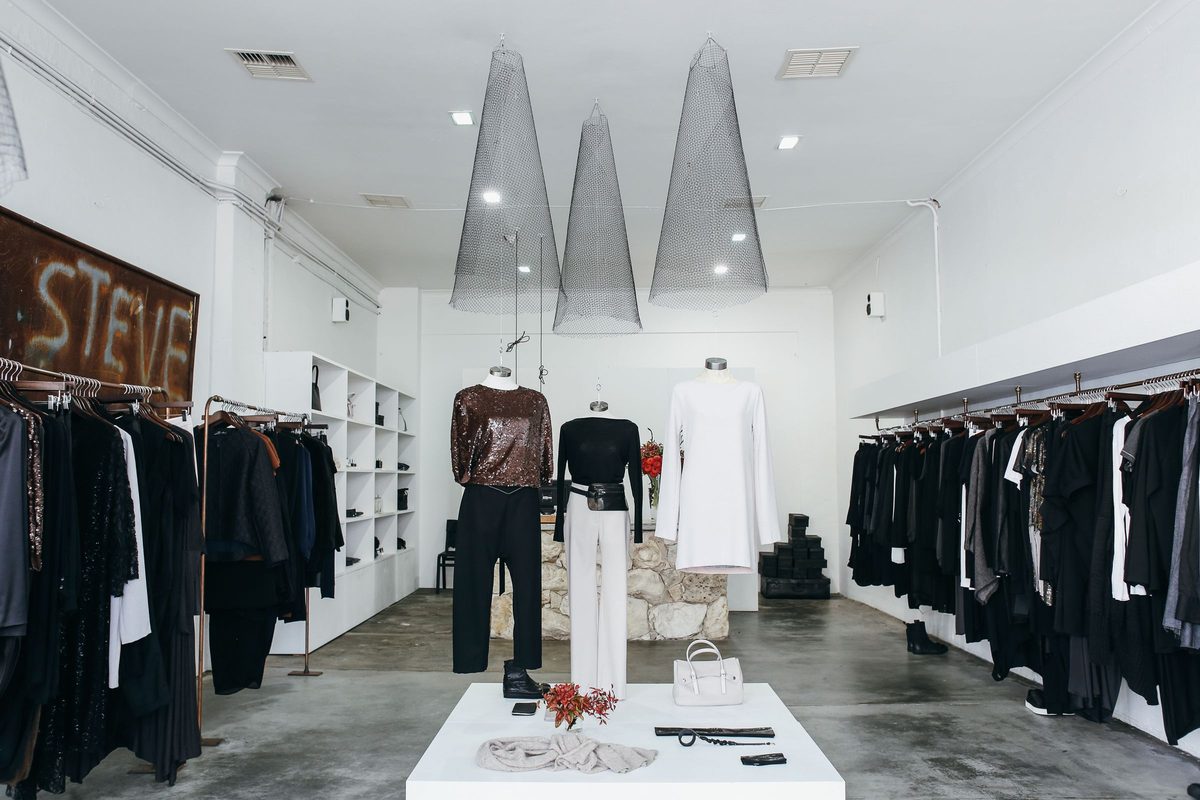
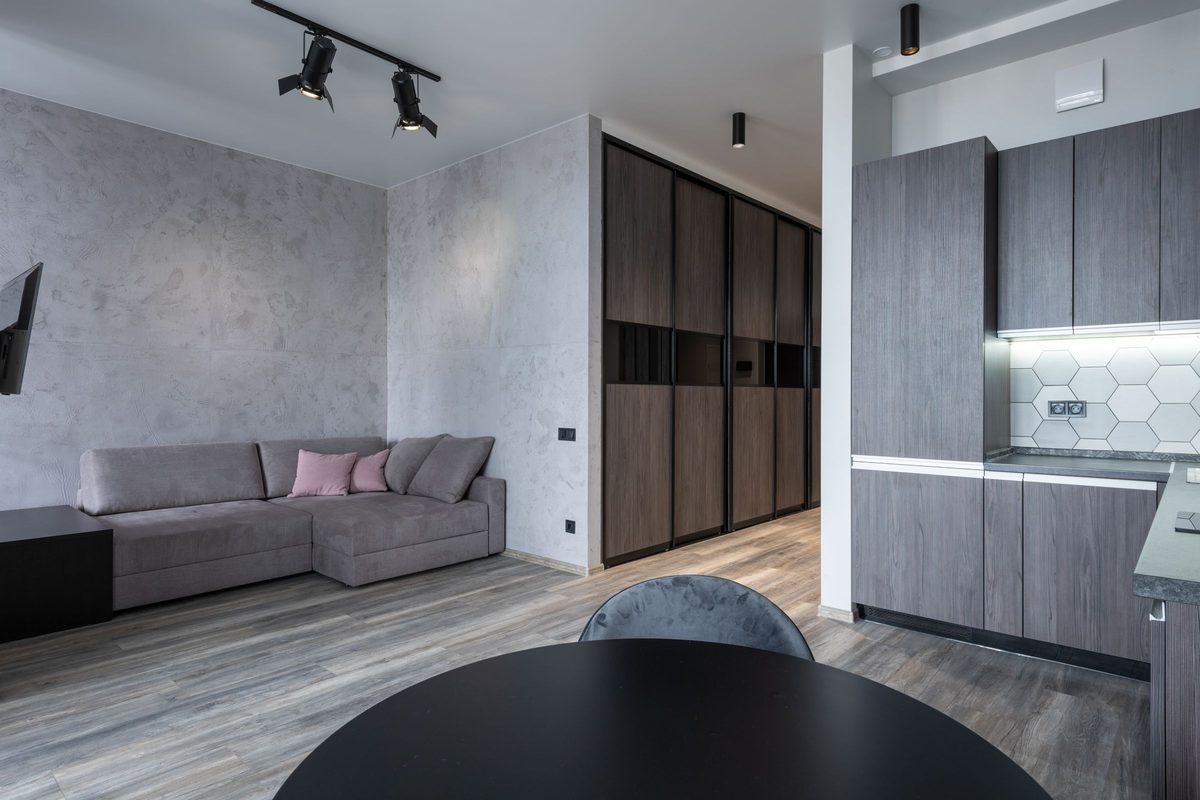
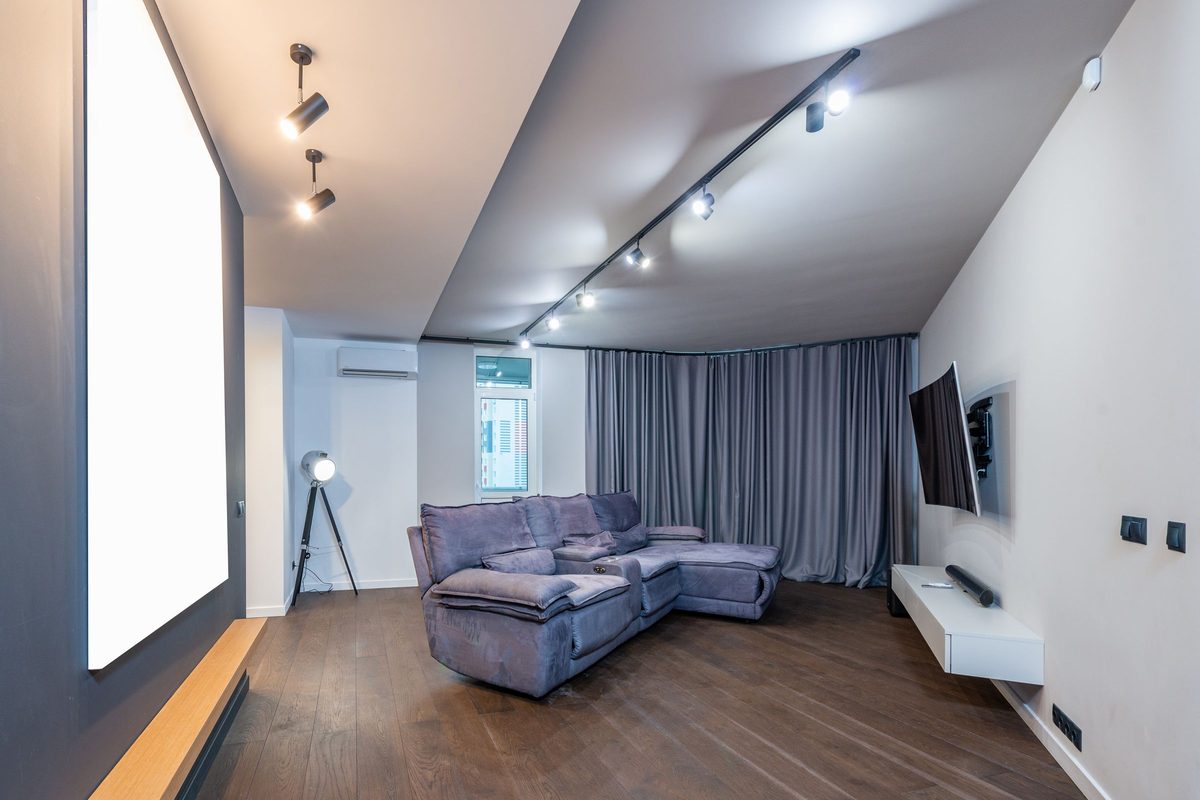
If you are lighting a retail floor, a gallery, an exhibition space, or a rented flat where the display changes with the season, take the track. If you are lighting a hotel corridor, a bathroom, or a new-build where the furniture plan is signed off and the ceiling is clean, take the fixed spotlight and specify the beam angles properly the first time.
And if you are stuck between them for the same room, the honest answer is often both: a run of track over the part that will change, fixed heads over the part that will not.
No. Track lighting is a system that carries power along a rail and lets heads be moved along it. A spotlight is a fixture type with a narrow, aimable beam that can be mounted on a track, recessed, or hardwired on its own.
Yes — that is the usual arrangement. Track heads are spotlights with a rail adapter on the back. The distinction is about mounting and power, not about the beam.
No. Moving or re-aiming a head on a live rail is a hand job. Adding a completely new run of track, or moving the feed, is electrical work.
Per head, no — a 12 ft rail with four 25 W heads runs about $392, versus roughly $416 for four hardwired spotlights once junction boxes and rough-in are counted. Track also avoids the wall-patching cost every time the layout changes.
It depends on beam angle and mounting height, not on a fixed number. At 5 ft with 24° heads at 30% overlap, a 12 ft rail takes 8 heads at a 1.49 ft pitch. Swap in 60° heads and the pools more than double in diameter.
Track lighting is a mounting decision. A spotlight is a beam decision. Most rooms need both answers, and the project that suffers is the one where someone bought a wall of fixed spotlights and then discovered, six months later, that the display had moved and the ceiling had not.
Want to see the numbers for your own room? Talk to EncoreLume, or compare against the other fixtures in the series: track lighting vs recessed downlights and track lighting vs pendant lighting.