Address
304 North Cardinal
St. Dorchester Center, MA 02124
Work Hours
Monday to Friday: 7AM - 7PM
Weekend: 10AM - 5PM
Address
304 North Cardinal
St. Dorchester Center, MA 02124
Work Hours
Monday to Friday: 7AM - 7PM
Weekend: 10AM - 5PM
How to choose a dimmer for track lighting: match the driver's phase type, stay inside its load window, and why a 150 W dimmer still flickers on small heads.
Choosing a dimmer for track lighting runs in the opposite order to the way most people choose one. You do not start with the dial on the shelf. You start with the driver printed on the back of the head, then you count the heads, then you check the two ends of the dimmer’s own load rating. Get those three in that order and the shelf shortens to one or two candidates. Get them in the wrong order and you buy a dimmer that buzzes, drops out at 30 %, or flickers only in the evening when nothing can be done about it.
This page is about the dimmer, not the protocol. If you are still deciding between phase-cut, 1-10 V and DALI as systems, read DALI vs 0-10V dimming or TRIAC vs DALI for track lighting first. Everything below assumes the protocol question is settled and you now have to pick a wall device that will behave with the heads on your rail.
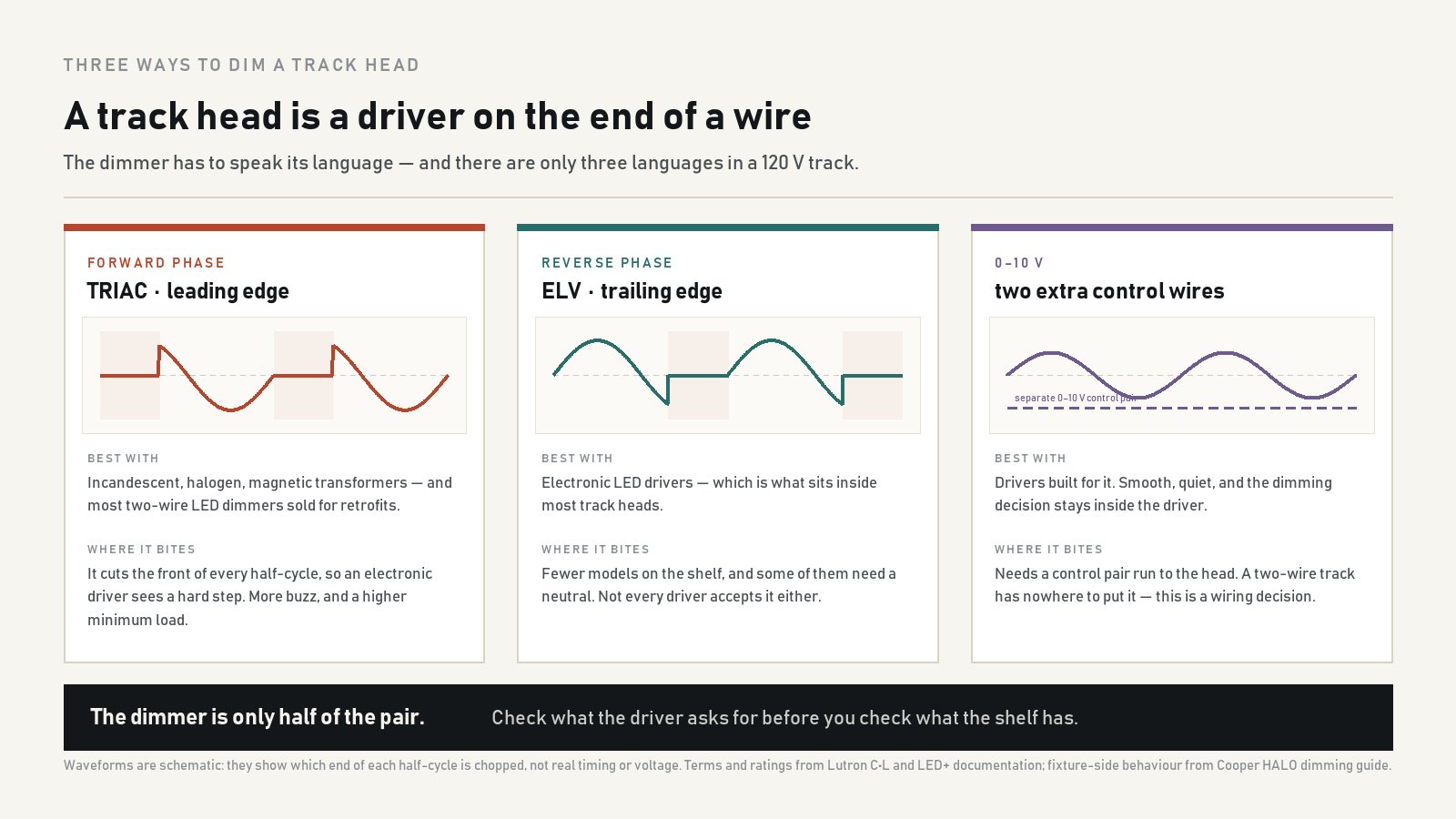
A track head is a driver on the end of a wire. The dimmer does not dim the LED; it decides what shape of wave the driver is allowed to see, and the driver decides what to do with it. That is why two dimmers with identical ratings can behave completely differently on the same six heads: one speaks the driver’s language and the other does not.
There are only three things a dimmer can do to the wave, and the driver datasheet says which one it wants. Forward phase cuts the front of every half cycle, is the oldest and the cheapest, and most electronic drivers tolerate it only if the dimmer carries an LED rating. Reverse phase cuts the back edge instead, which leaves the driver a clean zero crossing to work from and is the quieter choice for electronic loads. 0-10 V does not cut the wave at all – it runs a separate pair of low-voltage wires to the driver and asks politely. Reverse phase and 0-10 V are not interchangeable at the wall box: the second one needs a control pair that a two-wire track circuit does not have.
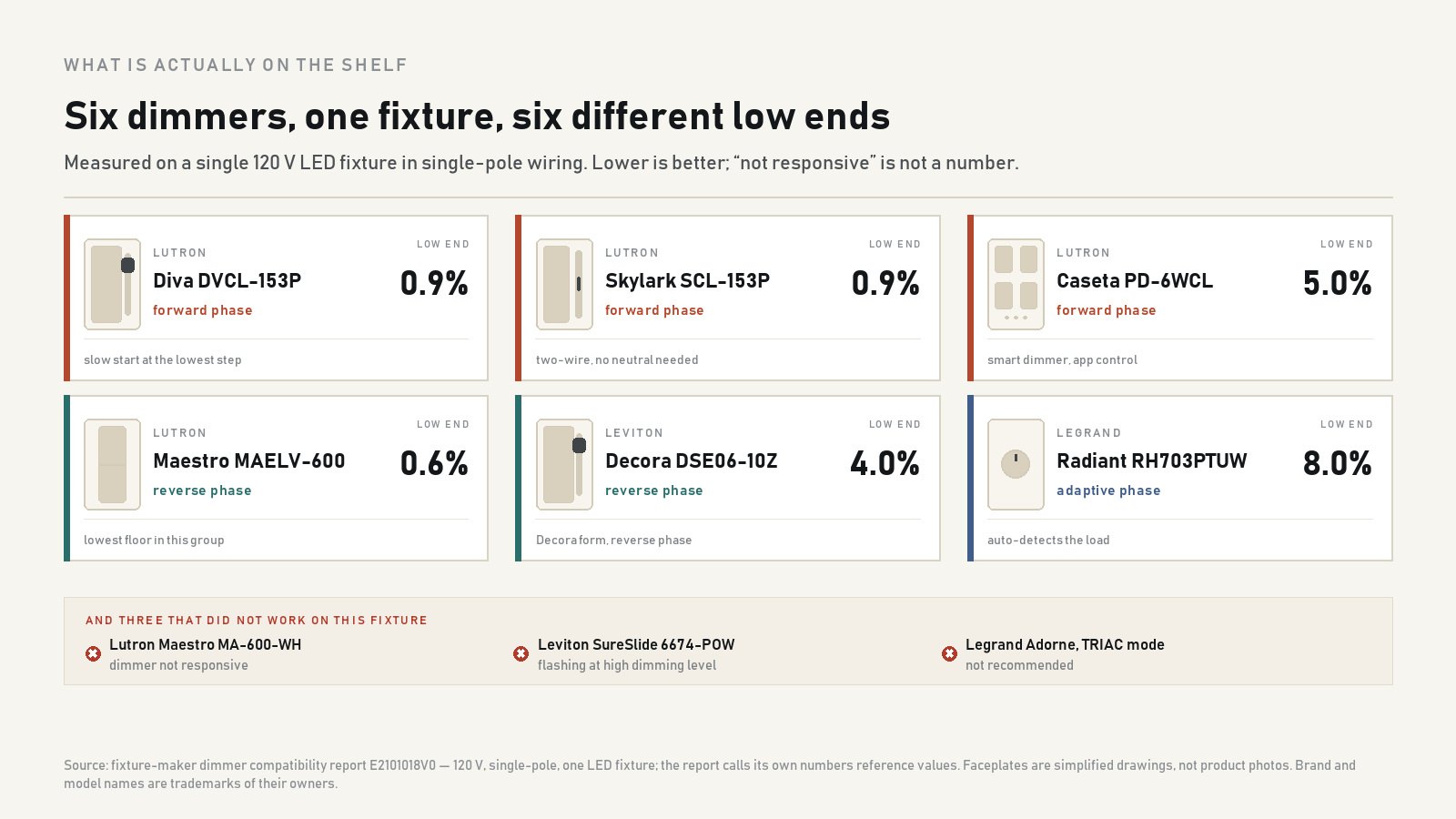
The practical consequence: a compatibility claim is a claim about a pair, not about a product. Any dimmer datasheet that promises “works with LED” is telling you it has an LED rating, not that it has been run against your driver. The pair gets tested, or the pair gets guessed at.
Before you blame the dimmer, look at what the fixture is allowed to give you. On a 120 V track, a dimming driver typically offers three flavours, and only two of them change colour on the way down.
Notice the asymmetry. A dim-to-warm head is forgiving of a poor dimmer, because the colour shift disguises small output steps. A standard-dimming head is not: every step the dimmer cannot resolve shows up as a visible hop in a white room. If your project is a gallery, a white-walled retail bay or a bedroom ceiling, choose the head with the dimmer floor in mind. AIMER and CADIO track heads are both available with independent, replaceable drivers precisely so the dimming spec can follow the project instead of the other way round.
A dimmer is rated at two ends and the catalogue usually prints only the top one. The top is the maximum load – exceed it and the device runs hot and derates. The bottom is the minimum load, and it is the one that produces the calls: a published 40 W typical minimum for LED loads and 25 W for incandescent on the same device. Under the floor, a phase-cut dimmer cannot form a stable piece of wave for the driver to work from, so the head pops on late, drops out early, or flickers in the lowest third of the travel.
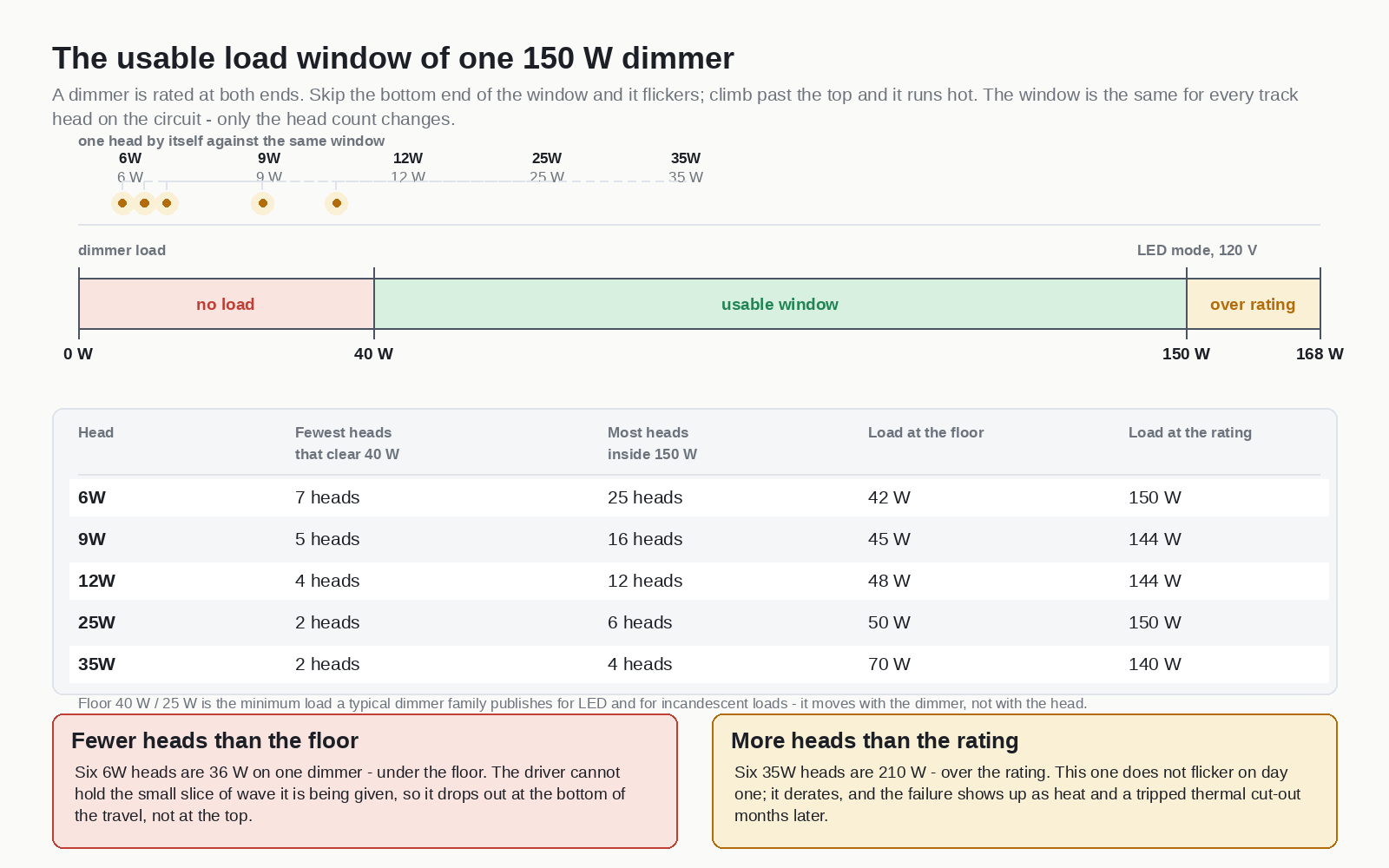
scripts/dimmer_track_illustrations.py, which shares its arithmetic with the figures quoted in this article.The arithmetic is short enough to do on a phone. Take a 150 W LED-rated dimmer with a 40 W floor and a six-head run:
| Head | Fewest heads that clear 40 W | Most heads inside 150 W | Six heads on one dimmer |
|---|---|---|---|
| 6 W | 7 heads (42 W) | 25 heads (150 W) | 36 W – under the floor |
| 9 W | 5 heads (45 W) | 16 heads (144 W) | 54 W – inside |
| 12 W | 4 heads (48 W) | 12 heads (144 W) | 72 W – inside |
| 25 W | 2 heads (50 W) | 6 heads (150 W) | 150 W – inside, at the ceiling |
| 35 W | 2 heads (70 W) | 4 heads (140 W) | 210 W – over the rating |
That table is the whole argument in five rows. The same dimmer is correct for six 9 W heads and wrong for six 6 W heads, and the difference is not quality – it is arithmetic. Small heads on a big dimmer is the most common failure we get asked about, and it is invisible on the box: the dimmer says 150 W, the six heads add up to 36 W, and nothing on either package says “this combination will misbehave”.
LED drivers do not draw a smooth current. On a cold start, the input capacitor fills in a couple of milliseconds and the instantaneous current spikes. For a 100 W head that is roughly 0.83 A steady and around 10 A at the peak – a twelve-fold multiple for a few milliseconds. Phase-cut dimmers survive this because they are rated for it; cheap ones are not, and the symptom is the flicker you get for the first half second after switching on, then never again. It is also why the dimmer, not the breaker, sets how many heads go on one control: the breaker sees the average, the dimmer sees the peak.
Compatibility lives in three documents, and a specifier should be able to produce all three before an order goes out:
When the list does not exist for your pair, the honest answer is that it is untested – and untested pairs fail in a small number of recognisable ways. The most useful thing you can do with ten minutes and a sample is to switch the circuit on with the dimmer at minimum, not at full. A pair that flickers at the bottom is a pair that will be complained about; a pair that is silent at the bottom is usually fine everywhere else.
The floor is where the argument usually gets imprecise, so here it is as a curve. A room lit to 300 lux at full output holds 150 lux at 50 %, 60 lux at 20 %, 30 lux at 10 % and 15 lux at 5 %. Those are not linear, and neither is the eye: 30 lux is a plausible evening level for a living room, 15 lux is a corridor at night. On a dim-to-warm pair the colour moves too – 2008 K at 50 %, 2284 K at 20 %, 2492 K at 10 % and 2700 K at 5 %, all from the same curve.
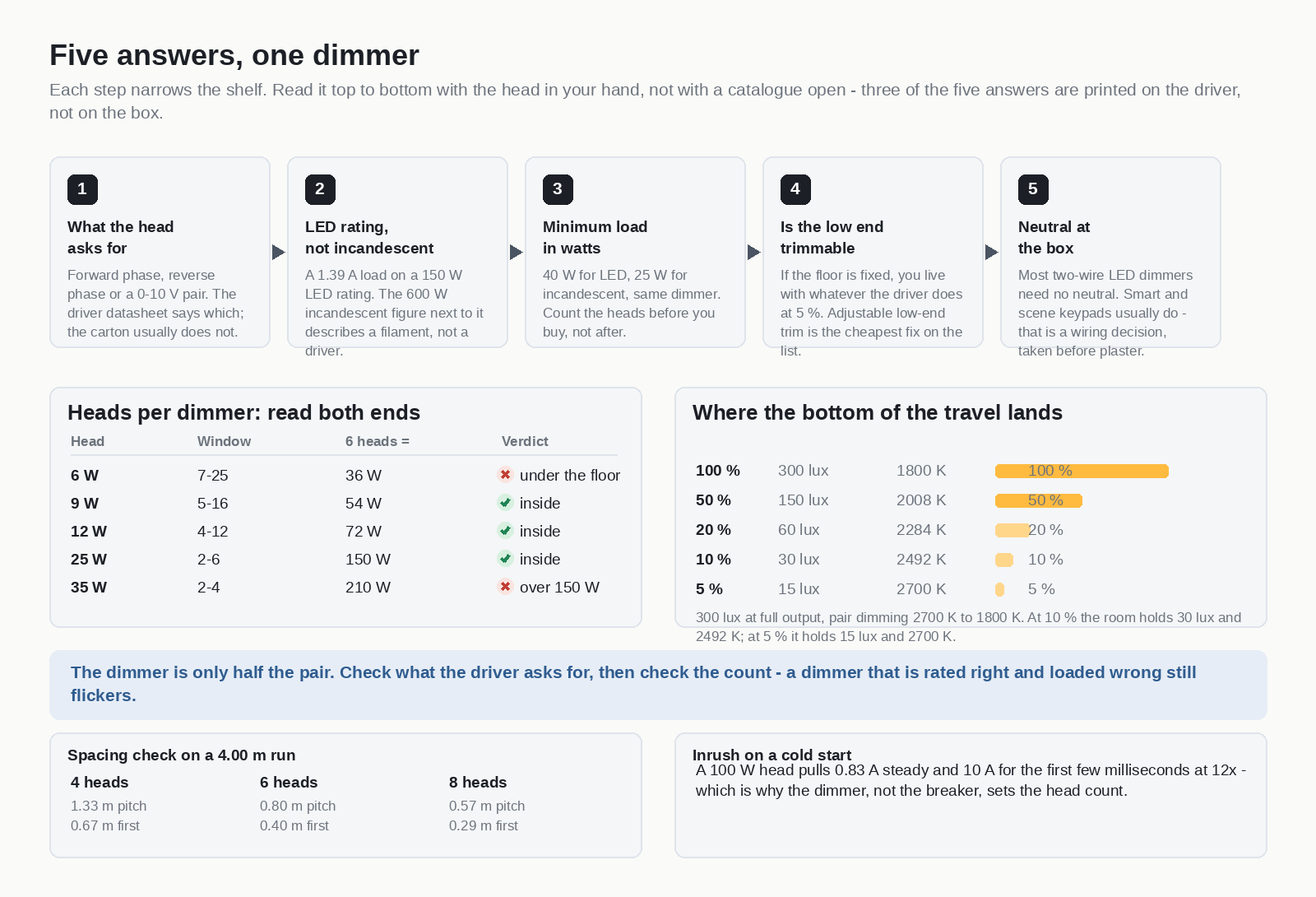
Which is why the most valuable specification on the dimmer is not the floor – it is whether the floor can be trimmed. Adjustable low-end trim lets you raise the bottom of the travel until the driver stops misbehaving, and it costs nothing at the wall box; a dimmer without trim forces you to live with whatever the driver does at 5 %. In a job where the head count cannot change (a finished ceiling, a listed fixture), trim is usually the only lever left.
Almost nothing in this list is a faulty dimmer. It is a pair that was never checked against each other, and the symptom tells you which half to change.
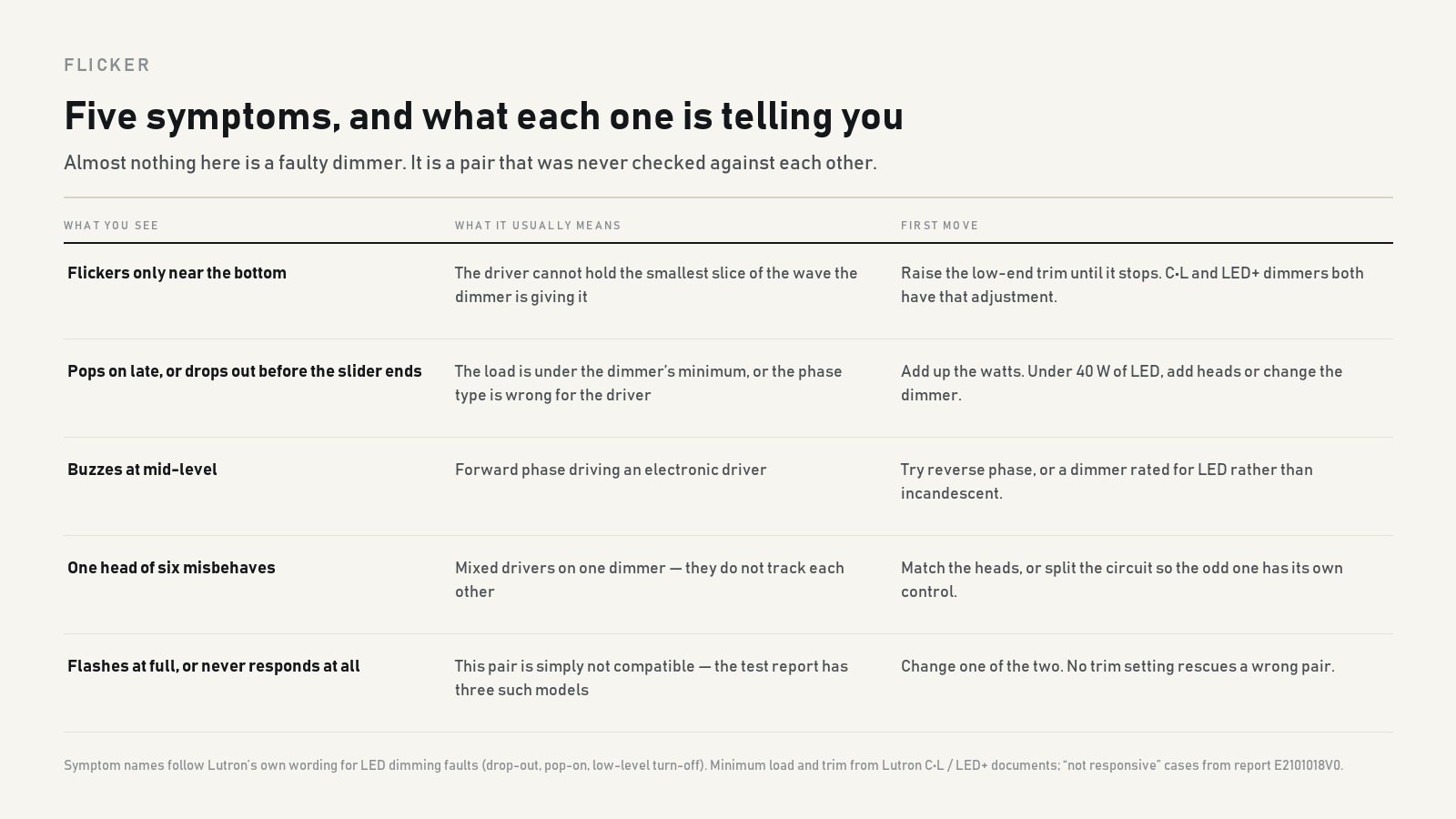
| What you see | What it usually means | First move |
|---|---|---|
| Flickers only near the bottom | The driver cannot hold the smallest slice of wave the dimmer hands it | Raise the low-end trim until it stops; only then look at the hardware |
| Pops on late, drops out before the travel ends | The load is under the minimum, or the phase type is wrong | Add heads or head wattage; check phase type against the driver sheet |
| Buzzes at mid-level | Forward phase driving an electronic driver | Move to reverse phase, or fit a dimmer rated for LED loads |
| One head of six misbehaves | Mixed drivers on one dimmer – they do not track each other | Match the heads, or split the circuit so the odd one is alone |
| Flashes at full, never responds | The pair is simply incompatible | Change one of the two; no trim setting rescues a wrong pair |
The one worth memorising is the first row. A circuit that is silent at full output and shimmers at the bottom is not a bad dimmer and not a bad head – it is a pair sitting just under the load floor, and the fix costs nothing but a screwdriver and five minutes with the trim.
Six things, five of them on paper one of them on the ceiling. Ten minutes with these in front of you closes the question before anything is ordered.
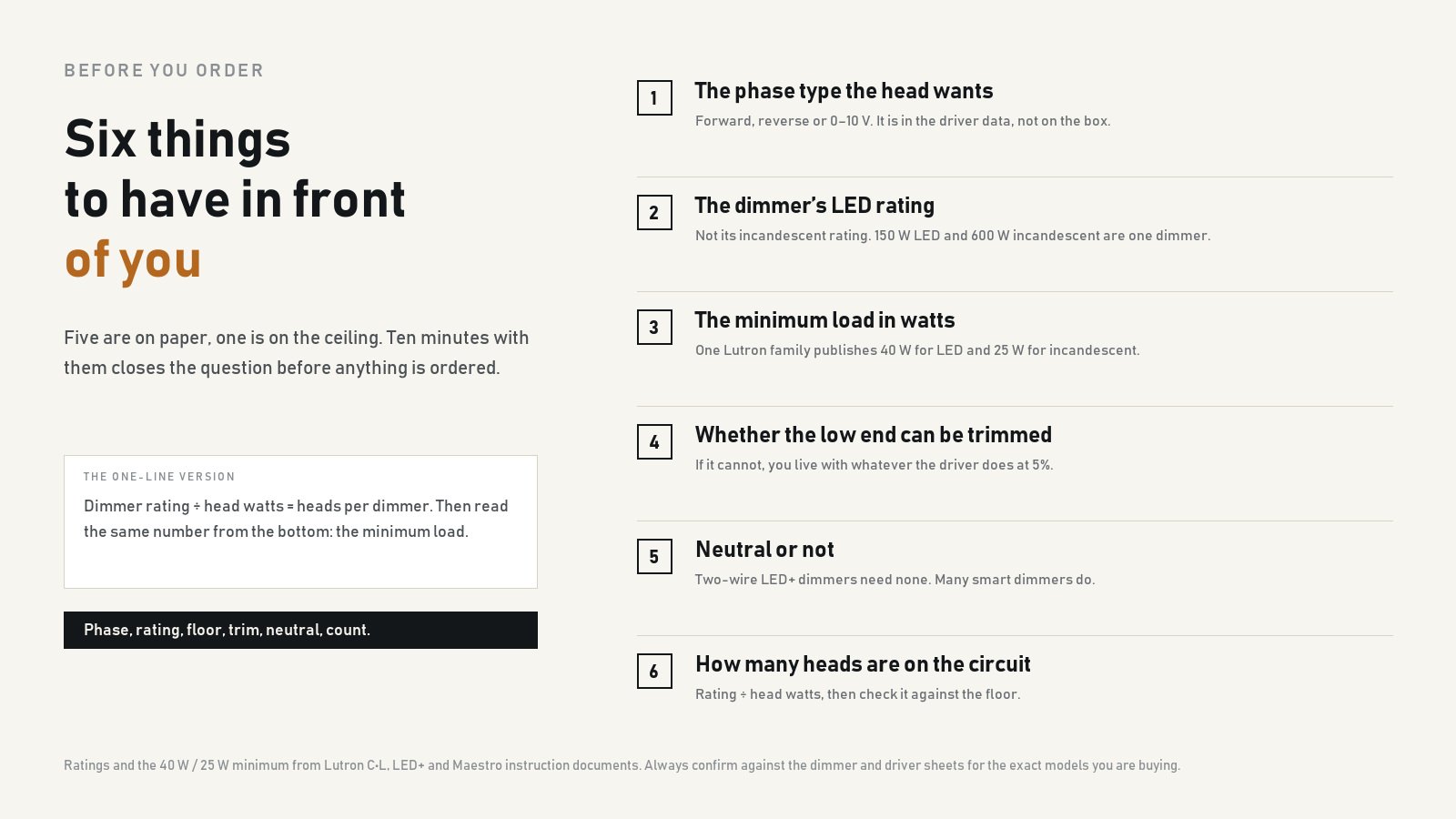
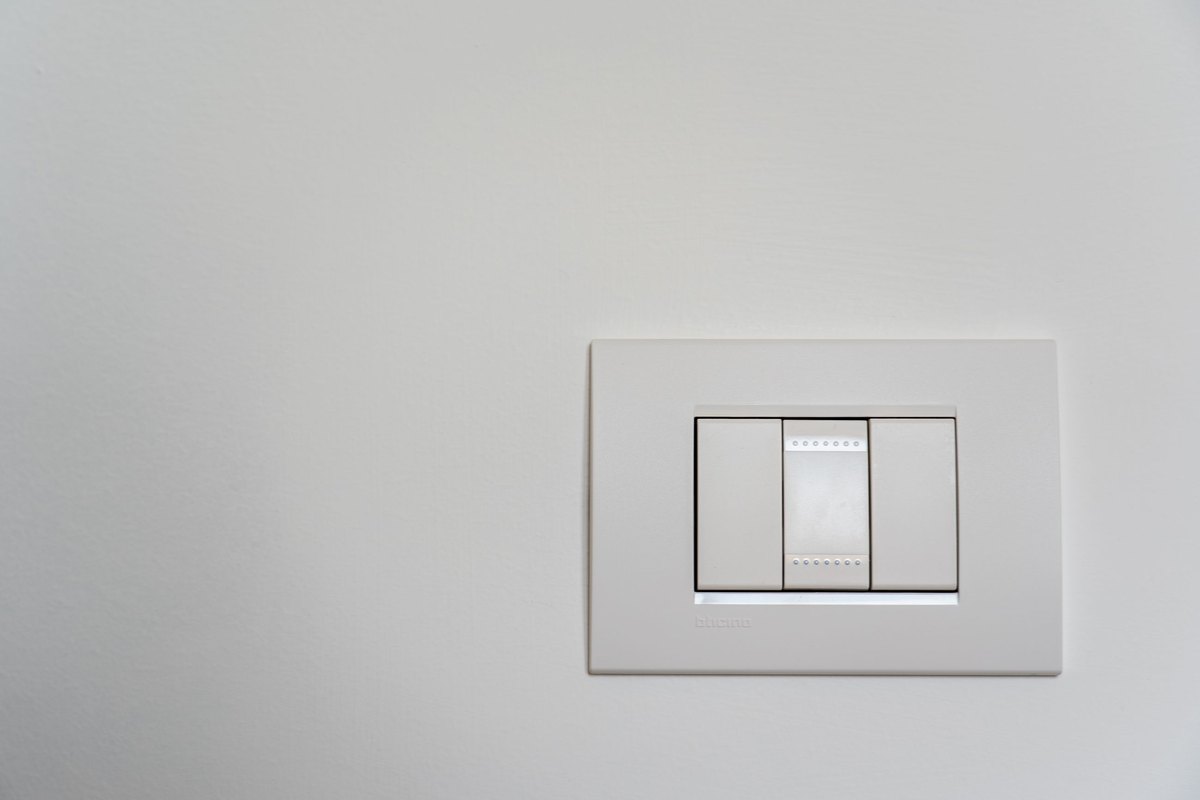
Two more that are easy to forget and expensive to fix. On a 4.00 m track run, six heads sit at 0.80 m pitch with a 0.40 m offset at each end; four heads sit at 1.33 m pitch. If dimming is meant to drop the room into an evening scene, that spacing needs to be checked against the beam angle at the same time – a run that looks fine at 100 % develops visible hot spots at 20 % because the eye’s tolerance for unevenness falls as the level does. The layout arithmetic is in track light spacing by beam angle and height. And leave the dimmer accessible: a device buried behind a fixed panel cannot have its trim adjusted, which turns a five-minute fix into a ceiling job.
The finished space is what all of this is for. A gallery at 12 % output, a jewellery case at 20 %, a bedroom at 8 % – those are the levels where load floors, trim and driver behaviour stop being paperwork.

No. The LED rating tells you the dimmer can handle a driver load up to that wattage; it does not tell you which phase type the driver expects or whether the pair has been tested together. Check the driver datasheet for the phase type, then the dimmer for its LED rating and its minimum load, then look for a published compatibility list that names the driver.
In most cases the circuit is sitting under the dimmer’s minimum load, so the driver cannot hold the small piece of wave it is being handed. Six 6 W heads on a 150 W dimmer is 36 W against a 40 W floor. Raise the low-end trim first; if that is not adjustable, add a head or change to reverse phase.
You need one that reaches the bottom of the travel. A dim-to-warm driver shifts from 2700 K towards 1800 K as output falls, and a dimmer with a fixed 10 % floor never gets low enough for the warm end to appear. Adjustable low-end trim, or a dimmer with a genuinely low LED floor, is what makes the feature visible.
Two answers, and you need both. Divide the LED rating by the head wattage for the ceiling, then divide the minimum load by the head wattage for the floor. A 150 W dimmer with a 40 W floor carries between 7 and 25 heads at 6 W each, but only between 2 and 4 at 35 W each.
The wall dimmer sets the whole circuit and is the normal choice for a residential or gallery run. Per-head dimming only makes sense on heads with an integrated control input, and it is usually harder to use than a wall plate. What matters most in practice is that the wall device’s floor and load window are checked against the heads on the circuit.
Choosing a dimmer for track lighting is three checks in a fixed order: what the driver asks for, how many heads are on the circuit, and whether the load lands between the dimmer’s minimum load and its LED rating. Everything else – brand, finish, smart features – is preference. Those three are arithmetic, and getting them wrong is what produces the flicker people blame on “LEDs”.
If you want the head and the driver specified as a pair, that is what we build. Encore Lume track lights ship with independent drivers whose dimming spec is chosen per project – forward phase, reverse phase or 1-10 V – and we can quote a driver that matches the dimmer already on your wall. Send the dimmer model and the head count, and we will tell you whether the pair is inside the window before anything is ordered. Request a quote or see the CADIO track light and AIMER track light ranges.