Address
304 North Cardinal
St. Dorchester Center, MA 02124
Work Hours
Monday to Friday: 7AM - 7PM
Weekend: 10AM - 5PM
Address
304 North Cardinal
St. Dorchester Center, MA 02124
Work Hours
Monday to Friday: 7AM - 7PM
Weekend: 10AM - 5PM
A diffuser plate sets a downlight's UGR before any driver does. See the arithmetic that splits UGR 19 from UGR 16, and the optics that get you there.
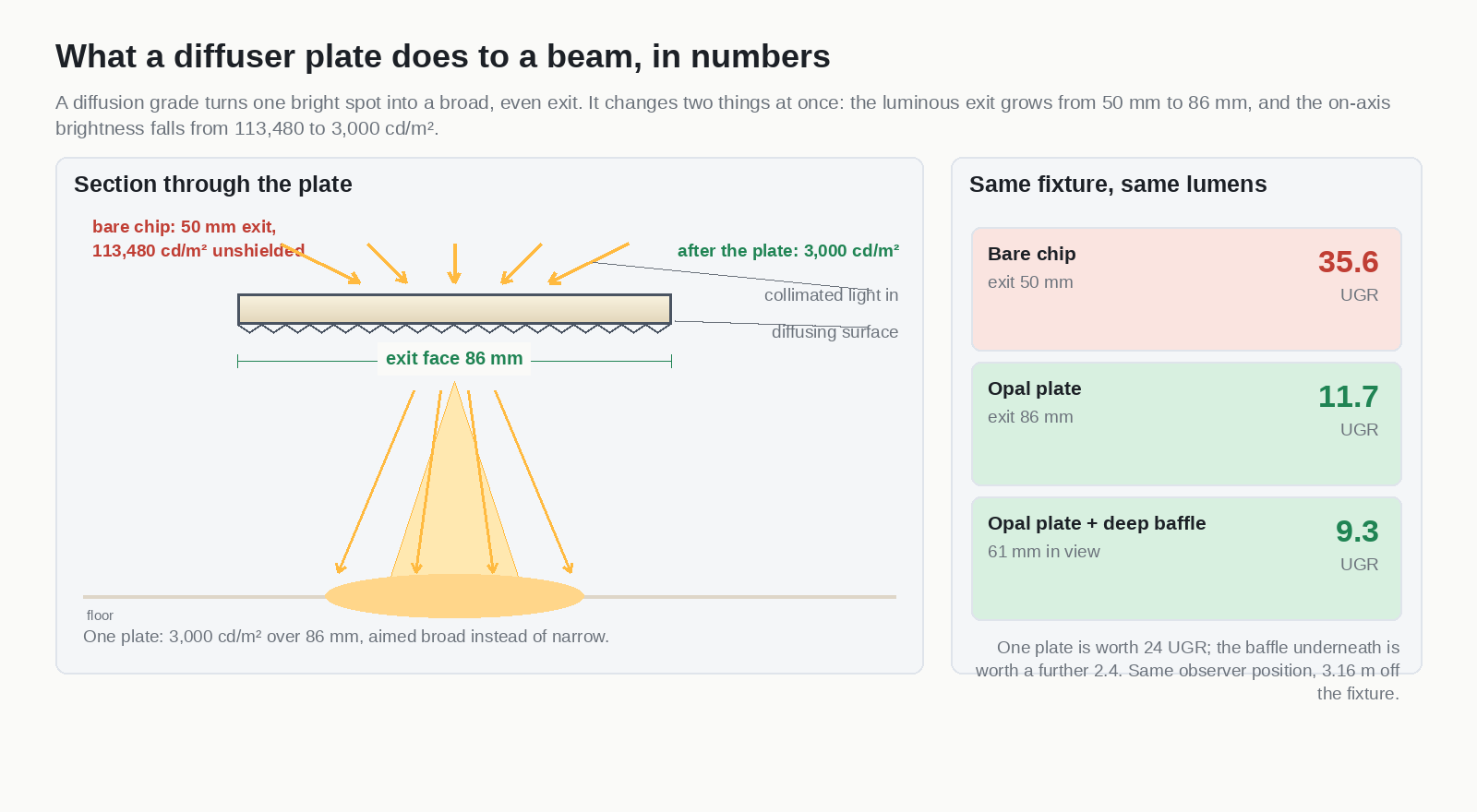
UGR 19 and UGR 16 are not two grades of the same downlight. They are two different optical solutions, and the part that separates them is not the driver, the wattage or the chip — it is the plate sitting in front of the chip. A diffuser plate does two things at once: it spreads the same flux over a bigger exit face, and it takes the brightness off that face. Both of those appear in the UGR expression, and one of them appears twice.
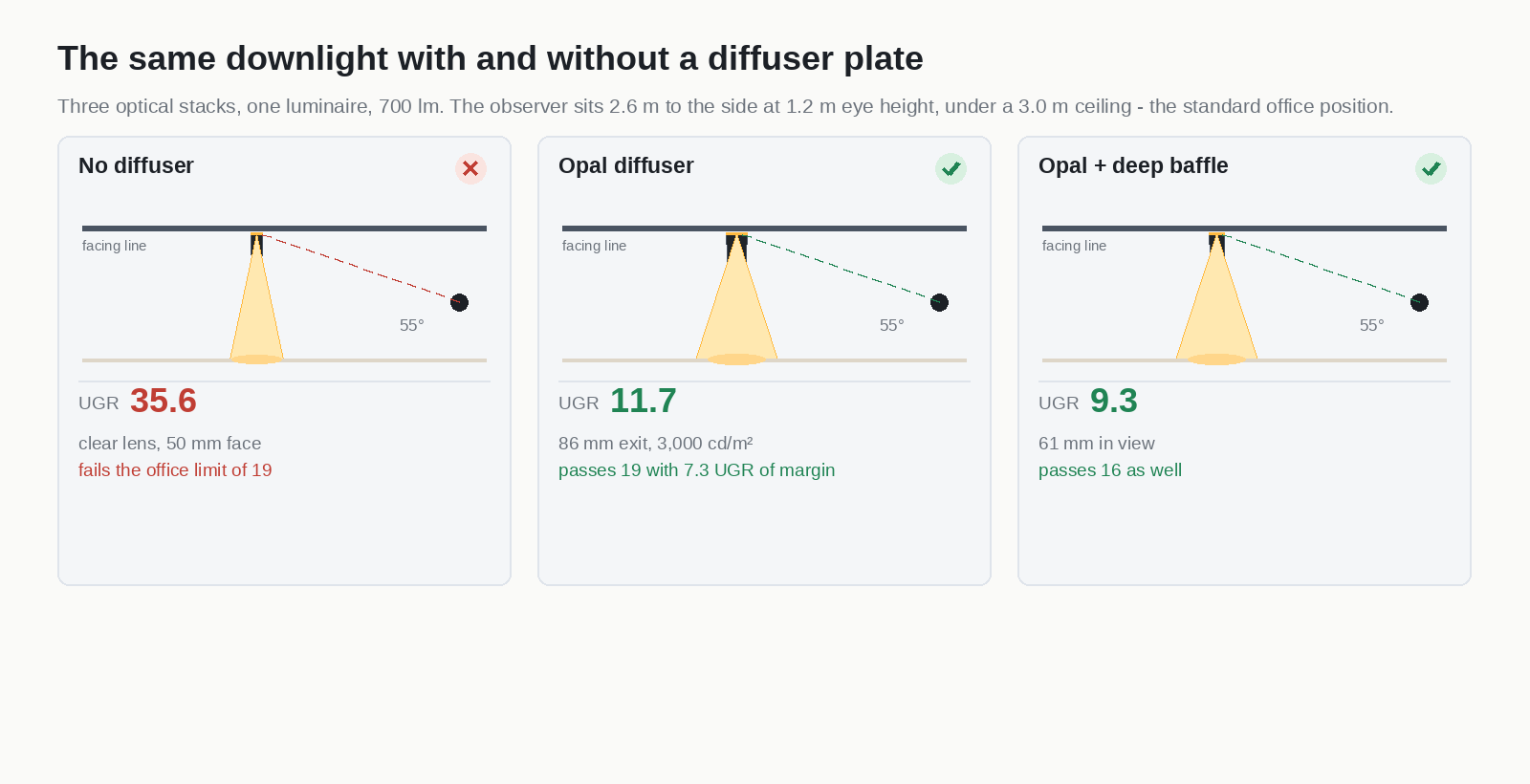
This article works out what a diffuser plate actually buys, in numbers, and where the cost lands. The worked example runs throughout: one 700 lm, 24° downlight on a 3.0 m office ceiling, with the observer seated 2.6 m to the side at 1.2 m eye height — a 3.16 m viewing distance at 55°. Swap the optical stack and nothing else, and the same fixture moves from a room nobody can work in to one that clears a UGR 16 limit. The arithmetic follows the log expression defined by the International Commission on Illumination (CIE 117) and adopted in EN 12464-1.
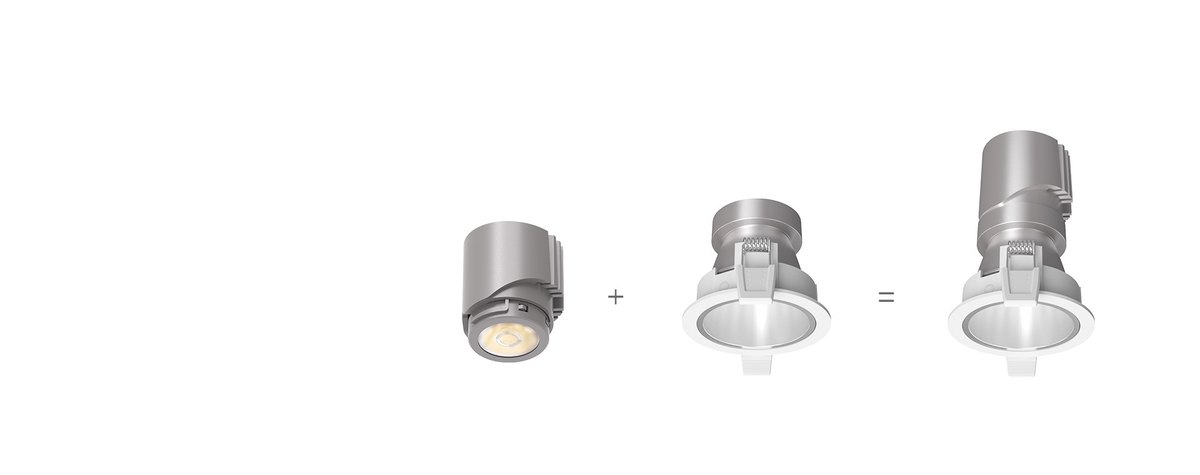
A diffusion grade is not a polish. It is a scattering layer — surface-etched acrylic, opal PMMA, a micro-prism sheet or a coated glass — chosen so that light entering a small, high-intensity aperture leaves a wider surface with no visible direction.
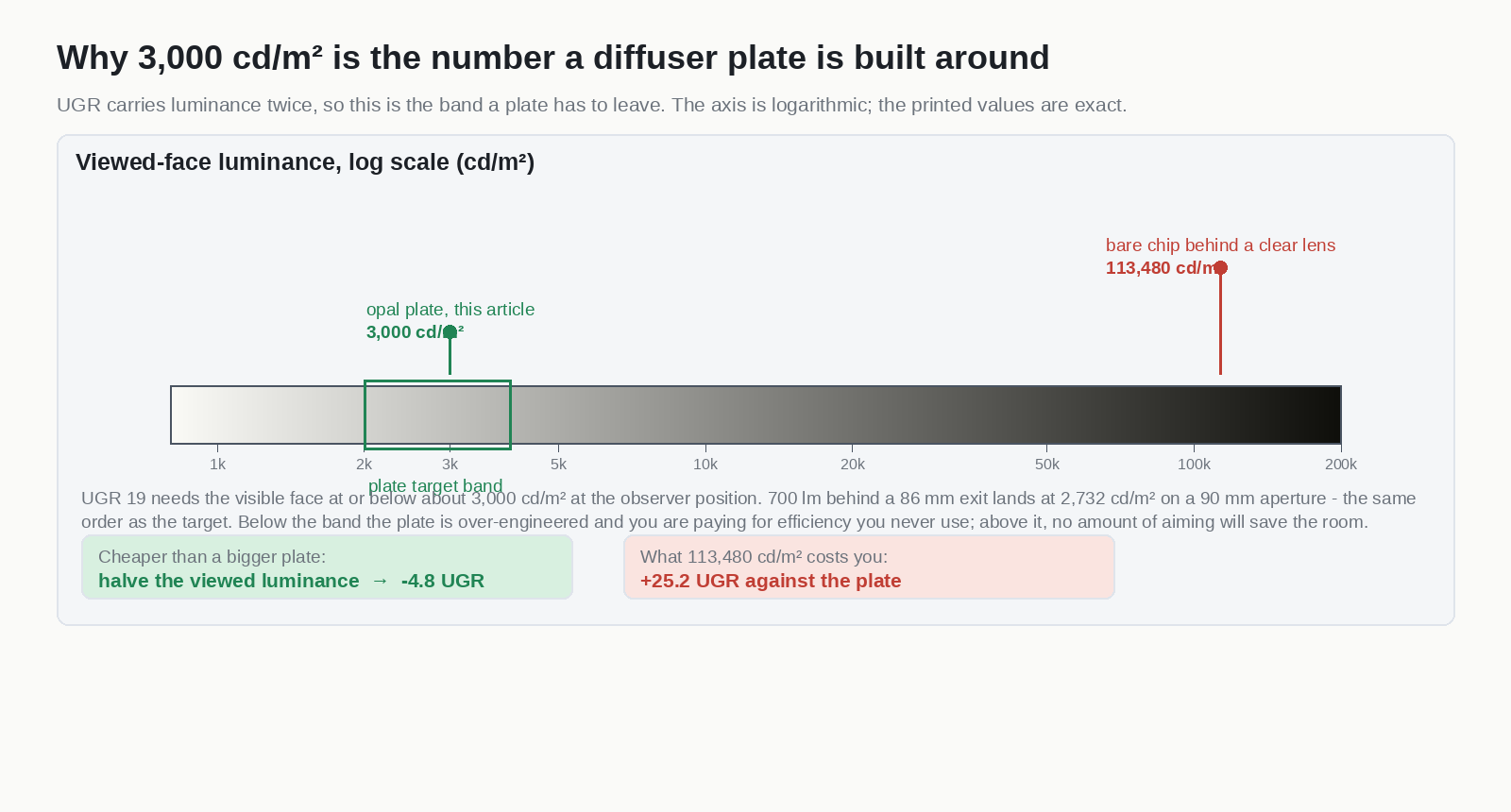
The instinct is to treat it as a filter that dims the fixture. It does cost some flux, but that is not the reason it works. Haze, back-scatter and internal reflection all convert a fraction of the output into heat and stray light, and in this fixture we assume that fraction is 8 %. The point is that the same 92 % now leaves an exit face 1.7× wider, so its brightness — candelas per square metre, the quantity the eye actually reacts to — falls by a factor of nearly 38.
Write the UGR expression out and the plate’s job becomes obvious:
UGR = 8 · log₁₀ [ (0.25 / Lb) · Σ ( L² · ω / p² ) ]
Of the four inputs, a plate touches two:
Lb (the background luminance) belongs to the room, and p (the Guth position index) belongs to where the occupier sits. Neither is the optic’s business — though both are levers you can pull, and we come back to them.
This looks like it should cancel out, and the reason it does not is worth stating plainly. ω grows only linearly with area, while L falls as 1/area — and then the L term is squared. Feed a 2.95× larger exit area into the formula and you get:
ΔUGR = 16 · log₁₀(L₂/L₁) + 8 · log₁₀(A₂/A₁)
The brightness term is worth −25.2 UGR and the area term gives back +3.8. Net: −21.4 UGR from one change of optic. Spreading light over a bigger face is a win precisely because it is scored twice.
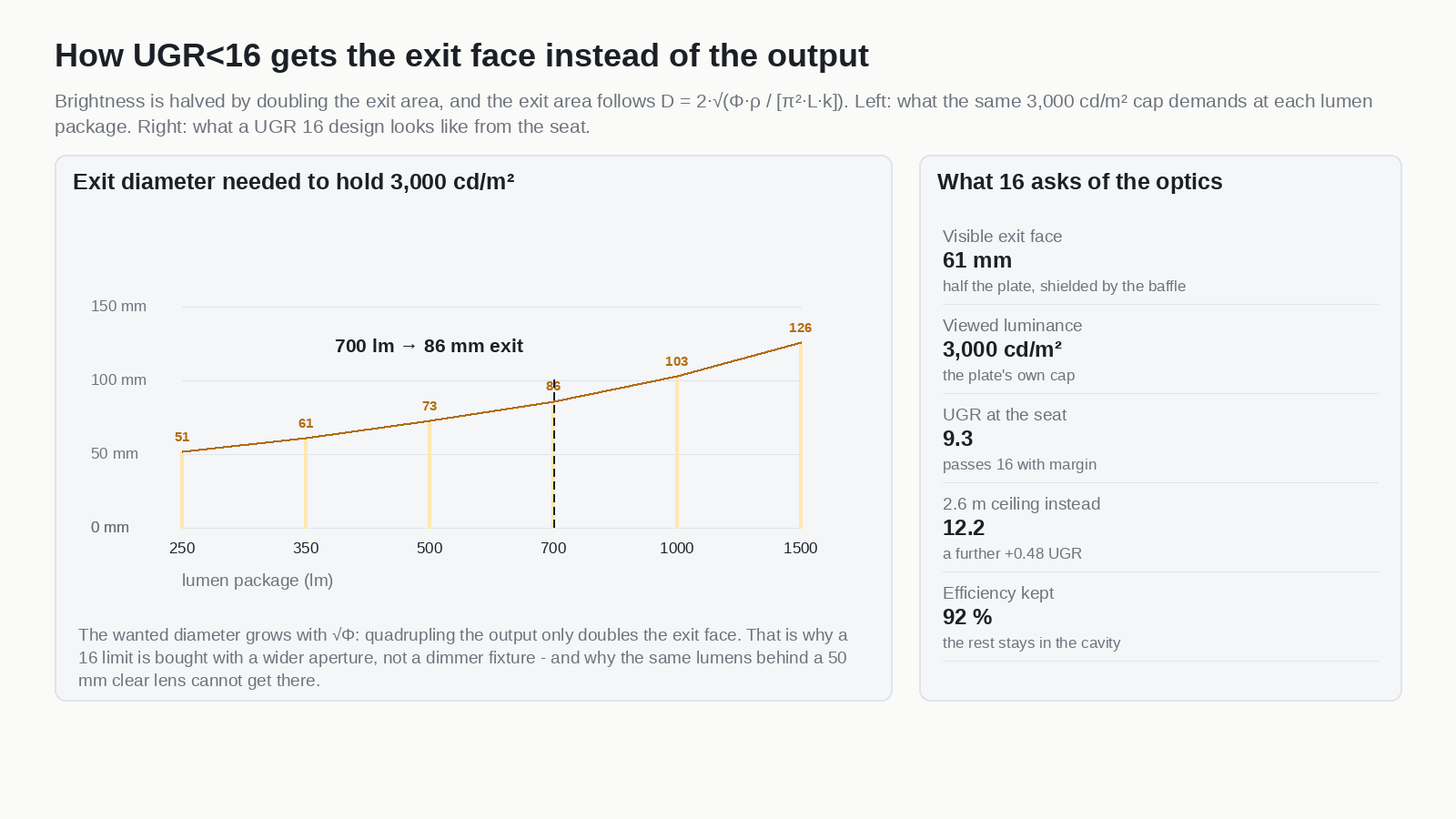
Turn the expression around and a UGR target becomes a size. Hold the room, the observer and the background fixed, and ask: what exit diameter does this lumen package need to stay under a luminance cap?
L = Φ · ρcavity / (π · A · k)
where Φ is the rated flux, ρcavity = 0.78 is the fraction of it that reaches the mix chamber’s exit face, and k = 10 folds in the loss outside the clear aperture. Solve for area and convert to a diameter:
D = 2 · √( Φ · ρ / [ π² · L · k ] )
For 700 lm at a 3,000 cd/m² cap that lands on 86 mm — which is why 90 mm apertures dominate the low-glare downlight market, and why every one of them is quoted in the 2,000–4,000 cd/m² band. That band is not marketing language; it is the size the arithmetic demands.
| Part | Job | Effect on the UGR expression | What it costs |
|---|---|---|---|
| Diffuser plate | Spread the flux over a large, low-luminance exit | Splits work between the L² term and ω; −21.4 UGR in this example | 8 % of the flux, and a wider beam that needs re-spacing |
| Deep baffle or honeycomb | Hide part of the plate from shallow viewing angles | Pure ω reduction; −2.4 UGR per halving of the visible face | Nothing measurable in flux, a taller body, a narrower beam |
| Cut-out diameter | Set how much flux can land on that exit face | Sets what luminance is achievable at all | Ceiling architecture and joist layout |
| Driver | Hold the flux steady and dim it | None. Dimming scales L and A together, so UGR barely moves | Protocol cost only |
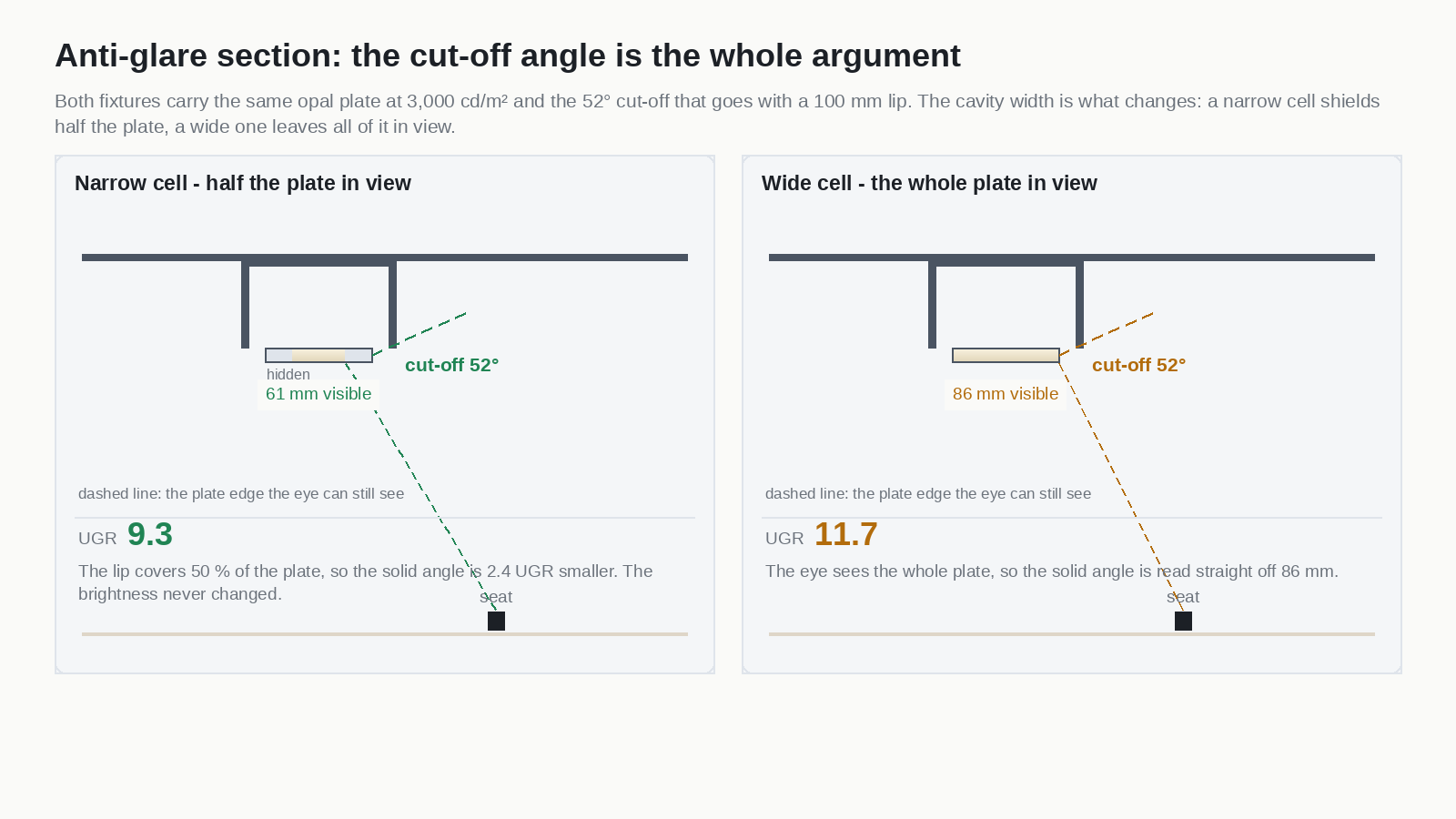
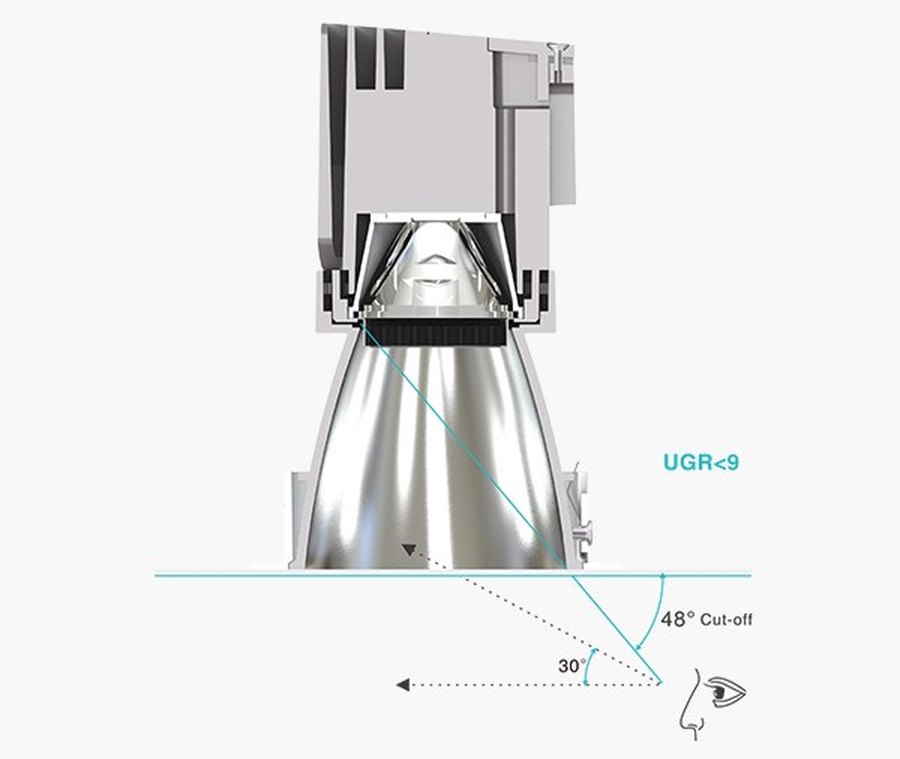
A deep baffle and a wider plate both attack the solid angle, and they are cheaper than one another depending on how the ceiling is built out. Take the 86 mm plate above and put a 100 mm lip around it, offset 77 mm from the fixture axis. The cut-off lands at 52°: any eye shallower than that to the horizontal can still reach the plate. Close the cell down until only half the plate falls inside that cone, and the visible face drops to 61 mm.
Luminance did not move a single candela per square metre. The solid angle halved. That is worth 2.4 UGR, and it is the cheapest 2.4 UGR in the whole exercise.
Four exit geometries, one fixture, one lumen package. Only the last two columns matter for the specification.
| Exit stack | Exit face | Viewed luminance | Solid angle ω | UGR | Verdict |
|---|---|---|---|---|---|
| Bare chip behind a clear lens | 50 mm | 113,480 cd/m² | 2.5 × 10⁻⁴ sr | 35.6 | Fails every limit in the table below |
| Opal PMMA diffuser plate | 86 mm | 3,000 cd/m² | 7.3 × 10⁻⁴ sr | 11.7 | Clears UGR 19 |
| Micro-prism / directional film | 122 mm | 1,500 cd/m² | 1.5 × 10⁻³ sr | 9.3 | Clears UGR 16; beam widens 2.24× |
| Opal plate + deep baffle (50 % shielded) | 61 mm | 3,000 cd/m² | 3.7 × 10⁻⁴ sr | 9.3 | Clears UGR 16 without touching the flux |
The last two rows reach the same number by opposite routes, and that is the most useful thing on this page. One buys the reduction with flux and beam spread; the other buys it with baffle depth and nothing else. Which one wins depends on whether the layout can tolerate a wider beam.
A diffuser plate is the rare specification where the engineer’s usual instinct — more output — makes the problem worse. 700 lm behind a 90 mm aperture runs at 2,732 cd/m². Push the same fixture to 1,500 lm without changing the optic and the L² term takes the UGR up by 5.3 units. The fixture gets better at lighting the floor and worse at being looked at.
What the 8 % bought, in this fixture, is the difference between a room that clears a UGR 16 limit and one that fails UGR 19. At a specification review that is not an efficiency question.
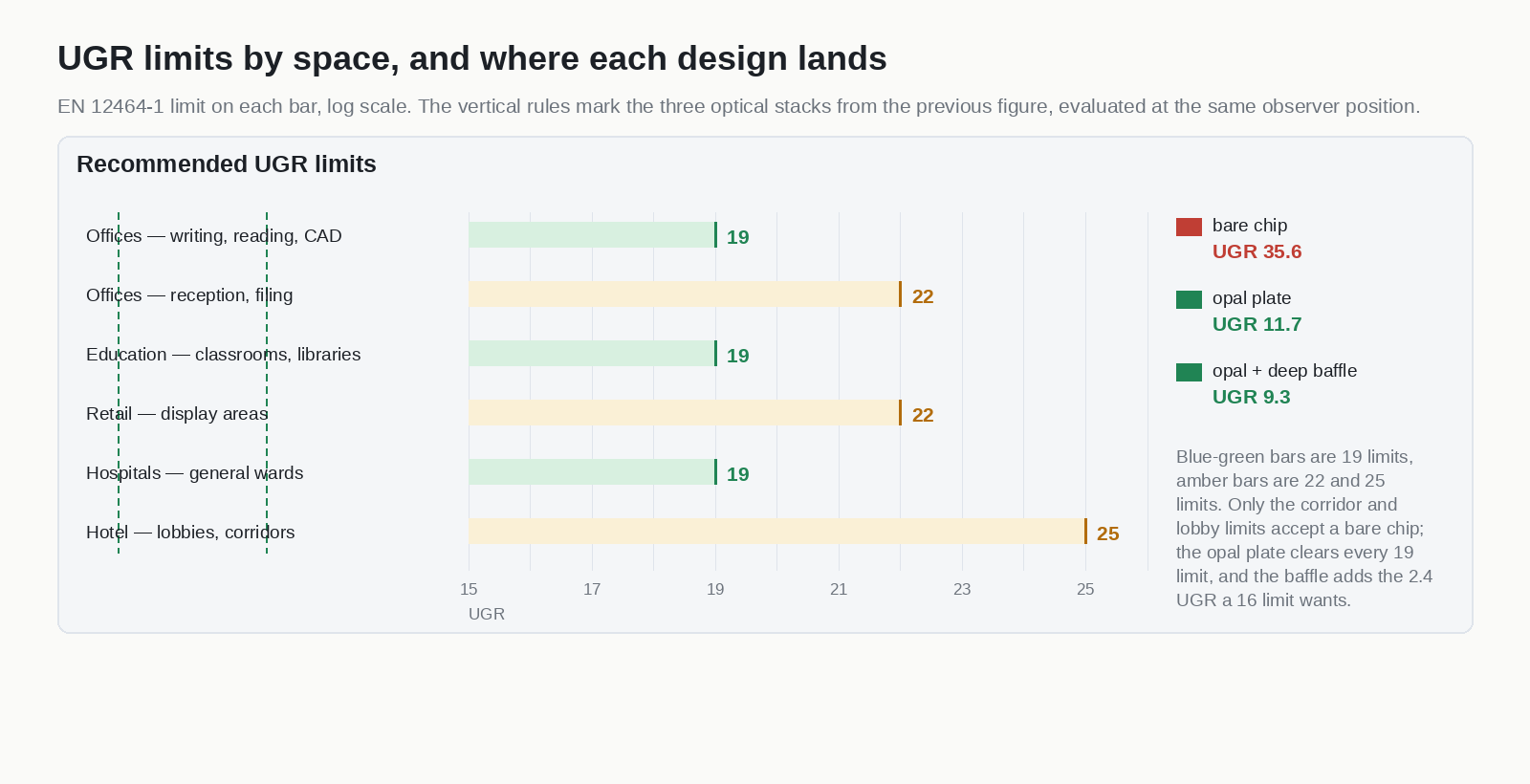
The limits below come from EN 12464-1 and are the ones a tender will quote. Read them against the three stacks in the comparison table:
| Space and task | UGR limit | Bare chip | Opal plate | Opal plate + baffle |
|---|---|---|---|---|
| Offices — writing, reading, CAD | 19 | Fails (35.6) | Passes (11.7) | Passes (9.3) |
| Offices — reception, filing | 22 | Fails (35.6) | Passes | Passes |
| Education — classrooms, libraries | 19 | Fails | Passes | Passes |
| Retail — display areas | 22 | Fails | Passes | Passes |
| Hospitals — general wards | 19 | Fails | Passes | Passes |
| Hotel — lobbies, corridors | 25 | Fails | Passes | Passes |
Note the shape of that result. For a single fixture at a 3.16 m viewing distance, an opal plate is not a marginal upgrade — it is the difference between passing and failing every space in the table. The 16 limit that technical drawing, precision assembly and most healthcare spaces ask for is what the second column of shielding buys.
UGR 16 is a different brief from UGR 19, and the temptation is to meet it by asking for a lower wattage. That fails, because dimming scales luminance and area together — the ratio cancels and the UGR barely budges.
Ask for the exit face, not the cut-out. A 1,000 lm fixture needs a 103 mm visible diameter to hold 3,000 cd/m²; a 500 lm one needs 73 mm. Tell the supplier you need the viewing-angle luminance curve rather than a single printed number, and check that the number was computed at your ceiling height — at 2.6 m instead of 3.0 m the same head gains 0.48 UGR, enough to undo the margin on a tight job.
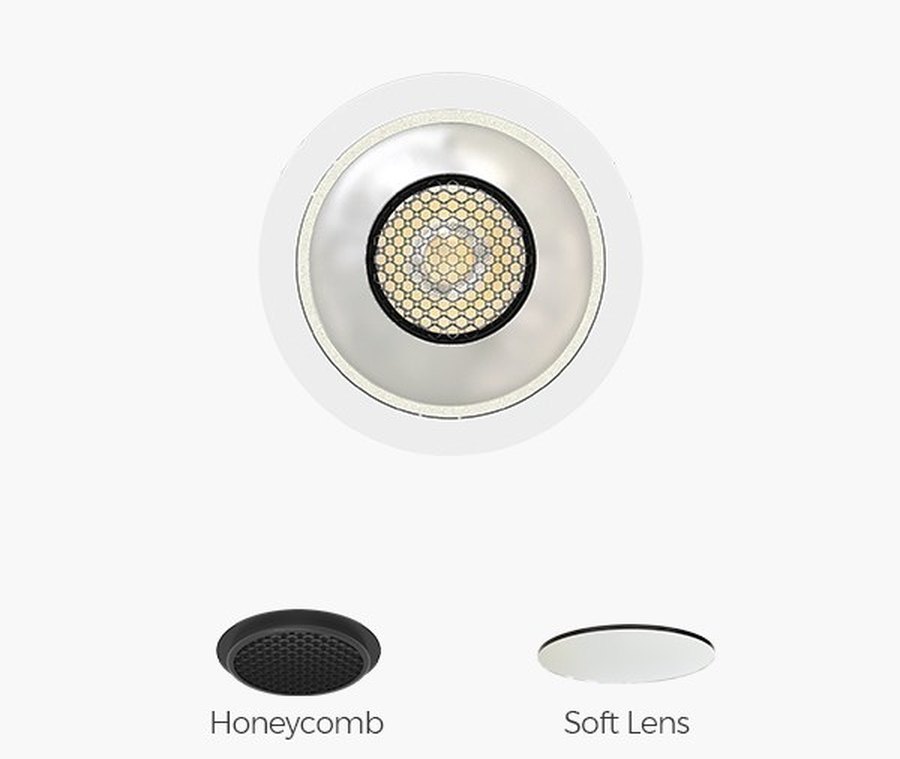
Buy the shielding instead. A deep baffle or a honeycomb grid under an opal plate halves the visible face for 2.4 UGR with no flux cost at all, and it is the only route to UGR 16 that leaves the beam pattern and the spacing alone.
Four things a plate datasheet has to state before the number means anything:
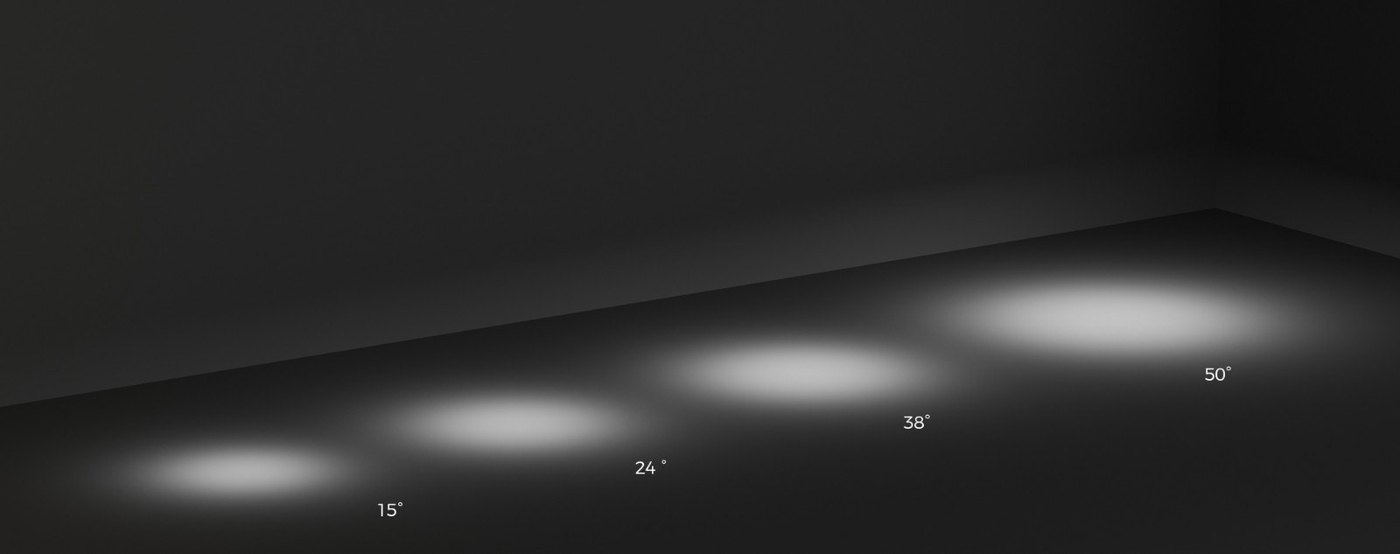
A wider exit face does not only change the UGR; it changes what the beam does on the floor, and the second effect lands on the spacing sheet. Spread 700 lm from a 24° beam into an equivalent 36° distribution and the pool at 2 m goes from 0.85 m across to 1.30 m — the same brightness per square metre of floor, over a wider area. The full method for turning that into centre-to-centre spacing is in our guide to track light spacing by beam angle and mounting height.
Three cases where a diffuser plate costs more than it pays:
There are four ways to move UGR, and they are not equally priced. Ranked by cost per unit:
| Lever | Change | ΔUGR | Cost |
|---|---|---|---|
| Background luminance | Double Lb (wash the walls, lift the ceiling finish) | −2.4 | Decoration, almost free |
| Observer distance | Move the seating 3.16 m → 3.87 m off the fixture | −1.7 | Furniture plan, free |
| Shielding | Baffle or honeycomb under the plate, half the visible face | −2.4 | A deeper body, no flux |
| Diffuser plate | Bare chip → opal exit at 3,000 cd/m² | −23.9 | 8 % of the flux, wider beam |
The plate is the only one of the four that produces a two-digit move, which is why it is the first decision and not the last. The rest are corrections you apply around it. If you want to see how the luminance term behaves when it is left to itself, our explainer on unified glare rating takes the four inputs apart without the optics, and what UGR under 19 does to a space covers how the numbers read in a finished room.
Two of the four inputs. It lowers the luminance L of the emitting face and changes the solid angle ω that face subtends at the eye. Because L enters the expression squared and ω enters linearly, spreading the same flux over a wider exit is a net win: in our worked example a 700 lm fixture moves from UGR 35.6 behind a clear lens to 11.7 behind an opal plate, a change of 23.9 units for 8 % of the flux.
Yes, in two ways. Either widen the exit until the luminance falls to the level the limit demands — 1,000 lm needs about 103 mm of visible face to hold 3,000 cd/m² — or keep the plate and add shielding so only part of it is in view. In this article’s geometry an opal plate plus a deep baffle reaches 9.3 without changing the flux or the driver.
It costs some flux — 8 % in this example, mostly back-scatter and internal reflection — and it spreads what is left over a wider area. The fixture still delivers the same total lumens, so the floor illuminance at a given spacing drops only by the transmittance, not by the luminance ratio. What changes is how the ceiling reads from below.
No. Dimming scales the luminance and the exit area together, so the ratio in the L² and ω terms cancels and the UGR hardly moves. Pushing this fixture from 700 lm to 1,500 lm raises UGR by 5.3 units; taking it down to 500 lm only brings it back down by a couple. Glare is a property of the optic, not of the setting.
Yes, and this is the part most often missed. A plate that halves the exit luminance by doubling the exit area also widens the distribution: our 24° beam becomes an equivalent 36° one, 2.24× the solid angle, and the pool at 2 m grows from 0.85 m to 1.30 m. Re-run the spacing before ordering — a low-UGR downlight placed on the old grid leaves scalloping between pools.
Ask for the luminance at the viewing angle in cd/m², the exit diameter actually in view rather than the ceiling cut-out, the transmittance so you can price the flux lost, and the ceiling height and observer geometry the number was computed at. A UGR figure without those four is a label, not a specification. The full reading method is in our guide to reading a UGR claim off a datasheet.
A diffuser plate is the single most effective UGR lever available in a downlight, and it is not because it dims anything. It converts a small, extremely bright face into a large, modest one, and the expression rewards the exchange twice. That is how one optical part separates UGR 19 from UGR 16 — or, in the geometry used here, how it separates a room that fails every limit in EN 12464-1 from one that clears the strictest of them.
The honest cost is 8 % of the flux and a wider beam, both of which have to be priced into the layout before it is drawn. If the project needs this settled against real photometric data rather than a printed label, we publish the viewing-angle luminance curves and the accessory options for the whole downlight range, and we will run the numbers on your ceiling height. Send us the room and the limit and we will come back with an aperture, a plate and a spacing.