Address
304 North Cardinal
St. Dorchester Center, MA 02124
Work Hours
Monday to Friday: 7AM - 7PM
Weekend: 10AM - 5PM
Address
304 North Cardinal
St. Dorchester Center, MA 02124
Work Hours
Monday to Friday: 7AM - 7PM
Weekend: 10AM - 5PM
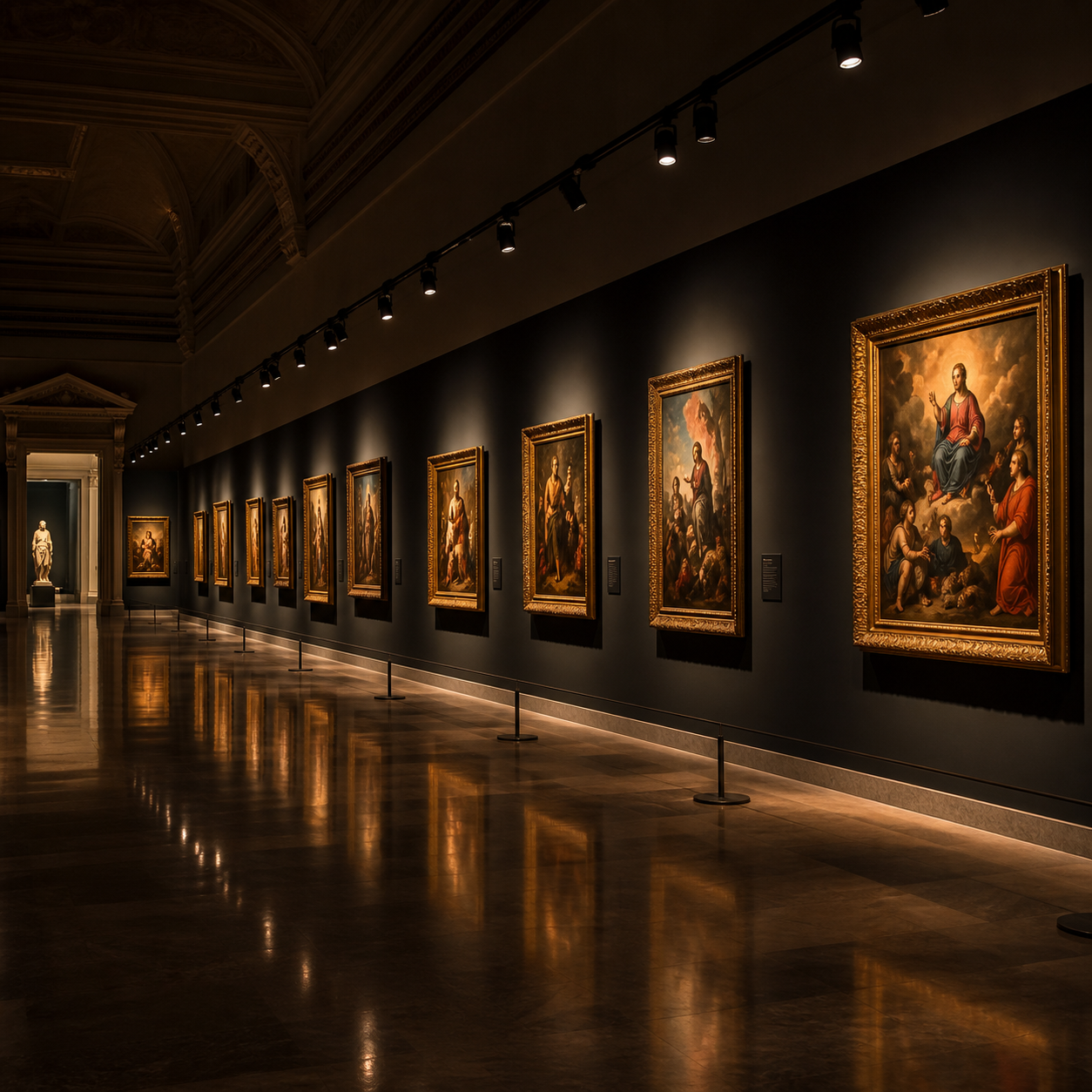
Museum lighting is governed by one of the strictest sets of standards in the lighting industry — and for good reason. Light is the single most damaging environmental factor in a museum: it fades pigments, degrades paper, and alters the chemical structure of everything from oil paintings to silk garments. Yet museums also need visitors to see the works clearly. Balancing conservation science with visual experience is the core challenge of museum lighting design.
This guide covers the museum lighting standards that matter most — lux levels, CRI requirements, UV control, and color temperature — plus the practical best practices used by lighting designers working in galleries, museums, and private collections. Whether you are upgrading an existing gallery or specifying lighting for a new museum build, these are the numbers to design around.
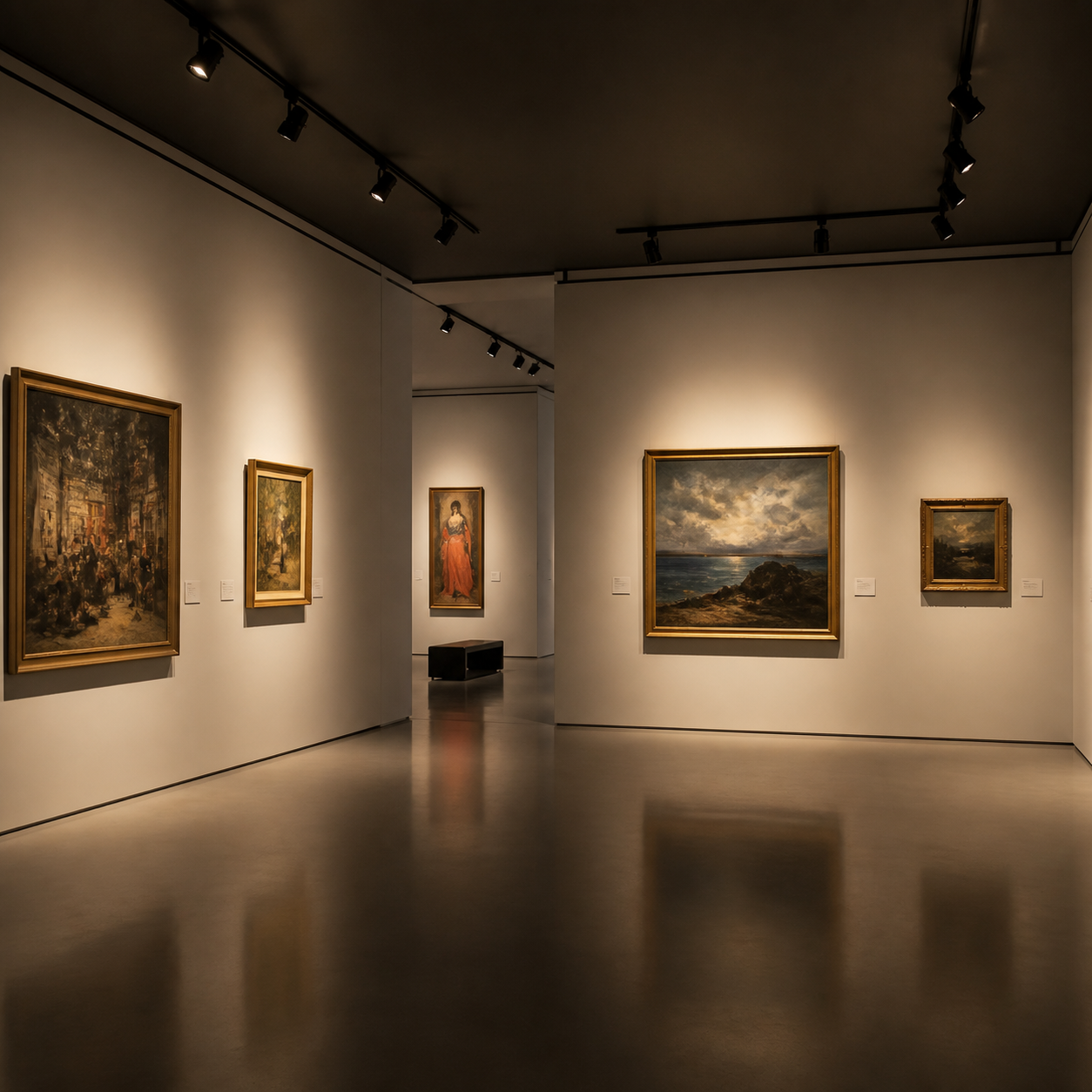
Museum lighting standards exist because light damage is cumulative and irreversible. Every photon absorbed by an artifact causes molecular change. Over decades of exhibition, even modest light levels cause measurable fading. The two most important concepts in museum lighting science are illuminance (how bright the light is, measured in lux) and annual light exposure (illuminance multiplied by hours of exposure, expressed in lux-hours per year).
The standards in this guide are built on decades of conservation research, published by the Illuminating Engineering Society (IES) and national conservation institutes, most notably the work of Garry Thomson (author of The Museum Environment) and the ongoing guidelines from the International Commission on Illumination (CIE) and national conservation institutes. For LED lighting specifically, the Getty Conservation Institute and the Canadian Conservation Institute have published practical selection guidelines that are now widely adopted.
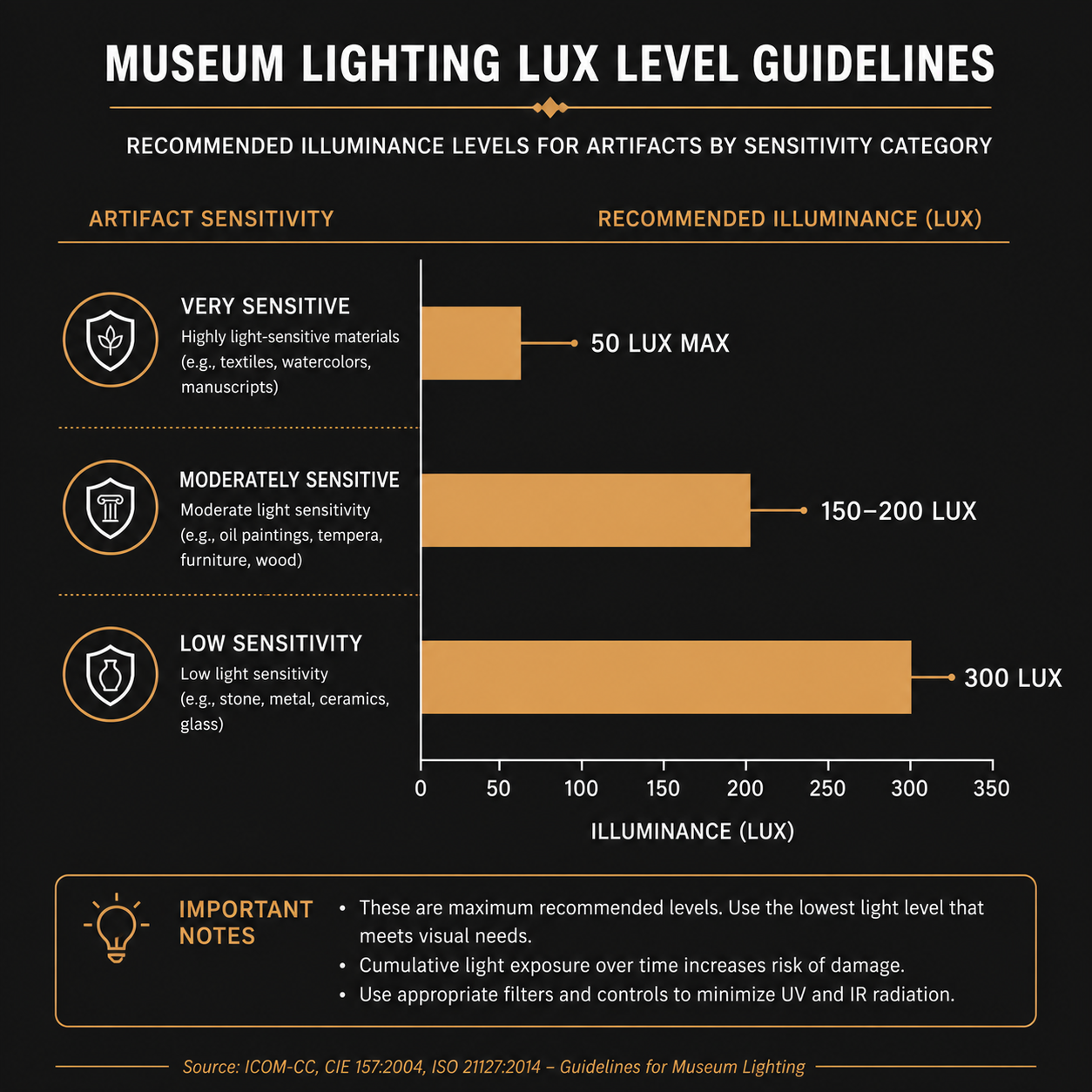
Lux is the metric unit of illuminance — the amount of light falling on a surface. Museum standards classify artifacts by light sensitivity and assign maximum lux levels for each category.
| Sensitivity Category | Maximum Illuminance | Typical Artifacts |
|---|---|---|
| Very sensitive | 50 lux | Watercolors, silk, textiles, manuscripts, photographs, feathers, leather |
| Moderately sensitive | 150–200 lux | Oil paintings, tempera, wood, lacquer, bone, ivory, undyed leather |
| Low sensitivity | 300 lux | Metal, stone, ceramic, glass, enamel, mineral specimens |
For reference, 50 lux is roughly the light level of a dim living room in the evening. A typical office desk is around 500 lux. The thresholds above are maximums, not targets — the guiding principle is to use the lowest light level that still allows the object to be seen satisfactorily.
Illuminance limits alone do not tell the full story. Two artifacts displayed at 50 lux for 10 years accumulate the same damage as one displayed at 100 lux for 5 years. This is why conservation standards also cap annual exposure:
For comparison, 50,000 lux-hours is achieved in under 5 months of standard museum opening hours (7 hours/day, 6 days/week). After that, exhibits are typically rotated into storage. This is why major museums rotate their most sensitive works.
American projects often specify illuminance in foot-candles (fc) rather than lux. One foot-candle equals approximately 10.76 lux. Common museum values:
Color Rendering Index (CRI, or Ra) measures how accurately a light source renders colors compared to a reference source. For museum lighting, high CRI is not a luxury — it is a requirement. A painting lit with poor color rendering looks flat and distorted, which misrepresents the artist’s work.
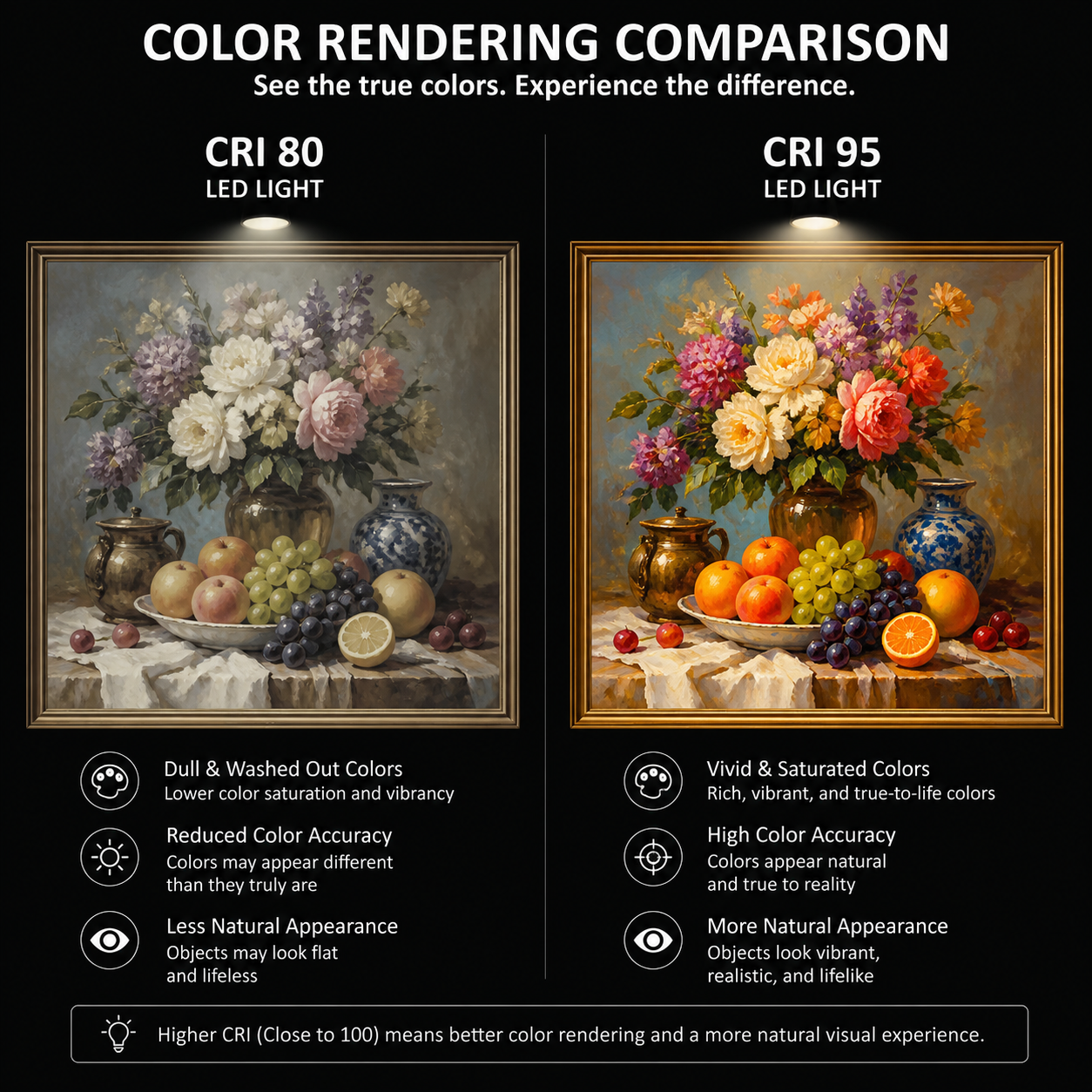
The current museum lighting standards for CRI:
Why does R9 matter so much in museums? Oil paintings from the Renaissance onward rely heavily on red, ochre, and crimson pigments — from vermilion to carmine. A light source with high general CRI but poor R9 will render these pigments muddy and brownish. High-end museum LED modules now routinely offer Ra 95+ with R9 > 90, which is the specification to insist on for fine art.
While CRI remains the industry standard, the newer TM-30 method (IES TM-30-20) provides a more complete picture using Rf (fidelity, comparable to CRI) and Rg (gamut, or saturation). Many specifiers now use both: CRI for compliance with legacy specifications, and TM-30 Rf/Rg values for finer color quality assessment. For museum projects, look for Rf ≥ 95 and Rg in the 95–105 range.
Ultraviolet (UV) radiation is the most destructive component of light for museum objects — it breaks chemical bonds and causes yellowing, fading, and embrittlement. Infrared (IR) radiation heats surfaces, accelerating chemical reactions and causing physical stress in hygroscopic materials.
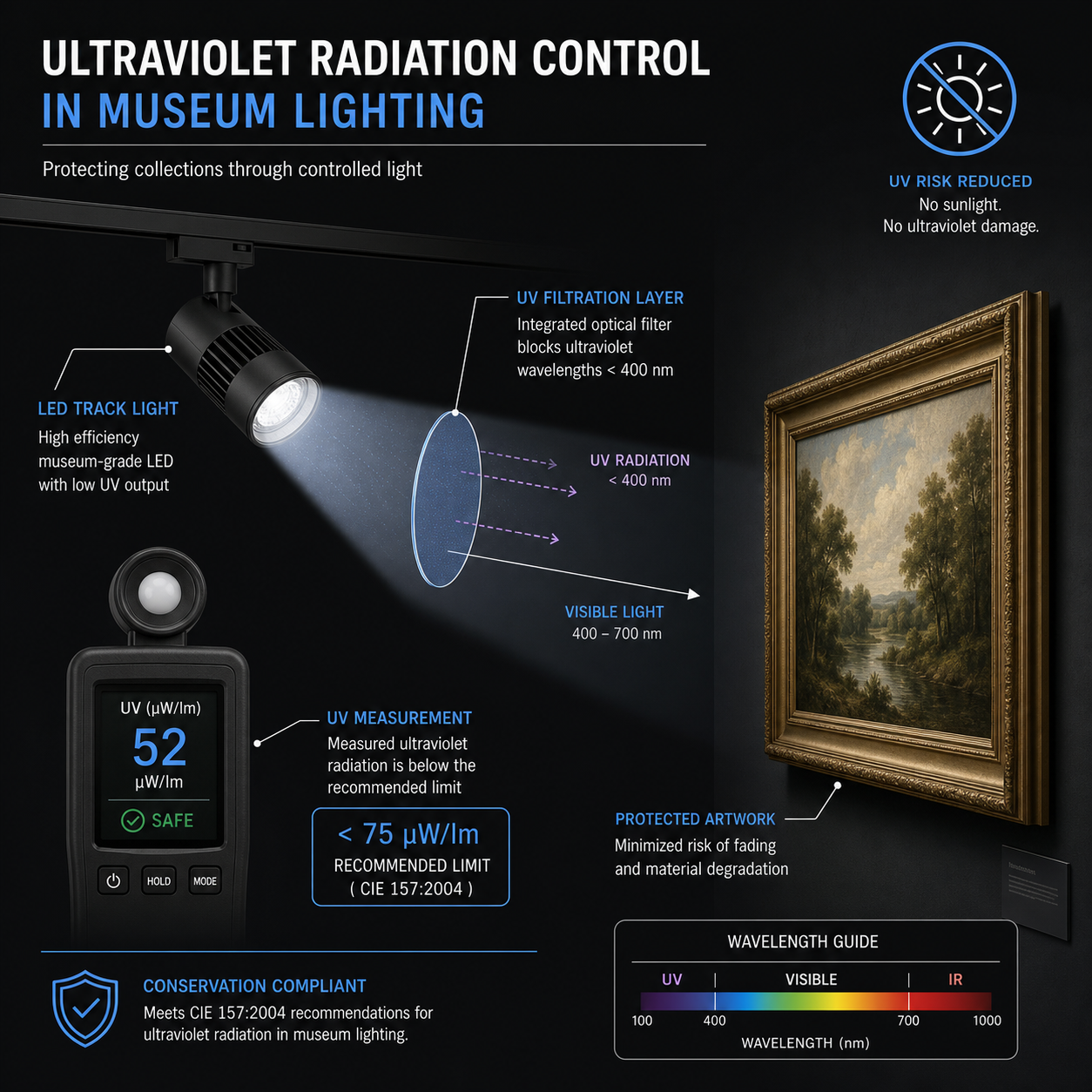
Museum UV standards:
Why LED wins on UV/IR:
For heritage buildings with original stained glass or period lighting, UV-filtering film on windows combined with LED track lighting is the modern standard retrofit approach.
Color temperature (CCT, in Kelvin) affects both how artwork appears and the emotional tone of the gallery. Unlike lux and CRI, color temperature is largely a matter of curatorial preference — but it must be consistent.
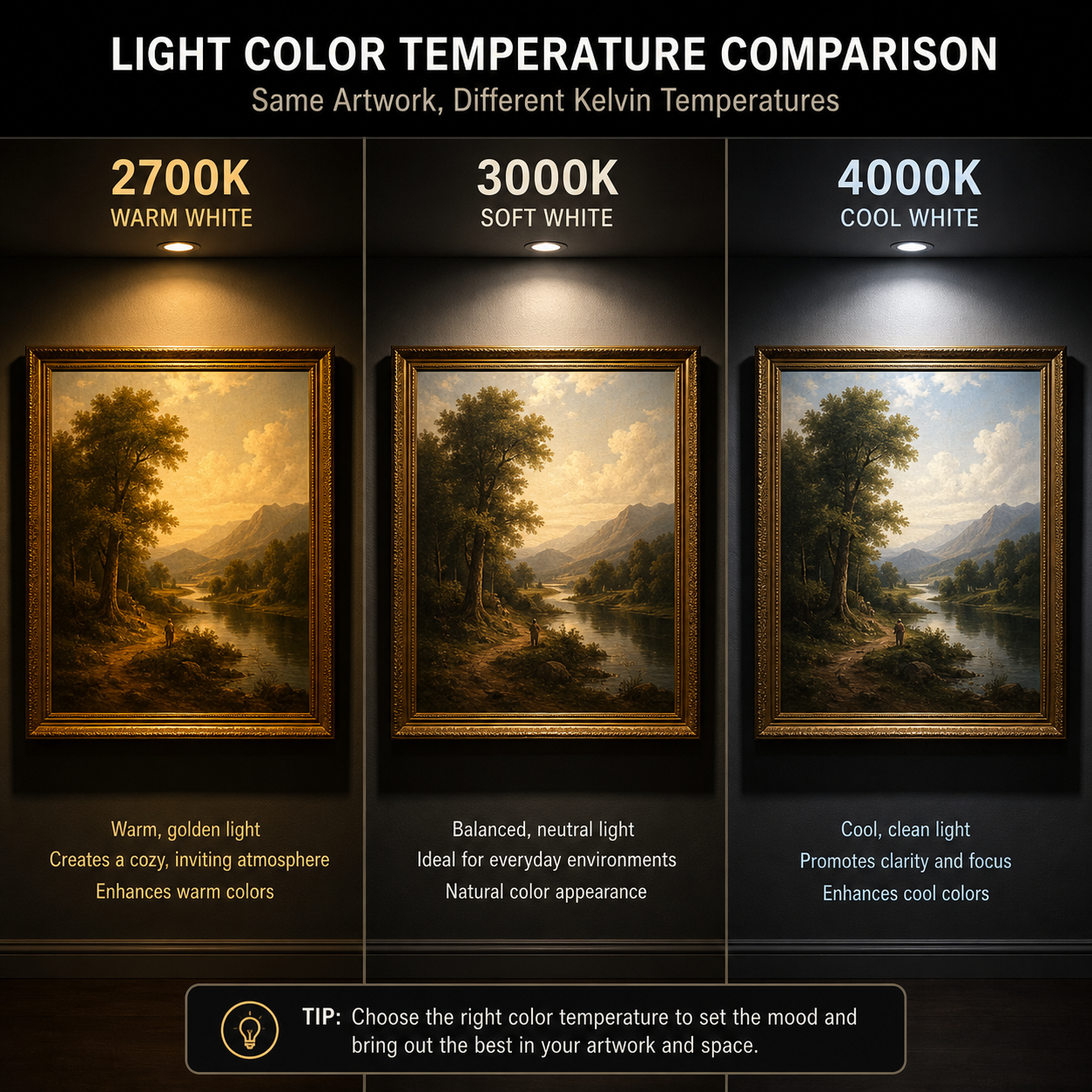
Common museum CCT choices:
The critical rule: never mix color temperatures in one gallery space. A painting lit at 3000K from track heads but catching 4000K spill from an adjacent display will look inconsistent. Specify one CCT per space, and match replacement lamps to the installed CCT exactly. Also verify the Duv (tint) of all fixtures — two fixtures both labeled 3000K can look pink or green if their Duv values differ.
Beyond the conservation standards, the visual quality of museum lighting depends on beam selection and aiming. Track lighting is the dominant system in museums precisely because it allows precise, adjustable aiming.
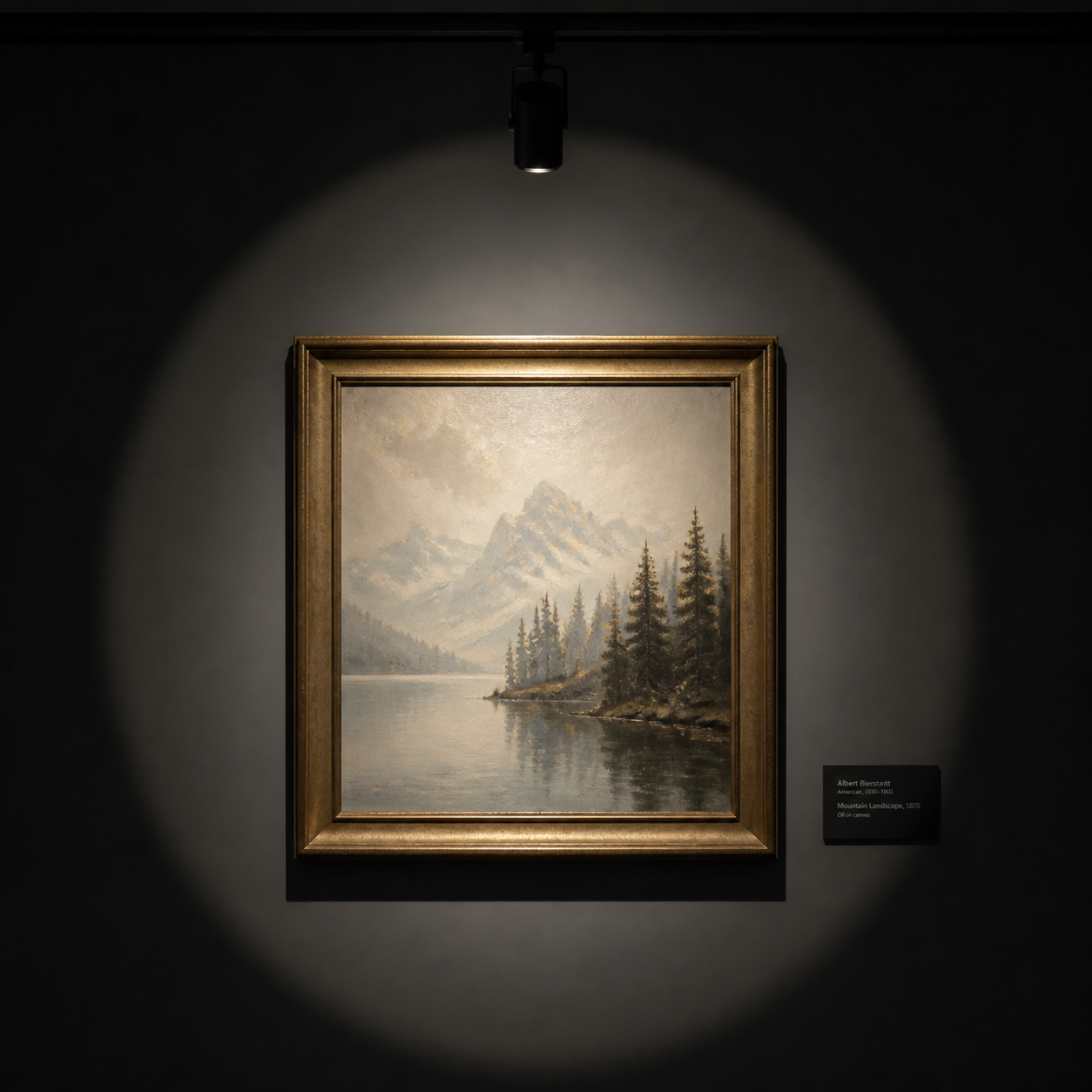
For framed works under glass, aim the beam to avoid specular reflections bouncing into the visitor’s eye — a 30–35° aiming angle generally achieves this. Use accessories like barn doors, snoots, and honeycomb louvers to cut spill light.
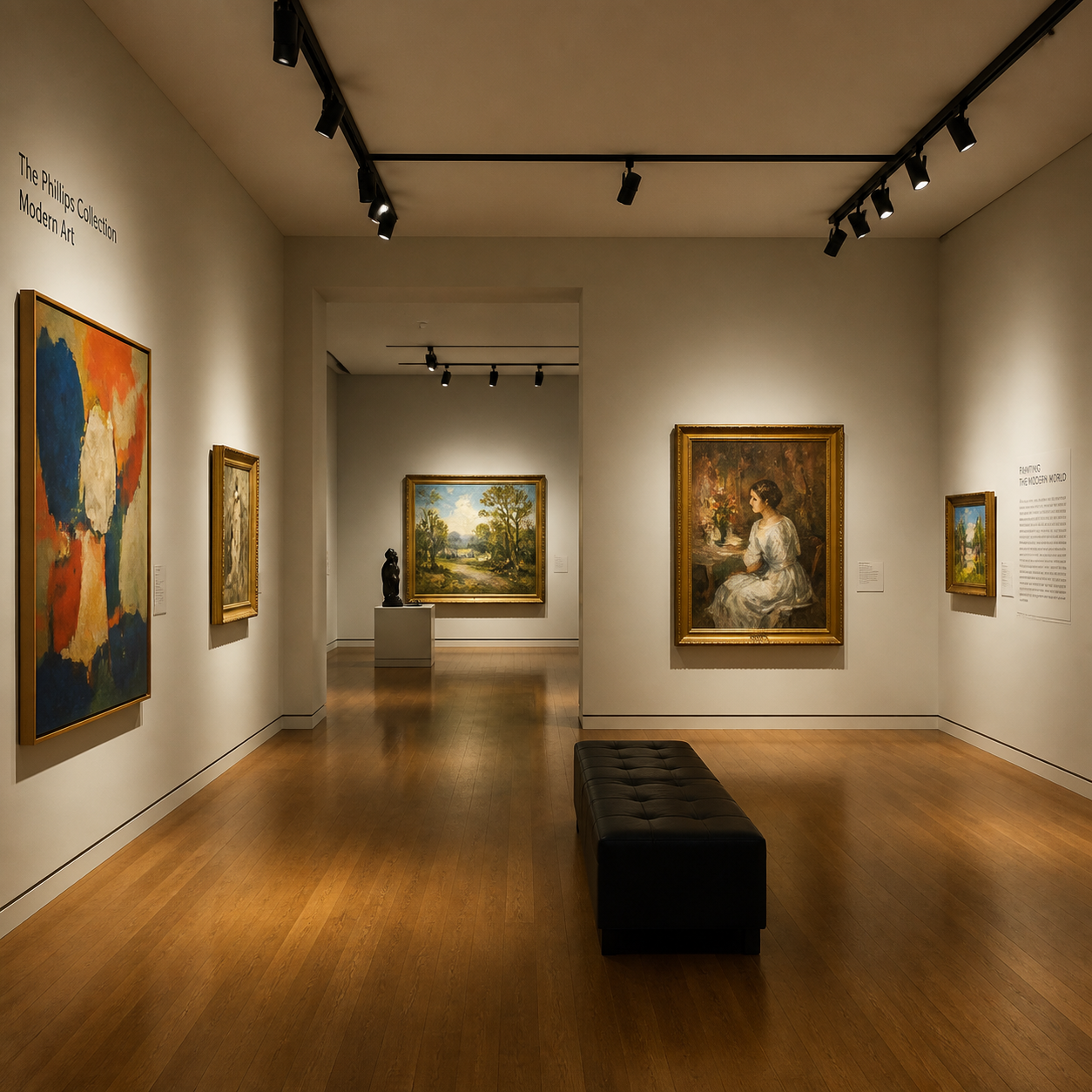
The standard maximum illuminance is 50 lux for very light-sensitive artifacts (watercolors, textiles, photographs), 150-200 lux for moderately sensitive objects (oil paintings, wood, ivory), and up to 300 lux for low-sensitivity materials (metal, stone, ceramic). Annual exposure should also be capped, typically at 50,000 lux-hours per year for highly sensitive items.
Minimum Ra 90 is required for general museum and gallery lighting, with Ra 95 or higher strongly preferred for fine art. Deep red rendering (R9) should be at least 90, since red pigments are common in classical paintings and the hardest for LEDs to reproduce accurately.
LED lighting emits essentially zero UV and infrared radiation, which are the two most damaging components of light for artifacts. LEDs also run cool (no surface heating), are fully dimmable for conservation lighting control, and last 50,000+ hours, reducing maintenance in hard-to-reach gallery spaces.
3000K is the most common standard for museums and galleries, offering a balance of warm atmosphere and color accuracy. 2700K suits historic interiors and antique collections, while 3500-4000K is preferred by some contemporary galleries. The key rule is consistency: never mix color temperatures in one gallery space.
Traditional museum standards cap UV content at 75 microwatts per lumen (uW/lm). Modern best practice with LED lighting is to eliminate UV entirely, since LED modules produce negligible UV radiation. Windows and skylights in galleries should use UV-filtering glazing or film.
Design museum lighting around three numbers: 50 lux for sensitive works, CRI Ra ≥ 95 with R9 ≥ 90 for color fidelity, and zero UV/IR via LED sources. Choose one color temperature per space — 3000K as the default — and use dimmable track lighting with narrow beams and glare-control accessories to aim light precisely at each work.
ENCORE’s museum-grade track lighting range is engineered for exactly these requirements: CRI 95+ modules with R9 > 90, zero UV/IR output, 3000K and 4000K CCT options, narrow to wide beam angles, and DALI/0-10V dimming for full conservation lighting control. See how ENCORE lighting performs in real cultural venues in our Sanxingdui Ruins Museum case study and our Beijing SKP retail lighting project.
Specifying lighting for a museum or gallery project? Talk to our lighting engineering team for project-specific photometric calculations and conservation-compliant fixture selection.