Address
304 North Cardinal
St. Dorchester Center, MA 02124
Work Hours
Monday to Friday: 7AM - 7PM
Weekend: 10AM - 5PM
How many Christmas lights can you plug together? 144 strings per 15 A circuit, 6 on a 150 W supply, 3-5 by the tag. Circuit load, cord drop and inrush.

The ceiling is not the wall. Read the tag on the lead-in, then do the arithmetic: a 15 A circuit held to the 80 % rule carries 144 strings of 100 bulbs, a plug-in adapter stops at 3 to 5 sets, a 150 W low-voltage supply stops at 6 strings, and an 18 AWG extension cord is the first thing to get warm long before any breaker notices. Four different limits, and most advice online only ever mentions the first number — 1,800 W on a 15 A circuit — which nobody reaches with Christmas lights.
This guide works the chain in the order the failures actually happen: the tag on the set, the class-2 supply on low-voltage strings, the branch circuit, the extension cord, and finally the inrush spike that trips a smart plug rated for ten times the steady current. Every number below is computed in one module (calc.py) and painted on the figures from that same module, so nothing here is a rule of thumb I rounded.
Five limits sit between the socket and the last bulb. Each one is a real stop, and the smallest of them wins. The reference load throughout is a 100-bulb string drawing 10 W (0.083 A at 120 V), which is typical of a modern mini set at 0.1 W per bulb.
| Limit | Number | What it is in strings | When it bites |
|---|---|---|---|
| Tag on the lead-in (“do not connect more than…”) | 3–5 sets typical | 3–5 | every time, for end-to-end connection |
| 24 V class-2 supply, 150 W | 5 A at 24 V | 6 | all low-voltage strings |
| 15 A circuit at the 80 % rule | 1,440 W, 12 A | 144 | only if other loads are on the circuit |
| 50 ft extension cord, 18 AWG | 4.8 % drop at 9 A | ~108 at 9 A | long runs on thin cord |
| Smart plug / plug-in timer at switch-on | peak 16.5 A per C7 string | 1–2 | incandescent strings, cold start |
Two of these are electrical limits; three are practical ones. The practical ones are the reason the honest answer to “how many Christmas lights can you plug together” is usually “fewer than the maths allows”.
Every set sold in North America and Europe carries a lead-in tag or a moulded label with an explicit maximum: “Do not connect more than 3 sets” or similar. That number is written for the wire gauge of that specific set, the fuses in its plug (typically 3 A or 5 A), and the way its sockets are moulded. It is not a suggestion and it is not superseded by the fact that a 15 A circuit has spare capacity.
A typical printed example: a set of 20 bulbs in series, 20 W, with a tag allowing three sets. Three sets is 60 W and 0.5 A. The circuit would carry 28 times that. The tag is not protecting the circuit; it is protecting the thin wire inside the string and the moulded joints between one set’s plug and the next set’s socket.
Why the same maths on a different set gives 6 instead of 3 is a legitimate question, and it has three answers: the wire gauge in the string, the fuse in the plug, and whether the set is wired in series (one continuous loop) or has parallel sub-circuits. You cannot see any of those from the outside, which is exactly why the manufacturer prints a number.

Set the tag aside for a moment and work out what the circuit would carry, because that number is worth knowing when somebody asks whether a second tree on the same circuit is safe.
The formula: strings = (volts × amps × 0.8) ÷ watts per string. On a 15 A, 120 V circuit that is (120 × 15 × 0.8) ÷ 10 = 144 strings, or 14,400 bulbs at 0.1 W each. The 0.8 is the continuous-load rule: a load that stays on for three hours or more is limited to 80 % of the branch rating, which is 12 A on a 15 A circuit and 16 A on a 20 A one.
Read the same arithmetic for the other common cases:
| Circuit | Continuous limit | Strings of 100 × 0.1 W | Bulbs |
|---|---|---|---|
| 120 V, 15 A | 1,440 W / 12 A | 144 | 14,400 |
| 120 V, 20 A | 1,920 W / 16 A | 192 | 19,200 |
| 230 V, 10 A (EU/UK) | 1,840 W / 15.3 A | 184 | 18,400 |
Those numbers are not permission. They are the point at which the arithmetic stops supporting you — and they exist so that the next section, where the real limits live, can be read as the small numbers they are.
Between the receptacle and the lights there is usually an extension cord, and it is the weakest conductor in the chain. Loop resistance counts both conductors, so a 50 ft cord puts 100 ft of copper in series with your load. At 9 A — four typical porch strings, or one loaded multi-colour run — the drop depends almost entirely on gauge.

The physics is Ohm’s law and it does not care about the breaker: Vdrop = I × Rloop, and the power lost in the cord is Vdrop × I. That 52 W sits in a coil of cable lying on wet ground or under a mat, and no breaker in the panel measures it. The symptoms in order: the far end of the run dims, the cord is warm to the touch, and the voltage at the last string is low enough that a transformer-equipped set behaves oddly.

Practical rule: for anything over 25 ft outdoors, go 14 AWG or heavier, keep the run under the 3 % drop line, and never coil a warm cord on itself. If you need the reach, split the load onto two cords rather than one long thin one — same lights, half the loop resistance per cord.
Strings sold with a 24 V or 12 V adapter are a different problem, because the adapter is a class-2 supply. Class 2 caps the output at 5 A and about 100 W in practice, and the nameplate on the supply is the ceiling for everything downstream, whatever the wall circuit can do.

Two consequences worth knowing. First, the failure mode is all-or-nothing: the supply either clamps or trips, so the whole run goes dark at once rather than one end dimming. Second, if you are close to the ceiling and the run is long, the drop in the low-voltage cable matters far more than it does on mains — a 2 V drop out of 24 V is 8 % of the supply, ten times worse than the same 2 V on 120 V.
If the strings are 24 V and the driver is 150 W, the answer is 6. Not 6 per circuit, not 6 per outlet: 6, full stop, then a second driver.
Everything above is steady state. Incandescent and older LED strings have a filament whose cold resistance is roughly a fifteenth of its working value, so the first half-cycle after switch-on draws a multiple of the running current. That spike is what a plug-in smart switch, a timer or a dimmer sees first.

Inrush is also why the same load behaves differently on two switches: a mechanical switch or a relay shrugs at a half-cycle spike, while a solid-state smart plug or a triac dimmer may read it as a fault. That is the explanation for “the app says overload” on a load that adds up to two amps — and the reason the fix is to split the strings across two switches or use the controller the set was sold with.

Inside a set, bulbs are wired in series — one continuous loop, same current through every lamp. The wire is in that loop too, so the loop explains two everyday behaviours that people attribute to overloading.

First, a chained second brand’s string doubles the resistance in the loop, so the far half reads dimmer even though the total load is still trivial. Second, one failed bulb blanks the whole series, which people often blame on “too many strings” when it is one open joint. Both are reasons to keep each brand’s run to itself and to join sets plug-to-socket rather than with a spliced joint.
Run the numbers on consumption and the question changes shape. Ten strings of 10 W on for six hours a night for a month is 18 kWh; on a representative 17 ¢/kWh rate that is about $3. At the full 80 % ceiling of a 15 A circuit — 144 strings — it would be 259 kWh and about $44, which is real money and still less than one space heater used the same way.

The LED-versus-incandescent gap is the same story in the other direction: the same 100 bulbs cost 4.8 W as LEDs and 40.8 W as incandescents, 8.5× apart, which moves the limit on anything except the tag. Buy LEDs because they run cooler at the joint and last longer, not because the load was the problem.

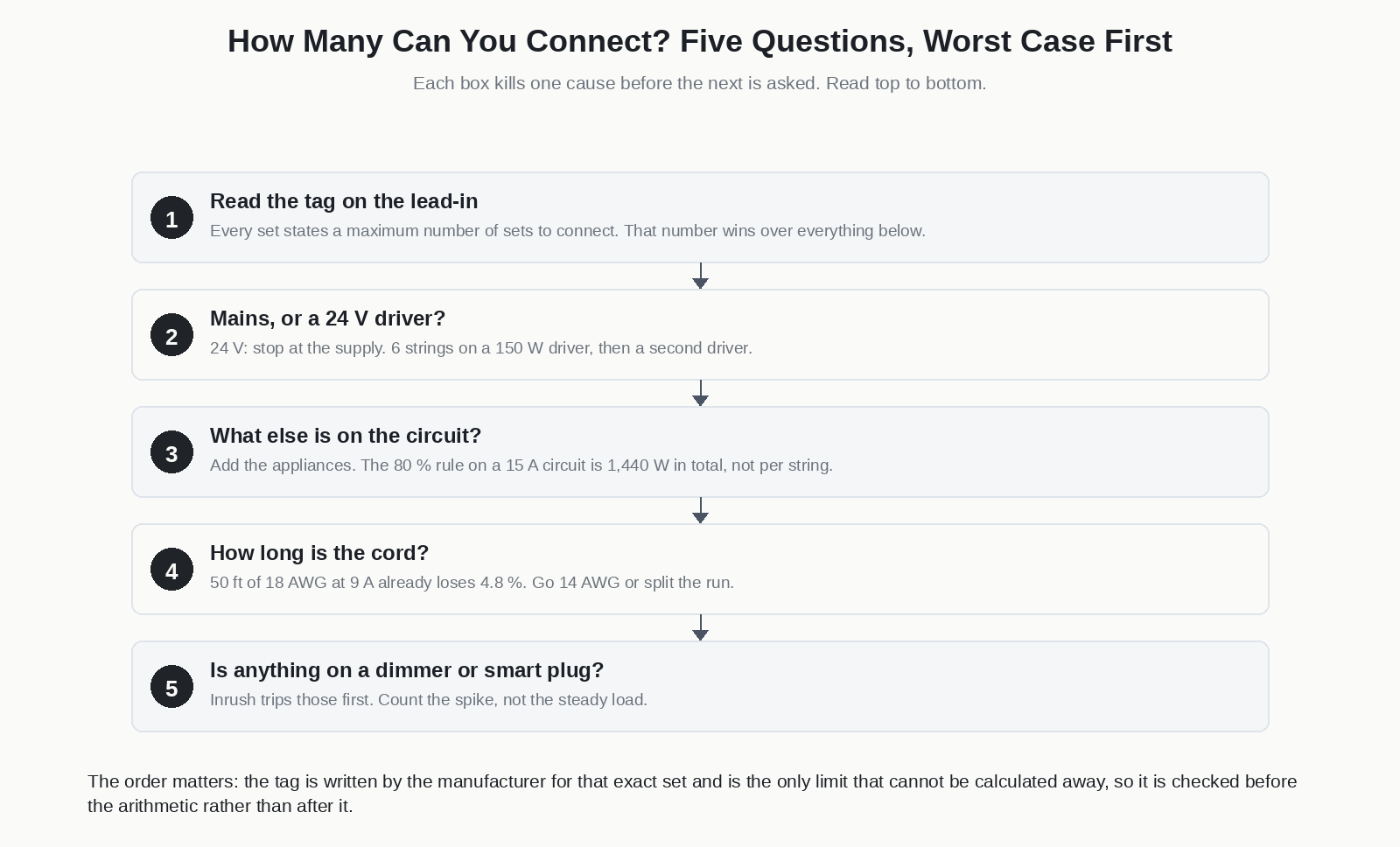
Written out, the same five steps:
1. Read the tag. If it says three sets, it is three sets. This is the answer for end-to-end connection, full stop.
2. Mains or a driver? On a 24 V supply, stop at the supply’s wattage divided by the string’s wattage.
3. What else is on the circuit? Add the appliances on the same breaker before applying the 80 % rule. A garage circuit in December is often a freezer, a chest fridge and a workshop light.
4. How long is the cord? Over 25 ft outdoors, 14 AWG or heavier, and split rather than extend.
5. Anything on a dimmer or smart plug? Count inrush, not steady load, and expect the incandescent or C7 strings to be the ones that trip it.
The Christmas-light chain and an architectural lighting circuit are the same three calculations: continuous load on the branch, voltage drop over the run, and the inrush of the driver. The difference is scale, and the fixture side of it is what we build for.
A track run in a gallery follows exactly this logic — the track’s feed point, the number of heads per circuit, and the cable length from the panel. If you are specifying track lighting for a space rather than a tree, the same arithmetic appears in CADIO track light 20W-30W (20–30 W heads, so 8 to 12 per 120 V/15 A circuit at the 80 % rule) and in AIMER track light 25-35W (25–35 W, 6 to 9 heads).

For a house facade the relevant product family is the wall-mounted linear fixture rather than the string, and the specification maths is the same: GALAXY Cylinder 20W-45W for a wash of wall, and the contact form if you want a driver load and voltage-drop calculation done for a run of 40 or 60 m.

Two more places the same numbers show up on this site: warm white vs cool white for Christmas lights settles the colour-temperature half of the same decision, and choosing a dimmer for track lighting covers the inrush-versus-electronic-switch problem on the fixture side.

The number printed on the lead-in tag wins: typically 3 to 5 sets of the same brand, end to end. If you are asking what the wall would allow, a 15 A circuit at the 80 % rule carries 1,440 W, which is 144 strings of 100 bulbs at 0.1 W each. The tag stops you long before the circuit does.
You can, but you should not chain them beyond the lower tag of the two, because the joint carries the current of both and neither manufacturer rated it. Chaining also doubles the wire in series, so the far end dims. If the colours match, keep the sets separate and feed both from the same extension cord instead.
Look at the cord’s amp rating rather than the string count. A 16 AWG cord at 50 ft at 9 A is exactly at the 3 % voltage-drop line and dissipating 33 W; an 18 AWG cord at the same load loses 4.8 %. Practically, three to four 100-bulb strings per 50 ft of 16 AWG is the comfortable ceiling, and 14 AWG is the right choice for anything longer.
Inrush. An incandescent C7 string peaks at about 16.5 A for one half-cycle to run at 0.55 A, and a plug-in smart switch rated 10 A sees that spike as a fault. Split the strings across two switches, or switch them with the manufacturer’s own controller instead of a generic plug-in timer.
The supply’s watts divided by the string’s watts. A 24 W string on a 150 W supply is 6 strings; on a 100 W supply it is 4. Class-2 limits the output to 5 A, so the supply is a hard stop — when it trips, the whole run goes dark rather than dimming.
The numbers are comfortable — ten strings run at 100 W — so the answer is not a load argument: switch them off while you sleep or while the house is empty. What fails in practice is a warm moulded joint next to something dry, and that joint is only being watched when someone is home. Keep the total under the tag, use a grounded outdoor cord, and never run a cord under a rug or through a doorway.
Plug together what the tag allows — three to five sets, or six strings on a 150 W driver — and check three things the tag cannot see: what else is on the circuit, how long and how thin the extension cord is, and whether anything solid-state is switching the load. The branch circuit is 144 strings of headroom, which is why nobody has ever tripped a breaker with Christmas lights; the cord, the joint and the plug-in switch are where the margin is actually thin.
If you are specifying a run of architectural fixtures instead of strings, the same three calculations are what we build to — send the run length, the head wattage and the supply voltage and we will return the circuit load and voltage drop.